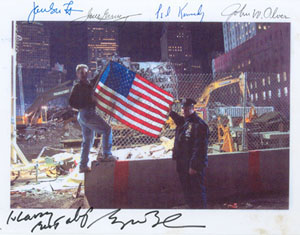
Owner of the Amherst Athletic Club and columnist for the Amherst Bulletin from 1991 to 2004, Larry Kelley is deeply involved with Amherst area relations and government. He ran for both Select Board and Finance Committee, and was instrumental in raising awareness about and banning the illegal sale of martial arts weapons in Massachusetts.
Included in the Kelley papers are over 100 newspaper clippings, either his editorials, letters to the editor, or guest columns, about issues ranging from the use of town safety services by Amherst College, his objection to the Civil Rights Review Commission’s right to subpoena, his fight to fly commemorative flags in downtown Amherst both on the anniversary of September 11th and on the day Osama bin Laden is captured, to his objection over the Amherst-Pelham Regional High School’s production of Eve Ensler’s The Vagina Monologues.
Non-partisan political organization based in Amherst, Massachusetts that influences public policy through education and advocacy by registering voters, organizing candidate forums, publishing voting guides, and disseminating general information on the legislative process and the functioning of government on the local, state, and federal levels.
Includes minutes, annual reports, financial records, publications, extensive files on specific programs, photographs, video- and audio-tapes, scrapbooks, and newspaper clippings. Also contains information on two league members who rose to national prominence: Lucy Wilson Benson (Under Secretary of State in the federal government in 1977) and Jane F. Garvey (Administrator of the Federal Aviation Administration in 1997).
Subjects
Amherst (Mass.)--Politics and governmentEducation--Massachusetts--Amherst--HistoryHousing--Massachusetts--Amherst--HistoryMassachusetts--Politics and government--1951-
Contributors
Benson, Lucy WilsonGarvey, Jane FLeague of Women Voters of Amherst (Amherst, Mass.)
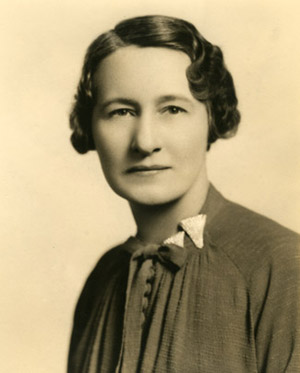
Overcoming a deeply impoverished childhood, Gertrude Lewis struggled to build a career in education, putting herself through college and graduate school. At the age of 32, she earned a bachelor’s degree from Ohio State, continuing on to a masters degree at New York University (1933), and finally, at age 51, a PhD from Yale (1947). For many years after receiving her doctorate, Lewis was employed as a Specialist for Upper Grades with the U.S. Office of Education in Washington. Among other career highlights, Lewis spent two years in Japan (1950-1951) as a Consultant in Elementary Education in the Education Section of the Allied Occupation government (SCAP). Lewis outlived her life partner, Ruth Totman, dying at home on December 10, 1996, a few months after her one hundredth birthday.
The Lewis Papers document the work and life of an educator of the masses, a traveler of the world, and a woman of the twentieth century. Documents pertaining to her work as an educator of both young students and veteran teachers show the changes within the theory and practice of pedagogy over time, over various geographic locales, and also highlight her role in that change. This collection also documents the numerous on-going side projects on which Lewis worked, including fostering creativity in schoolchildren, a biography of Franklin D. and Eleanor Roosevelt, and her own poetry and prose.
Subjects
Education, Elementary--JapanEducation, Elementary--United States--HistoryEducation--EvaluationEducation--United States--HistoryHealth Education--United StatesJapan--Civilization--American influencesStudents--Health and hygiene
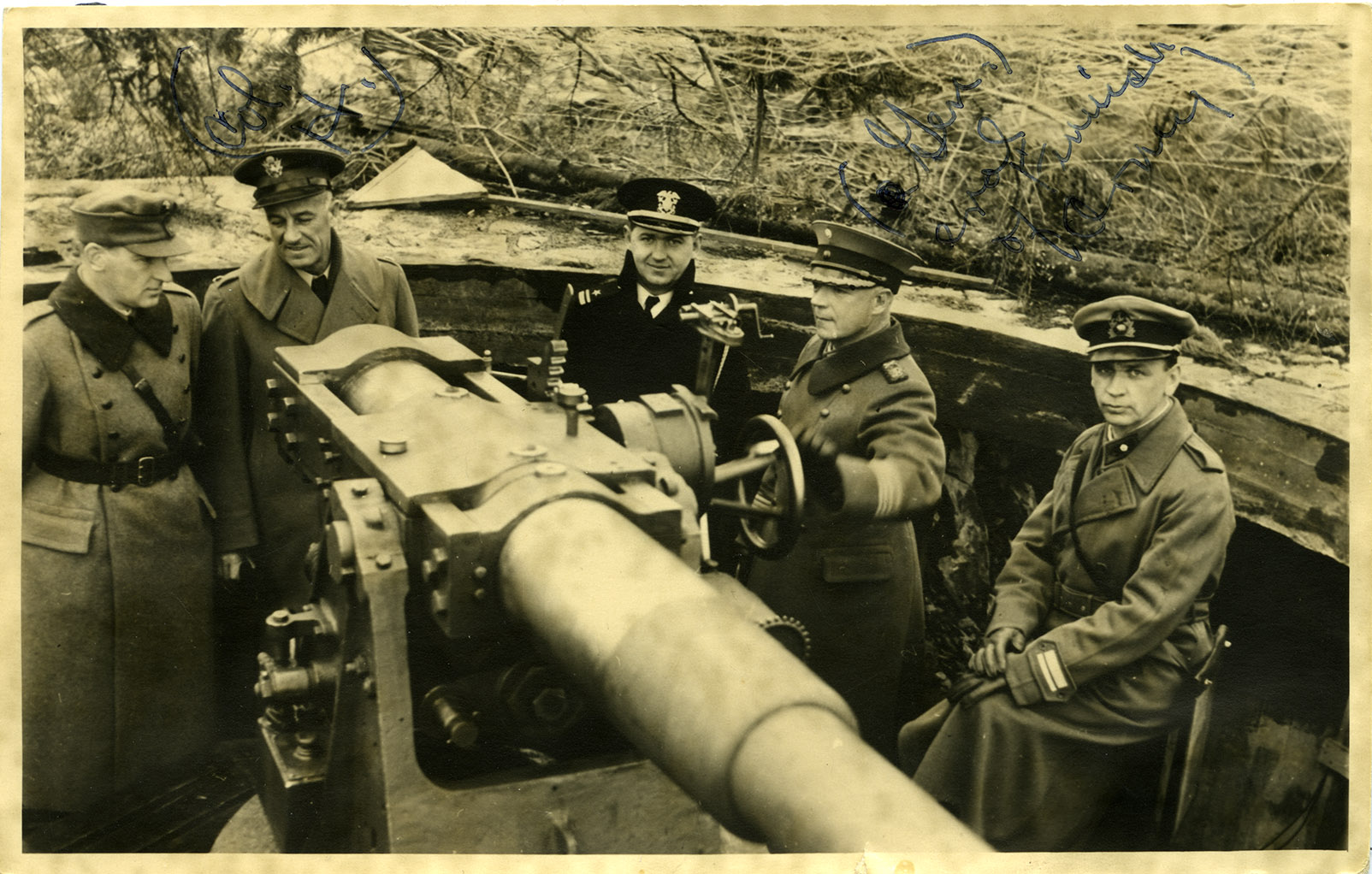
Antoni Lipski emigrated from Grodno, now Belarus, in 1907, and settled in the Oxbow neighborhood of Northampton, Mass. An employee of the Mount Tom Sulphite Pulp Company, he and his wife Marta had a family of twelve, ten of who survived to adulthood. Their oldest child Stanley Walter Lipski graduated from the US Naval Academy in 1935 and was killed in action aboard the USS Indianapolis in July 1945.
The slender record of two generations of a Polish immigrant family from Northampton, Mass., the Lipski collection includes two documents relating to Antoni Lipski and four photographs, two letters, and news clippings relating to his eldest son, Stanley Walter Lipski, a naval officer who was killed in action aboard the USS Indianapolis during the Second World War.
Gift of Anthony Lipski, Oct. 1991
Subjects
Polish Americans--MassachusettsUnited States. NavyWorld War, 1939-1945
Contributors
Lipski, Antoni, 1882-1953Lipski, Stanley Walter, 1911-1945
A native of Northampton, Massachusetts, Benjamin Smith Lyman was a prominent geologist and mining engineer. At the request of the Meiji government in Japan, Lyman helped introduce modern geological surveying and mining techniques during the 1870s and 1880s, and his papers from that period illuminate aspects of late nineteenth century Japan, New England, and Pennsylvania, as well as the fields of geology and mining exploration and engineering. From his earliest financial records kept as a student at Phillips Exeter Academy through the journal notations of his later days in Philadelphia, Lyman’s meticulous record-keeping provides much detail about his life and work. Correspondents include his classmate, Franklin B. Sanborn, a friend of the Concord Transcendentalists and an active social reformer, abolitionist, and editor.
The papers, 1848-1911, have been organized into nine series: correspondence, financial records, writings, survey notebooks, survey maps, photographs, student notes and notebooks, collections, and miscellaneous (total 25 linear feet). A separate Lyman collection includes over 2,000 books in Japanese and Chinese acquired by Lyman, and in Western languages pertaining to Asia.
Language(s): JapaneseEnglish
Subjects
Geological surveys--AlabamaGeological surveys--IllinoisGeological surveys--India--PunjabGeological surveys--JapanGeological surveys--Japan--MapsGeological surveys--MarylandGeological surveys--Nova ScotiaGeological surveys--PennsylvaniaGeological surveys--Pennsylvania--MapsGeologists--United StatesGeology--Equipment and supplies--CatalogsGeology--Japan--History--19th centuryJapan--Description and travel--19th centuryJapan--MapsJapan--PhotographsJapan--Social life and customs--1868-1912Mining engineering--Equipment and supplies--CatalogsMining engineering--Japan--History--19th centuryMining engineers--United States
Contributors
Lyman, Benjamin Smith, 1835-1920Sanborn, F. B. (Franklin Benjamin), 1831-1917
As a journalist with the Boston Globe, a news commentator on WGBH television, and Curator of the Nieman Foundation for Journalism at Harvard, Louis M. Lyons was an important public figure in the New England media for over fifty years. A 1918 graduate of Massachusetts Agricultural College and later trustee of UMass Amherst, Lyons was an vocal advocate for freedom of the press and a highly regarded commentator on the evolving role of media in American society.
The Lyons Papers contain a selection of correspondence, lectures, and transcripts of broadcasts relating primarily to Lyons’ career in television and radio. From the McCarthy era through the end of American involvement in Vietnam, Lyons addressed topics ranging from local news to international events, and the collection offers insight into transformations in American media following the onset of television and reaction both in the media and the public to events such as the assassinations of John F. Kennedy and Martin Luther King, the war in Vietnam, and the social and political turmoil of the 1960s.
Subjects
Boston GlobeCivil rights movementsFreedom of the PressFrost, Robert, 1874-1963Johnson, Lyndon B. (Lyndon Baines), 1908-1973Journalistic ethicsJournalists--Massachusetts--BostonKennedy, John Fitzgerald, 1917-1963King, Martin Luther, Jr., 1929-1968TelevisionUniversity of Massachusetts. TrusteesVietnam War, 1961-1975WGBH (Television station : Boston, Mass.)World War, 1914-1918
When Charles Marsters founded the Boston Lacrosse Club in 1913, the club was the only one in New England to play teams from outside of the region. Under Marsters’s leadership, however, participation in the sport rose steadily at both the high school and collegiate level, helping establish New England as one of the centers of the American game. In 1935, he and Tom Dent founded the New England Intercollegiate Lacrosse League (NEILL) to continue to build the sport.
The NEILL records document the growth of lacrosse from informal club team play to a more regulated, interscholastic and intercollegiate varsity sport. The bulk of the collection consists of correspondence, minutes, and agendas kept by co-founder Charles Marsters and a handful of other NEILL officers, but with material documenting the growth of the sport at UMass Amherst from the 1950s onward and the addition of women’s lacrosse as a collegiate sport. The collection also includes some printed material (including rulebooks), news clippings, and photographs.
Subjects
College sports--New EnglandLacrosse for women--United StatesLacrosse guideLacrosse--New England--HistorySchool sports--New EnglandUniversity of Massachusetts Amherst--Sports
Contributors
Boyden, Frank L. (Frank Learoyd), 1879-1972Marsters, Charles ENew England Intercollegiate Lacrosse League
The Northeast Organic Farming Association began as the vision of a New York City plumbing supplies salesman and has grown into a large association supporting information-sharing, education, collaboration, and certification. Increasingly influential non-profit organization with chapters in Connecticut, Massachusetts, New Hampshire, New Jersey, New York, Rhode Island, and Vermont, NOFA has “nearly 4,000 farmers, gardeners and consumers working to promote healthy food, organic farming practices and a cleaner environment.”
The NOFA collection includes records, publications, ephemera, photographs, and other materials from NOFA chapters in Massachusetts, Connecticut, New Hampshire, New York, and Vermont, along with material from the Interstate Council. The collection includes information on NOFA’s conferences and programs, educational work, lobbying, and their initiatives in organic certification and organic land care.
Reflective, critical, and radical, Carl Oglesby was an eloquent voice of the New Left during the 1960s and 1970s. A native of Ohio, Oglesby was working in the defense industry in Ann Arbor, Michigan, in 1964 when he became radicalized by what he saw transpiring in Vietnam. Through his contacts with the Students for a Democratic Society, he was drawn into the nascent antiwar movement, and thanks to his formidable skills as a speaker and writer, rose rapidly to prominence. Elected president of the SDS in 1965, he spent several years traveling nationally and internationally advocating for a variety of political and social causes. Oglesby died of lung cancer on September 13, 2011.
In 1972, Oglesby helped co-found the Assassination Information Bureau which ultimately helped prod the U.S. Congress to reopen the investigation of the assassination of John F. Kennedy. A prolific writer and editor, his major works include Containment and Change (1967), The New Left Reader (1969), The Yankee and Cowboy War (1976), and The JFK Assassination: The Facts and the Theories (1992). The Oglesby Papers include research files, correspondence, published and unpublished writing, with the weight of the collection falling largely on the period after 1975.
Gift of Carl Oglesby, 2006-2008
Subjects
Assassination Information BureauGehlen, Reinhard, 1902-1979Kennedy, John F. (John Fitzgerald), 1917-1963--AssassinationKing, Martin Luther, Jr., 1929-1968PacifistsPolitical activistsStudent movementsStudents for a Democratic Society (U.S.)United States--Foreign relationsVietnam War, 1961-1975Watergate Affair, 1972-1974
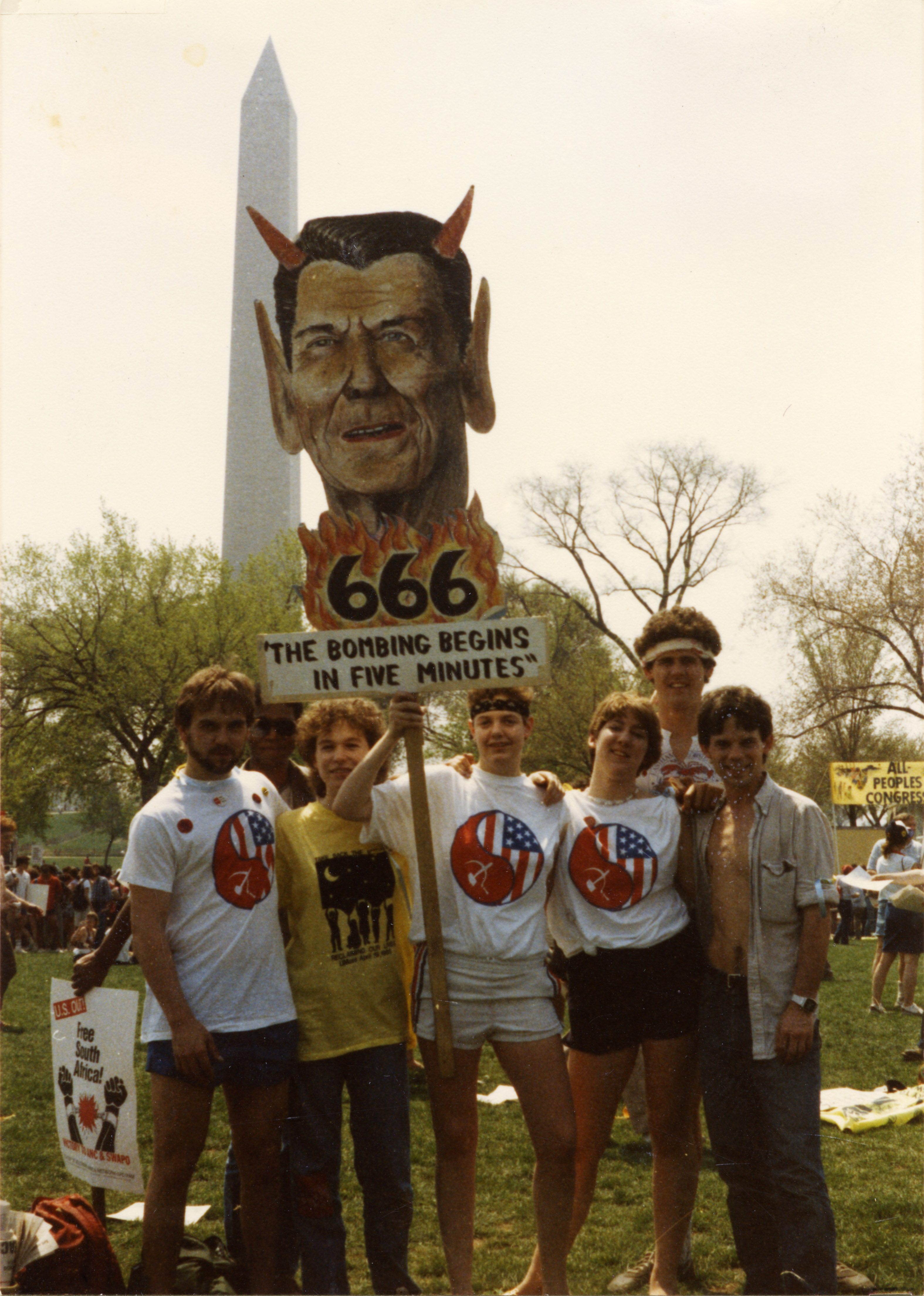
Peacemakers contingent at the Four Days in April protests, 1984
Although the precise origins of UMass Peacemakers are murky, by 1982, the group was an active presence on the UMass Amherst campus organizing opposition to militarism and the nuclear arms race and providing support for the nuclear freeze movement. Organizing vigils, demonstrations, informational workshops, and providing civil disobedience training, the Peacemakers were the most visible pacifist group on the UMass Amherst campus in the 1980s.
The UMass Peacemakers Records focus on the activities of the student group between 1983 and 1990, documenting their role in confronting the aggressive international expansionism of the Reagan administration and its “Star Wars” program, while also engaging at the local and national level by organizing rallies, lectures, poetry readings, and film screenings. At UMass, Peacemakers was part of the larger Progressive Student Network, and worked alongside other student organizations including the Radical Student Union.
Gift of Peacemakers through Peter Sakura, May 1991
Subjects
Antinuclear movements--Massachusetts--AmherstCentral America--Foreign relations--United StatesDisarmament--MassachusettsPeace movements--Massachusetts--AmherstStudent movements--Massachusetts--AmherstUnited States--Foreign relations--Central AmericaUniversity of Massachusetts Amherst--StudentsVietnam War, 1961-1975--Protest movements--Massachusetts
Contributors
American Friends Service CommitteeUMass Peacemakers

 View issues of