The University of Massachusetts Amherst
Robert S. Cox Special Collections & University Archives Research Center
CredoResearch digital collections in Credo

You searched for: "Aging" (page 1 of 10)

Spriggs, Marshall

Marshall Spriggs Collection

ca. 1970-1980
2 boxes 3 linear feet
Call no.: MS 1250

Marshall Spriggs was an educational activist at UMass/Amherst while an undergraduate from 1969 through 1974. He eventually became the chair of the Academic Affairs Committee of the Undergraduate Student Senate , the voice of undergraduates in their institution’s educational policy. After leaving Amherst, he served as a reading teacher in New York City and as an Assistant Community Representative with the Massachusetts Office for Children. In the late 1970s, he became the Managing Editor of the Boston People’s Yellow Pages published by Vocations for Social Change in 1980. The PYP attempted to catalog all the groups doing progressive political work in the Boston area. In the 1980s and beyond, he served as the Publications Director for statewide legal services, a founder of an international environmental organization, and filled various posts at Harvard University and MIT.

The Marshall Spriggs Collection features social change publications including the People’s Yellow Pages, Black Bart Brigade: The Outlaw Mag, AFSC New England Regional Office printed material, and What’s Left in Boston as well as articles on educational reform, student power, and racism.

Gift of Marshall Spriggs.

Subjects

Peace movements--United States--PeriodicalsStudent movements—United StatesVietnam War, 1961-1975-- Protest movements

Types of material

NewslettersPeriodicals
Walters, Delores

Delores Walters Papers

1950-2024
1 Box 0.42 linear feet
Call no.: MS 1269

Dr. Delores M. Walters is an educator, anthropologist, and consultant whose advocacy for diversity, inclusion, equity, and cultural competency in academic, local, and global communities spans an extraordinary career. Training as a cultural anthropologist and previously as a registered nurse led to culturally and historically engaging community-based service-learning and public history projects. She designed and implemented courses and initiatives in various academic and community settings that promoted cultural competency in health care, alleviation of health disparities and cultural/ historical heritage. Throughout her journey, a Black Feminist perspective guided those initiatives:
“My intention was to empower students and teachers, including those engaged in health care, with cultural/historical knowledge and awareness, especially about and among African Americans and other peoples of color, that will enrich our communities locally, nationally, and worldwide.”

Subjects

Gender Resistance

Contributors

Walter, Delores M.
McKinstry, Gary

Gary McKinstry Oral History with Marc Peloquin

2023
6 video recordings
Call no.: MS 1246

A psychic medium entertainer for more than 30 years, Gary McKinstry received his doctorate, Philosophy in Religion, at the Universal Life Church Modesto, California in 1999, and was ordained as a Universal Life Minister.  That same year, he with his wife Virginia established their company, GVM Productions. Certified as a professional Tarot Reader C.P.T.R. from the American Tarot Association, McKinstry went on to become a Certified Hypnotherapist with the Indian Mountain Meditation Center, New Bedford, Massachusetts, to learn the inner workings of the mind in 2000 and 2002. As a paranormal specialist from 2005–2008, McKinstry worked as an Extraordinary Case Manager for Orion Paranormal managing the process and research of ghost hunting cases.

McKinstry’s oral history with Marc Peloquin was recorded in six parts and covers a range of topics including: psychedelic vs. self-hypnosis, white and black magic, feminine energy vs. masculine energy, reading tarot and playing cards, and destiny.

Gift of Gary McKinstry, 2024.

Subjects

MagicMediumsTarot
Polish Genealogical Society of Massachusetts

Polish Genealogical Society of Massachusetts Collection

1990-2023
1 box 0.5 linear feet
Call no.: MS 366

Founded in 1989, the Polish Genealogical Society of Massachusetts is a not-for-profit organization devoted to encouraging and supporting research into Polish family history and more generally into Polish culture and history. The Society sponsors educational programs and publications and operates a research library at the Polish Center of Discovery in Chicopee, Mass.

The collection consists of a complete run of the semiannual newsletter of the Polish Genealogical Society of Massachusetts, Biuletyn Korzenie (Roots Bulletin), from 1990-2023. At that point the Society became a chapter of the national organization, and Biuletyn Korzenie is continued as Massachusetts material in the Polish Genealogical Society of America journal, Rodziny.

Whiting, Frederic Allen, Jr.

Frederic Allen Whiting Jr. Papers

1923-1978 Bulk: 1945-1977
2 2.5 linear feet
Call no.: MS 1230
Allen Whiting at his typewriter.
Frederic Allen Whiting at his typewriter

Frederic Allen Whiting Jr., the “Poet Laureate of Perkins Cove”, was born on January 10, 1906 in Boston Massachusetts to Olive Elizabeth Cook, a singer, and Frederic Allen Whiting Sr., a philanthropist and museum director and president of the American Federation of Arts. They moved to Cleveland in 1912 where Frederic Sr. became the director of the Cleveland Museum of Art. Having a father as the director of a cultural heritage institution, exposed young Frederic to the intellectual class. He met poets, scholars, and others from the world of arts and letters including Sir Lawrence Binyon, Langdon Warner, Carl Purington Rollins, and Thomas Whitney Surette. He attended the private Hawken School in Cleveland and Deerfield Academy in Massachusetts, which he referred to later as “redolent of witchcraft and Indian massacres, and compliance with chamber of commerce goals and attitudes”. He went to Harvard for two years before becoming a freelance writer.

Adopting the pen name Allen Whiting, his first foray into writing began when he wrote commentary and criticism for the Magazine of Art, the organ of the American Federation of the Arts, where he was also editor from 1931-1942. Some of his pieces for the magazine were republished in the New York Herald Tribune and The Washington Post. Under his tenure, the circulation rose and he became familiar with all aspects of magazine production and made contacts with members and chapters of the American Federation of Arts, which consisted of artists, writers, teachers, museum officials, art dealers, and officials working with U.S. government cultural projects. On one occasion in 1940, Whiting took charge of the Federation’s annual convention, which met in San Francisco. He left the magazine in May 1942 to participate in the war effort.

Whiting was appointed Chief of the Office of War Information’s Overseas Exhibit Section. Charged with developing programming and staff, Whiting aimed to project positive visual images of the United States to Europeans. He was responsible for planning and carrying through creative programming, administrative duties, and liaison work with other civilian agencies, Army & Navy administrators, business leaders, and the press. Following the end of the war, he was brought to Washington by Elmer Davis to develop an exhibit aimed at explaining to liberated Europe the demand on resources of the continuing war in the Pacific. The project was abandoned following the surrender of Japan in August of 1945.

Following the war, Whiting became a freelance writer and photo editor, wrote two novels, short stories, and non-fiction pieces on a variety of subjects, including politics, the arts, and food. He designed and produced a brochure for a New England children’s camp and was a contracted photo research and editor for the State Department.

In 1951 he was recruited to work as a civilian information specialist with the Department of the Army’s Reorientation Division for occupied areas, which was responsible for supplying materials used to re-educate the people of Japan and the Ryukyu Islands. Out of an office in New York, he supplied the U.S. Information Centers in Japan with musical recordings and other media. The job ended following the end of the U.S. occupation in December, when he resumed freelance writing and editing. He moved his parents from Florida to Ogunquit, Maine in 1952, where he became the Associate Director of the Museum of Art of Ogunquit where he assembled a Winslow Homer exhibit but was later “politely fired” by Henry Strater.

Throughout the 1950s Whiting’s wife Rose suffered from several strokes and eventually died in 1960. Whiting was also caring for his aging parents, which caused much stress and led to excessive drinking where his “control over beverage alcohol had left me behind”. His mother died in 1955. During this time he found solace in the Roman Catholic Church and was committed to the Augusta State Hospital in 1957. Whiting’s battles with alcoholism and simultaneous search for God was explored in his unpublished 1965 autobiographical novel, Minutes of the Days.

The collection contains evidence of an attempt to start an organization called The Society of Servants of Rose Hill, whose aim was to “bring to bear in a practical manner the venerable and curative offices of prayer and work upon those in particular need of them”. The goal was to create cooperatively governed outpatient retreat centers in bucolic settings for people recently released from psychiatric institutions. The mission statement stated that no one would be turned away for financial or religious reasons. There is no evidence that the organization ever came to fruition.

Whiting’s career as a published poet began in the 4th grade. He was eventually published in several magazines including Spirit: A Magazine of Poetry, The American Poetry Magazine, The Harvard Advocate, Voices, and The Cecelian. He spent much of his creative life in Ogunquit, Maine reading his work at informal gatherings of “mostly young people of creative bent, gathered in the vicinity of Perkins Cove”. In 1952 he completed his first novel, The Gift of Merlon Crag.

The collection consists of copies, drafts, published and unpublished copies of Whiting’s poetry written throughout his lifetime. The manuscript of his unpublished autobiographical novel, Minutes of the Days is also contained herein. Some biographical information, written by Whiting while planning to release Minutes of the Days, is in the collection as well.

Gift of Frederic Whiting, 2024

Subjects

Poetry

Types of material

CorrespondenceManuscripts (documents)Notes (documentsPoemsTypescripts
Restrictions: Commercial reuse is governed by Whiting's heirs. No restrictions on access
Upperman, Mae

Mae Upperman Collection

9 boxes, ca. 200 books 13 linear feet
Call no.: MS 1194

Born in 1937, Mae Upperman grew up Asbury Park, New Jersey, a town segregated by race and wealth. She was educated at Tufts University, receiving a B.A. in adult education and physical therapy, and Boston University, receiving a Master’s degree in education. Her career features work in several fields, each one with a focus on improving lives of vulnerable individuals in society. These contributions include: working as a physical therapist for the Visiting Nurses Association of Boston; working at the Action for Boston Community Development, a non-profit dedicated to helping Boston residents out of poverty; researching new initiatives in Head Start; and developing and managing a center-based early intervention program for children with developmental disabilities. Alongside Upperman’s professional achievements, she is also an artist, poet, and book collector.

The Mae Upperman Collection consists of more than 200 books by Black women authors and Upperman’s artwork, much of which depicts abstract Black figures. An article about Upperman and her collection appeared in the Massachusetts Daily Collegian in 2023.

Gift of Mae Upperman, 2023

Subjects

African American women artistsAfrican American women authors

Types of material

PaintingsWorks of art
Bell, Upton

Upton Bell Collection

1915-2015
23 boxes
Call no.: MS 1120

Upton Bell is the son of Bert Bell, National Football League Commissioner from 1946 to 1959. Growing up inside the early NFL, Upton witnessed his father’s leadership: implementing a proactive anti-gambling policy; negotiating a merger with the All-America Football Conference (AAFC); bringing professional football successfully to television; creating the NFL Draft; and initiating the Sudden Death rule, which launched the meteoric rise in the popularity of professional football. Bell’s mother, Frances Upton, was a Broadway actress and movie star of the 1920s and 1930s and funded Bert Bell’s creation of the Philadelphia Eagles. Bell’s grandfather, John C. Bell, helped found the NCAA and served on the Walter Camp Intercollegiate Football Rules Committee which negotiated with President Teddy Roosevelt to save college football.

Upton Bell’s career in professional football began in the early 1960s working at the Baltimore Colts training camp and ticket office, advancing to head scout by the late 1960s. Bell served the team through two NFL Championships and two Super Bowls, winning Super Bowl V in 1971. After leaving the Colts, Bell was hired as general manager of the Boston Patriots, encouraging their name change to the New England Patriots. He then bought the Charlotte Hornets, a team in the short-lived World Football League. Soon after the WFL folded, Bell began a broadcasting career in Boston, where for more than 40 years he has been a host and commentator covering the country’s top newsmakers. He is a three-time AP Talk Radio Award winner and author of Present at the Creation: My Life in the NFL and the Rise of America’s Game (University of Nebraska Press, 2017).

Bell’s collection of sport artifacts and memorabilia from his and his father’s careers in professional sport includes hundreds of items, with a selection of items, including the Baltimore Colts Super Bowl ring, on permanent exhibit in the Special Collections reading room.

The digital exhibit “Upton Bell Collection: In the huddle of football history” includes essays on family history, Upton Bell’s career, and a selection of digitized items.

Gift of Upton Bell, 2018.

Subjects

Football--HistoryNational Football League--HistorySuper Bowl--History

Contributors

Bell, Bert, 1894-1959Bell, UptonUpton, Frances

Types of material

CorrespondenceMemorabiliaNewspaper clippings
Swaim, Nina

Nina Swaim Papers

ca. 1950-2015
4 boxes 5 linear feet
Call no.: MS 1125

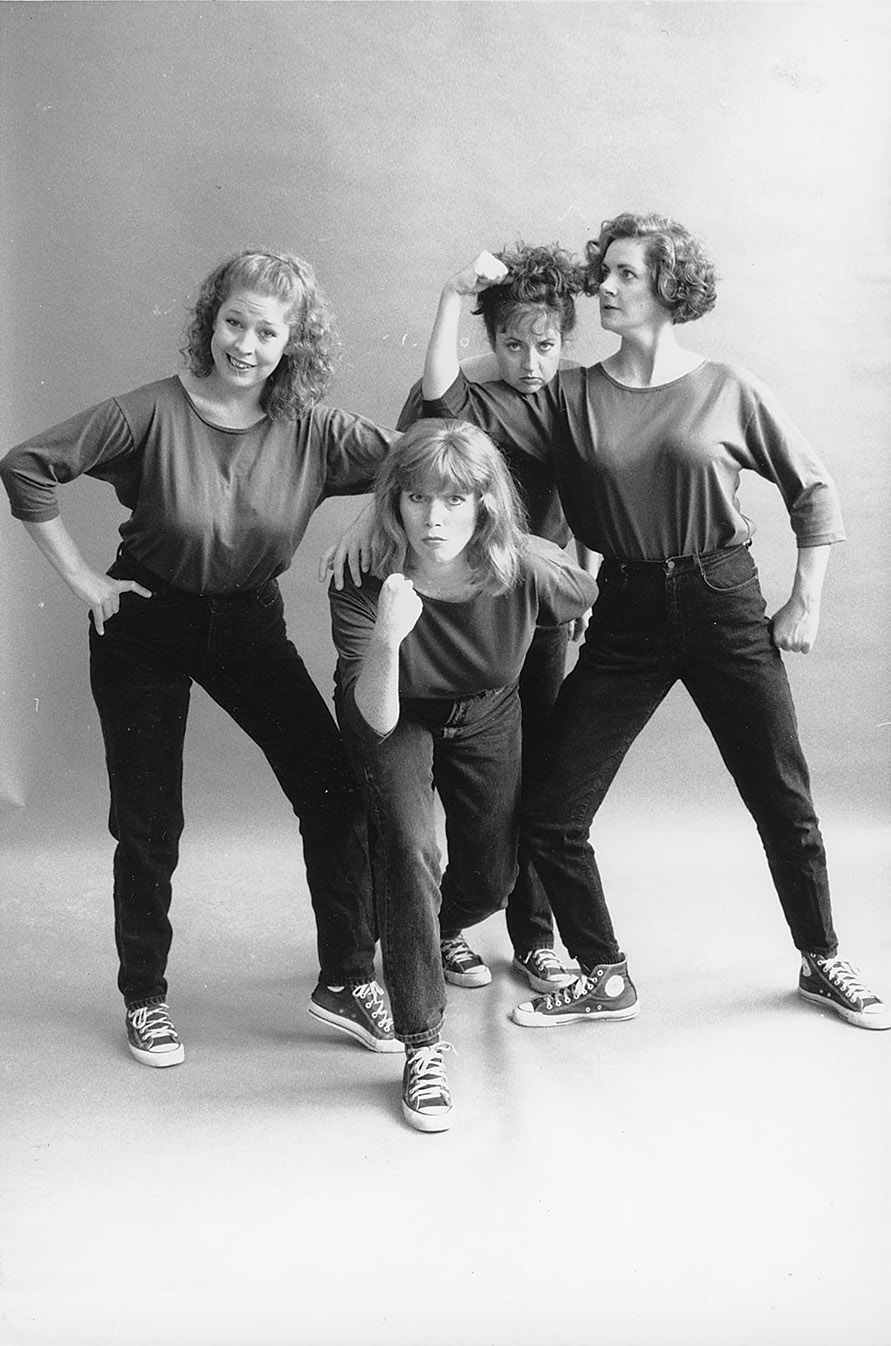
Eleanor “Nina” Hathaway Swaim (1938-2015) was a feminist, environmental and antinuclear activist, antiwar organizer, and proponent of women’s collective enterprises globally. She was arrested for the final time just a month before her death, chained to the gates of a pipe yard in Williston, VT, protesting a fracked gas pipeline. Born into a conservative family in Sharon, MA, Swaim was radicalized during the mid-sixties by courses at the Free University on the Lower East Side and during the 1968 occupations at Columbia University, where she was an administrator. She joined the It’s All Right to be a Woman Theater in 1970 and toured the country with them before leaving New York City to work in a GI bookstore near a military base in Massachusetts, helping soldiers protesting the Vietnam War. Learning the printing trade, she moved to Vermont and co-founded the women’s collective press, New Victoria Press, worked as a mediation coordinator for the Vermont Supreme Court, and became a strong force in the antinuclear movement, helping found the Upper Valley Energy Coalition (UVCE), and co-authoring a book with Susan Koen, “A Handbook for Women on the Nuclear Mentality.” She met her husband, Douglas Smith, through UVEC, and the pair worked on numerous antinuclear, environmental, and other grassroots campaigns and protests together, including a project in Mozambique on water access, where Swaim worked as a cooperator with the revolutionary Organization of Mozambican Women. Other international work included picking cotton in Nicaragua, visiting Cuba under siege, and touring Gandhian centers in India to learn practical nonviolence and social change techniques. A practicing Buddhist, Swaim was an avid writer, gardener, beekeeper, and hiker, and in addition to her other causes, spearheaded numerous events related to the natural world, food security, and honeybees.

The Nina Swaim Papers offer an intimate look into the life of an indomitable and inspiring grassroots activist focused on both local Vermont issues and global concerns. Unpublished writings, clippings, and correspondence, as well as photographs, tapes, and scrapbooks reflect her international travels and work, as well as her community and concerns in the antinuclear and environmental movements based out of Vermont. Detailed writings, reflections, short stories, travel notes, and a comprehensive set of journals dating from the late sixties make up a large part of the collection. They are full of the musings of an activist pondering the meaning of women’s consciousness raising and conflict settlement, of worker collectives and other community building, of struggles and misunderstandings between lesbian and straight women, of power in organizations like Clamshell Alliance and the Upper Valley Energy Coalition, of motherhood and aging, and of the relationship between action for social change and spiritual practice.

Gift of Douglas V. Smith, 2021.

Subjects

Antinuclear movement--United StatesAntinuclear movement--VermontEnvironmental justiceFeminismNuclear energy--VermontPeace movements--United States

Contributors

Nina Swaim

Types of material

CorrespondenceDiariesPersonal narrativesPhotographs
Ellsberg, Daniel

Daniel Ellsberg Papers

ca. 1935-2020 Bulk: 1950-2000
Call no.: MS 1093
Daniel Ellsberg is seated at his desk with a telephone in his left hand while reaching for a paper on his desk.
Ellsberg seated at his office desk ca. 1982

For the latest updates and information about this collection, visit our research page on Ellsberg.

Author, Activist, Veteran, Civil Servant, Whistleblower, Cold Warrior, Academic, Patriot. Daniel Ellsberg has spent the bulk of his 89+ years asking questions and seeking truth. From his beginnings in government service as a marine operations officer, where he first received top secret clearances and saw war plans for the Suez Crisis in 1956-57; to his time in the Pentagon where he was involved in high level decision-making around nuclear policy and the Vietnam War; and to his moral awakening in 1968-69 when he decided to begin copying the Pentagon Papers for public release; Daniel Ellsberg has utilized his whip-smart intellect to dissect and disseminate complex government policies for those seeking to understand and critique the moral failings of their leaders.

In his singular career, Ellsberg traced an arc from Cold Warrior to antiwar and antinuclear activist. Initially, he seemed primed for the soft chair of the academy. As an undergraduate at Harvard, he produced a brilliant thesis in economics on “Theories of Rational Choice Under Uncertainty,” which fed decades of further research—his own and others—on the questions of ambiguity and decision-making. A prestigious year as a Woodrow Wilson Fellow at Cambridge would ordinarily have led to the next logical step toward an academic coronation, a doctorate at Harvard, but with his educational deferment running out and conscription looming, Ellsberg applied to become an officer in the Marine Corps. By the time he resumed doctoral research (on game theory), he had acquired a personal understanding of the military from the perspective of a platoon leader that would in the years to come leaven his scholarship.

As he wrapped up his dissertation, Ellsberg accepted a position with the RAND Corporation, placing him in the cold heart of where Cold Warriors honed their thoughts. An analytical mind and keen insight into decision-making fit neatly into the demands of understanding the problems of command and control in nuclear war. At RAND, Ellsberg found himself drawn into assignments such as the formal review of the Cuban Missile Crisis of 1962, which he conducted as a consultant to the Pentagon. What he witnessed from the privileged perch of top-level clearance was unsettling: he saw a shocking and persistent gap between what the best intelligence indicated and what the political establishment said and did.

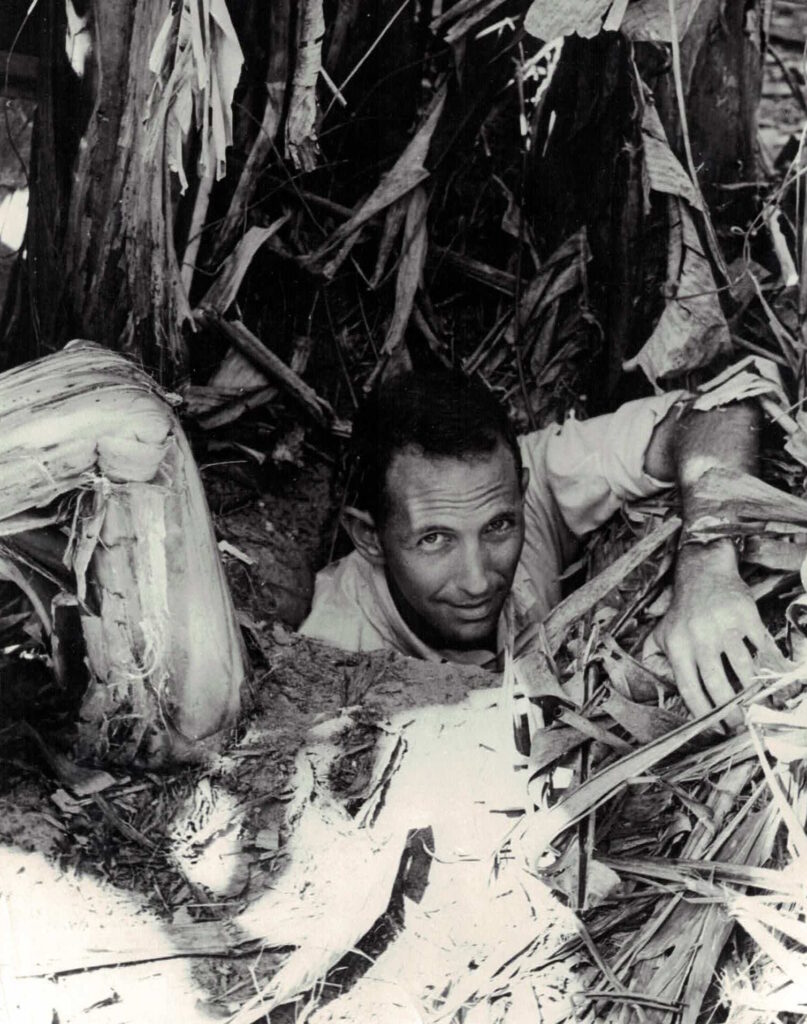
Dan Ellsberg emerging from a hole in the ground with his left hand on the ground looking at the camera
Ellsberg emerging from a National Liberation Front tunnel system. ca. 1966

Vietnam emerged as a particular focal point for Ellsberg in 1964, establishing a powerful symmetrical concern with the nuclear threat that had been consuming his days. That summer, Ellsberg was attached to the Pentagon to assist in a strategic analysis to contribute to escalating the war, beginning his assignment ominously on the day of the Gulf of Tonkin incident. Less than a year later, he traveled to Vietnam as a high-level official of the State Department to work under Maj. Gen. Edward Lansdale, tasked with reviewing “pacification” efforts in the provinces. This was no desk job, nor would he be a mere observer. For much of 1966, Ellsberg traveled the country, machine gun in hand, often engaging in forward combat operations with U.S. forces. By the time he returned to RAND, his experiences had led him to conclude that the war was simply not, as many had argued, a civil war in which the U.S. had intervened, but a war of foreign aggression—American aggression. Having been an official of both the Defense and State Departments for years and having had high-level, authorized access, he had a unique perspective on the backdrop of official dishonesty, of secrets and lies and pro-war manipulations on the part of the military and political establishment, and he began to find common cause with the antiwar movement.

The germ of what would become the Pentagon Papers was planted at a War Resisters League conference at Haverford College in 1969, when Ellsberg encountered a draft resister, Randy Kehler (whose papers are also ensconced in SCUA). Kehler’s deliberate, direct confrontation of the system and his unstinting, willing acceptance of the consequences were moving, and by October, Ellsberg lit upon the idea of copying the secret, and deeply revealing reports on the war that he was reviewing for RAND. He knew well that if discovered, his actions could result in decades behind bars. For several weeks, Ellsberg and his colleague Anthony Russo surreptitiously photocopied a trove of 47 volumes and thousands of individual pages of sensitive documents that clearly revealed the extent to which four presidents over two decades had concealed and misrepresented the war and its dim prospects in the hopes, in part, of gaining electoral advantage and out of fear for being seen as the man who lost the war.

Initially, Ellsberg sent copies of the Pentagon Papers to the Senate Foreign Relations Committee and sympathetic members of Congress in the hope of creating a political momentum against the war from within the system. None spoke up. Only when the strategy of drawing congressional support failed did Ellsberg leak copies to the media—nineteen newspapers in all. To make a long (and frequently cinematized) story short, The New York Times struck first, publishing excerpts from the papers beginning on June 13, 1971, leading to the first four injunctions in American history constituting prior restraint against publication, and ultimately to prevailing in the Supreme Court over by the end of the month, voiding those injunctions. To make another long (and frequently cinematized) story short, Ellsberg set off a chain of events that played a catalytic role in the Watergate scandals and the undoing of President Richard Nixon.

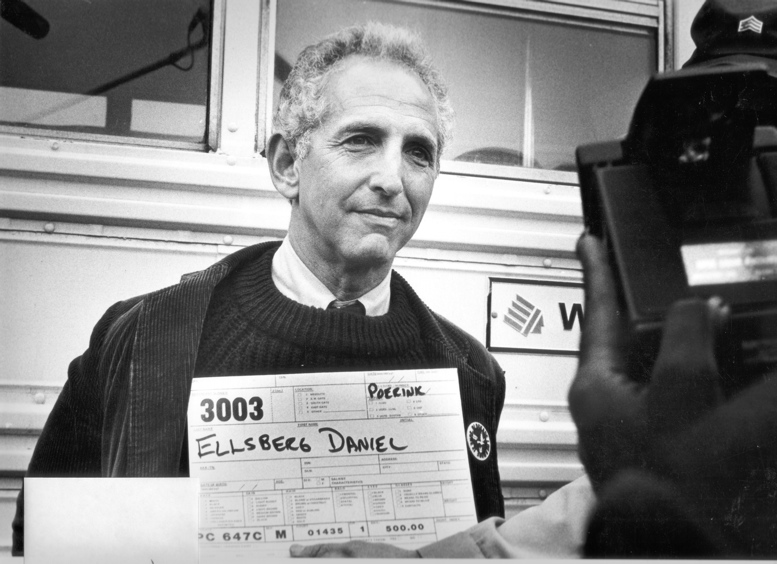
Daniel Ellsberg holding an arrest card being photographed by police in front of a school bus
Ellsberg holding an arrest record in front of a school bus ca. 1982

In January 1973,  Ellsberg went on trial for his part in copying and distributing the Papers. Facing decades of prison time, he waged a resilient defense over the next four months and eventually won. Having survived the full force of the governmental onslaught, Ellsberg persisted. With the charges against him dismissed on the grounds of governmental misconduct, he returned to the front lines of opposition to tackle nuclear weapons, war, and governmental secrecy. He speaks, writes, and educates in the cause almost continuously, and he has taken part in protests and civil disobedience at sites such as the Pentagon, the Department of Energy, the Rocky Flats Nuclear Production Facility, and the Lawrence Livermore Laboratories.

The scope of the Ellsberg collection is vast; from family mementoes and correspondence during his time in the Marines in the 1950s, to research material collected during the War on Terror in the early 2000s. The collection provides researchers with a trove of valuable material on U.S. Government decision-making and secrecy from the Cold War to War on Terror eras, as well as Ellsberg’s personal life. Ellsberg’s time at RAND is well represented with unclassified reports and studies as well as notes, correspondence, analysis, and clippings. His trip to Vietnam in 1966 is chronicled with notes, correspondence, photographs, reports, and a series of reel-to-reel tape recordings. There are a voluminous amount of legal files and material acquired through Freedom of Information Act (FOIA) requests from his Pentagon Papers trial in 1973, which also bleeds into material on Richard Nixon and the Watergate crisis. His post-government anti-nuclear efforts are represented with correspondence, subject files, clippings, notes, and drafts of his 2017 book, The Doomsday Machine.

Anchoring much of the material are Ellsberg’s period notes taken during meetings, briefings, phone calls, and writing sessions while he worked at RAND and the Pentagon. They provide firsthand evidence of statements made by various government officials in the Kennedy, Johnson, and Nixon administrations as well as Ellsberg’s own observations and insights at the time.

The collection rounds out with clippings,  magazines, newspapers, audio recordings, and video/film documentaries about Ellsberg, personal correspondence with friends and family, and  material related to his advocacy on behalf of 21st century whistle blowers Edward Snowden, Chelsea Manning, and Julian Assange.

Acquired from Daniel and Patricia Ellsberg, May 2019

Subjects

Afghan War, 2001-AmbiguityAntinuclear movementArab-Israeli conflict -- 1948-1967Cuban Missile Crisis, 1962DisarmamentEllsberg, DanielIraq War, 2003-2011Nixon, Richard M. (Richard Milhous), 1913-1994Pentagon PapersPersian Gulf War, 1991RAND CorporationSecrecySecurityUnited States--Officials and employeesVietnam War, 1961-1975WarWar on Terrorism, 2001-2009Watergate Affair, 1972-1974

Contributors

Ellsberg, DanielRAND Corporation

Types of material

Clippings (information artifacts)Drafts (documents)Electronic mailFliers (Printed matter)Legal documentsManuscripts (document genre)Motion picturesNewslettersPamphletsPersonal correspondencePhotographsReportsSound recordingsVideotapes
Restrictions: collection in-process. available upon request.
Folk New England

Folk New England Collection

Call no.: MS 1015
Depiction of Folk New England logo
Folk New England logo

Founded by Betsy Siggins in 2009, Folk New England’s mission is to document, preserve, interpret and present the ongoing cultural legacy of folk music in all its forms, with emphasis on New England’s contribution to the enrichment of North American life. The organization continues a dialogue between New England’s distinct folk music heritage and its future, through the establishment of a regional folk music archive, robust collections development and access, multi-disciplinary outreach and education, and engaging entertainment programs for the public.

The Folk New England collections document the folk music scene, broadly construed, with an emphasis on the folk revival of the late 1950s and 1960s to the present. Although the performers and music are central, the growing array of collections also documents producers, venues, photographers, and others involved in the scene.

Gift of Folk New England, April 2018-

Subjects

Folk music--New EnglandFolk musicians--New England