The University of Massachusetts Amherst
Robert S. Cox Special Collections & University Archives Research Center
CredoResearch digital collections in Credo

Collections: mss

Anderson, Kathleen “Betty”

Kathleen (Betty) Anderson Papers

1968-2017
2 boxes 2.17 linear feet
Call no.: MS 1242

Born June 15, 1923, Kathleen “Betty” Anderson was an influential self-taught ornithologist and conservationist. While she was born in Montana, Anderson spent most of her life in southeastern Massachusetts, most notably at Wolf Trap Hill Farm in Middleborough, where Anderson kept extensive notes on wildlife sightings in a series of diaries that span decades. Anderson’s professional career as an ornithologist began in the 1950s when she worked for the U.S. Public Health Service after an outbreak of equine encephalitis. In the 1960s, Anderson established an Operation Recovery banding station on Duxbury Beach, as well as what is now Manomet, Inc., where she served as the founding director from 1969-1983. She served as a charter member and Chair of MassWildlife’s Natural Heritage and Endangered Species Advisory Committee, as well as being President of the Trustees of the Wildlands Trust.

Among Anderson’s numerous awards and accolades, she received the Cornell Laboratory of Ornithology Arthur A. Allen Award; the Francis Sargent Award from the Massachusetts Fisheries and Wildlife Board; the Allen Morgan Award for Lifetime Achievement from Mass Audubon; and she was one of the first women to be elected to membership in the Nuttall Ornithological Club, serving as president in 1987.

Anderson passed away on August 24, 2018 at the age of 95.

The Kathleen “Betty” Anderson Papers consist almost entirely of her Daily Reminder diaries from 1968-2015, with a couple of missing years. Using these diaries, Anderson kept detailed notes observing wildlife and environmental conditions at Wolf Trap Hill Farm. These diaries provide not only her research notes and findings, but also Anderson’s daily activities. Included, often loose at the front and back of the books, or between pages, are newspaper clippings, postcards, the occasional leaf or bird feather, and other ephemera. Alongside the diaries, there is a notebook with notes about various plant species and a notebook with butterfly sightings and notes.

Gift of Joseph F. Larson and the Anderson family, 2022.

Subjects

Birds--MassachusettsOrnithologists--Massachusetts

Contributors

Anderson, Kathleen "Betty"

Types of material

Clippings (information artifacts)Diaries
Andrä, Volkmar

Volkmar Andrä Collection of Deutsche Schallplatten

1953-2015 Bulk: 1960-1991
68 boxes
Call no.: MS 1227
The back of an engineer at a mixing desk positioned between two speakers.
Engineer at Deutsche Schallplatten listening to a recording.

Eastern Europe’s socialist republics of the Cold War era strove to establish national cultures that reflected communist objectives and withstood Western influences. In order to promote collectivist ideals, state authorities supervised the production of literary works, motion pictures, television programs, sound recordings, and other forms of cultural content. To centralize the manufacturing of music records for its national market of sixteen million citizens, the GDR maintained a state-owned record company. Formally under the supervision of Ministerium für Kultur (Ministry of Culture), VEB Deutsche Schallplatten (German Records, NOE) provided the GDR audience with classical, traditional, and popular music as well as literary and educational recordings.

Mandated to cover a broad spectrum of content, Deutsche Schallplatten established separate divisions to develop artists and repertoire, releasing the vast majority of its works on five major labels:

  • Amiga: popular recordings for all age groups
  • Eterna: classical and political recordings
  • Litera: literary recordings like audio books for adults and children
  • Nova: recordings that reflected socialist lifestyles
  • Schola: educational recordings for use in schools

Apart from the producers affiliated with these labels, the company’s creative division also included graphic designers who crafted cover art and musicologists who documented the growth of the respective catalogs. Counting managers, administrators, technologists, and the sizeable workforce of its industrial plants, Deutsche Schallplatten after the mid-1970s had around 800 employees. Yet, in the course of German reunification and the privatization of nationally owned enterprises, the enterprise lost its cultural relevancy and failed economically. Ultimately, competing firms acquired the catalogs of Amiga and Eterna, which encompassed the master tapes of and exploitation rights to Deutsche Schallplatten’s commercially most viable recordings.

As the former monopolist underwent its eventual dissolution in the early 1990s, a time when public interest in GDR culture hit an all-time low, most of its material legacy was to be discarded. Aware that a unique cultural heritage was earmarked for destruction, the former music producer Volkmar Andrä intervened to preserve decommissioned recordings and files. With assistance from Sven Kube, an academic historian who has reconstructed Deutsche Schallplatten’s evolution, these materials were transferred to UMass Amherst.

Comprised chiefly of sound recordings and text files, but featuring other media types, this collection offers unique insights into the music life of the German Democratic Republic (GDR) between the early 1960s and the country’s demise in 1990.

Gift of Volkmar Andrä, 2021
Language(s): German

Subjects

Record Labels--Germany (East)

Types of material

45 rpm recordsAlbums (sound recordings)Open reel audiotapesPhonograph recordsSound recordings
Andre, Linda, 1959-

Linda Andre Papers

ca. 1970s-2009
52 boxes 78 linear feet
Call no.: MS 1251

In 1984 at the age of 24, Linda Andre was coerced into receiving electroconvulsive therapy (ECT), an experience that turned her into an “accidental activist” in the psychiatric survivor movement. A talented photographer and writer on photographic theory before treatment, Andre suffered profound memory and cognitive loss after electroshock resulting in permanent harm. Soon after undergoing ECT, Andre connected with a psychiatric survivors resistance movement group, Project Release. She advocated for informed consent to ECT and for holding the FDA accountable in its failure to appropriately regulate electroshock devices.  In 1992, when Marilyn Rice, the founder of the Committee for Truth in Psychiatry (CTIP), died Andre assumed the role of director. Her decades of activism, research, and writing about ECT culminated in the 2009 publication of her book Doctors of Deception: What They Don’t Want You to Know About Shock Treatment. Andre died by suicide in 2023 at the age of 63.

Linda Andre’s collection is a vast resource for the of study electroconvulsive therapy (ECT), its unethical promotion and use, as well as its harmful, long-term effects on individuals. Included are articles and writings related to ECT, personal stories of survivors forced hospitalization and ECT treatment, and materials related to the psychiatric survivor’s movement. Andre’s own presentations and writings related to ECT are featured along with research and drafts that resulted in her book, Doctors of Deception: What They Don’t Want You to Know About Shock Treatment. Her photographs and creative writing document her immense artistic talent, while her journals, family photos, and correspondence reveal Andre’s personal history.

Gift of Alandra Markman, 2024.

Subjects

Alternatives to psychiatric hospitalizationAntipsychiatryElectroconvulsive therapy

Contributors

Committee for Truth in Psychiatry

Types of material

ArticlesAudiovisualPhotographs
Angelo, William J.

William J. Angelo Papers

1973-1990
5 boxes 2.25 linear feet
Call no.: MS 441

As a staffer for Congressman Silvio Conte, Angelo researched numerous small business and economic development issues, both for constituents and for national legislation, prepared subcommittee and committee hearings, and wrote numerous articles and floor statements for Conte. The collection provides an overview of Conte’s work with and for small businesses, as well as Angelo’s contributions to the Small Business Act.

Subjects

Conte, Silvio O. (Silvio Oltavio), 1921-1991Massachusetts--Politics and government--1951-Small business--Laws and LegislationUnited States. Congress

Contributors

Angelo, William J

Types of material

Bills (legislative records)Letters (Correspondence)
Anglin family

Anglin Family Papers

1874-1955 Bulk: 1914-1926
2 boxes 1 linear feet
Call no.: MS 699
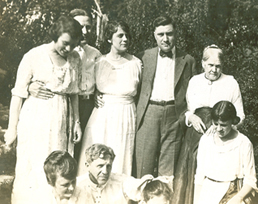
Depiction of Anglin family and friends, ca.1921
Anglin family and friends, ca.1921

Born in Cork, Ireland to a prosperous family, the Anglin siblings began immigrating to Canada and the United States in 1903. The first to relocate to Canada, brothers Will and Sydney pursued vastly different careers, one as a Presbyterian minister and the other as a salesman at a Toronto slaughterhouse. George and Crawford both served in the military during World War I, the former in the British Infantry as a medical officer and the latter in the 4th University Overseas Company first in France and later in Belgium where he died saving the life of a wounded soldier. Gladys Anglin trained as a nurse, but worked in a Canadian department store and at the Railway Office before suffering a mental breakdown and entering the Ontario Hospital as a patient. Ethel remained in Ireland the longest where she taught Domestic Economics at a technical school. The only Anglin to immigrate to the United States and the only female sibling to marry, Ida and husband David Jackson settled in Monson, Massachusetts where they raised four daughters.

The Anglin siblings were part of a close knit family who stayed in contact despite their geographic separation through their correspondence. Siblings wrote and exchanged lengthy letters that document not only family news, but also news of local and national significance. Topics addressed in their letters include World War I, the Irish revolution, medicine, religious ministry, and domestic issues from the ability of a single woman to support herself through work to child rearing.

Subjects

Anglin family--CorrespondenceIreland--Emigration and immigration--HistoryIreland--History--War of Independence, 1919-1921Irish--Canada--HistoryIrish--United States--HistoryWorld War, 1914-1918
Animating Democracy

Animating Democracy Records

1996-2022
23 boxes 34.5 linear feet
Call no.: MS 1272

Stored offsite; contact SCUA to request materials from this collection.

Animating Democracy was a program of Americans for the Arts from 1996 to 2022. Its goal was to inspire, inform, promote, and connect arts and culture as potent contributors to community, civic, and social change. It worked to bring national visibility to arts for change work, build knowledge about quality practice, and create useful resources. By demonstrating the public value of creative work that contributes to social change and fostering synergy across arts and other fields and sectors, it advanced the arts sector as an integral and effective part of solutions to the challenges of communities and toward ensuring a healthy democracy. Animating Democracy placed high value on learning from and building capacity and visibility for practitioners’ work on the ground. At the same time Animating Democracy brought to bear Americans for the Arts’ strengths in research, policy, professional development, visibility, and advocacy specifically to advance and elevate arts for change work on field, cross-sector, and national levels. To advance its goals, Animating Democracy collaborated with other organizations and field leaders who worked at the heart of arts for change in order to draw on expertise and diverse perspectives in the design and implementation of its programs and services.

The records of Animating Democracy include subject files, print publications, photographs and videos, which provide insight into the development of the initiative, its programs and impacts, its underpinning values, and collaborative and inclusive ways of working to achieve its goals of arts for community, civic, and social change.

Gift of Pam Korza and Barbara Schaffer Bacon, 2025.

Subjects

Arts and society--United States

Contributors

Americans for the Arts (Organization)
Antipa, Gregory A.

Gregory A. Antipa Papers

1953-1960
10 boxes 15 linear feet
Call no.: MS 567

A specialist in ciliate development and ecology, Gregory Antipa received a doctorate in Zoology at the University of Illinois in 1970, and since 1978, has been on faculty at San Francisco State University. Working with Paramecium, Conchophthirus, and other taxa, Antipa’s research has ventured into structure/function relationships, chemotaxis, and cellular adaptations, and he has been involved in research into the decomposition of organic wastes by protozoa. He is a member of several professional organizations, including the American Society for Cell Biology,the Microscopy Society of America, and the International Society of Protistologists.

The Antipa collection consists primarily of electron micrographs of ciliates Condylostoma, Trichodina, Conchophthirus, and the mussel encommensal Mytilophilus, along with a lab manual on protist culture and assorted notes.

Subjects

ConchophthirusCondylostomaProtozoans--DevelopmentTrichodina

Contributors

Antipa, Gregory A

Types of material

Scanning electron micrographs
Arcadia Players

Arcadia Players Records

1989-2005
18 boxes 27 linear feet
Call no.: MS 451

Since 1989 the Arcadia Players have been performing Baroque music with the aim of providing an authentic experience both for the musicians and the audience by employing instruments and performance practices that draw from the seventeenth and eighteenth centuries. In residence at the Massachusetts Center for Renaissance Studies at UMass Amherst, the ensemble performs an annual series of concerts in several communities throughout western Massachusetts.

The collection consists of brochures, programs, photographs, videorecordings of performances, and financial and administrative records. Together the items provide a behind-the-scenes look at the operations of a small but successful professional ensemble of musicians.

Subjects

Music--17th centuryMusic--18th centuryMusicians--Massachusetts

Contributors

Arcadia Players
Archambault, Richard

Ashfield Oral History Collection

1968-1969
1 folder 0.1 linear feet
Call no.: MS 042 bd

Richard Archambault conducted interviews of various citizens of Ashfield, Massachusetts, under the direction of Joel Halpern of the University of Massachusetts Amherst Anthropology Department. Contains copies of typed notes from interviews, as well as names of the citizens who were interviewed.

Subjects

Ashfield (Mass.)--History

Contributors

Archambault, Richard

Types of material

Oral histories
Archivo General de Notarias (Mexico)

Archivo General de Notarias (Mexico) Collection

1829-1875
8 boxes 12 linear feet
Call no.: MS 272

With funding from the Tinker Foundation, the historian Robert Potash and colleagues in the UMass Amherst Computing Center and at the Colegio de Mexico collaborated in 1982 on a project to test the feasibility of using computers to create guides to the richly structured, but poorly organized records of notaries in Spanish America. The collaborative issued their results under the title Guide to the notarial records… (1982), which was followed by several volumes issued by the Colegio de Mexico.

This collection consists of photocopies of records selected from the Notarial Archives in Mexico City from the years 1829, 1847, and 1875, along with data tabulation sheets and computer print-outs.

Language(s): Spanish

Subjects

Mexico--History--19th centuryNotaries -- Mexico -- History

Contributors

Potash, Robert A., 1921-

Types of material

Notarial documents