Marshall Spriggs was an educational activist at UMass/Amherst while an undergraduate from 1969 through 1974. He eventually became the chair of the Academic Affairs Committee of the Undergraduate Student Senate , the voice of undergraduates in their institution’s educational policy. After leaving Amherst, he served as a reading teacher in New York City and as an Assistant Community Representative with the Massachusetts Office for Children. In the late 1970s, he became the Managing Editor of the Boston People’s Yellow Pages published by Vocations for Social Change in 1980. The PYP attempted to catalog all the groups doing progressive political work in the Boston area. In the 1980s and beyond, he served as the Publications Director for statewide legal services, a founder of an international environmental organization, and filled various posts at Harvard University and MIT.
The Marshall Spriggs Collection features social change publications including the People’s Yellow Pages, Black Bart Brigade: The Outlaw Mag, AFSC New England Regional Office printed material, and What’s Left in Boston as well as articles on educational reform, student power, and racism.
Gift of Marshall Spriggs.
Subjects
Peace movements--United States--PeriodicalsStudent movements—United StatesVietnam War, 1961-1975-- Protest movements
Stock certificates and other printed financial instruments became a medium for American corporations to signify their role in an expanding nation and their importance to the American economy. Often elaborately printed, in part to thwart counterfeiters, stock certificates and other financial instruments typically incorporated imagery reflecting their corporate activity, a burgeoning economy, and an the idealized nation.
This small collection of stock certificates and bonds was assembled for their value in illustrating printing history due to their more or less elaborately engraved letterheads and borders. Issued from 1842 to the even of the Great Depression, the collection includes 42 different certificates, plus a handful of duplicates, issued by railroad companies, insurance companies, banks, bridge companies, coal companies, dispatch and transit companies. The illustrations run the gamut from idealized representation of the corporation to symbolic expressions.
Acquired from Kenneth W. Rendell, Dec. 1976
Subjects
Business--History--19th centuryBusiness--History--20th century
Founded in 1975 by Pir Vilayat Inayat Khan, The Abode of the Message is the headquarters for members of the Sufi Order International. Sitting on 430 acres, formerly the site of a Shaker Village in New Lebanon, New York, the Abode was settled by 75 adults and 20 children coming from all over the United States. The Sufi Order initiates spent the first several months preparing for the arrival of winter, a task that required much effort since buildings were in need of repair, there was no central heating system or updated electrical wiring, and few bathrooms. Within a year, the community prospered with the establishment of woodworking, stained glass, and sewing shops, a bakery, and a small school. Today, the community is smaller in number, but their mission remains the same: to collectively embody spiritual awakening.
The collection consists chiefly of publications produced by the Abode, including two newsletters Connections and The Messenger dating from the 1970s to the present. Also represented are other Sufi Order publications, such as Heart & Wing and Mureed’s Newsletter.
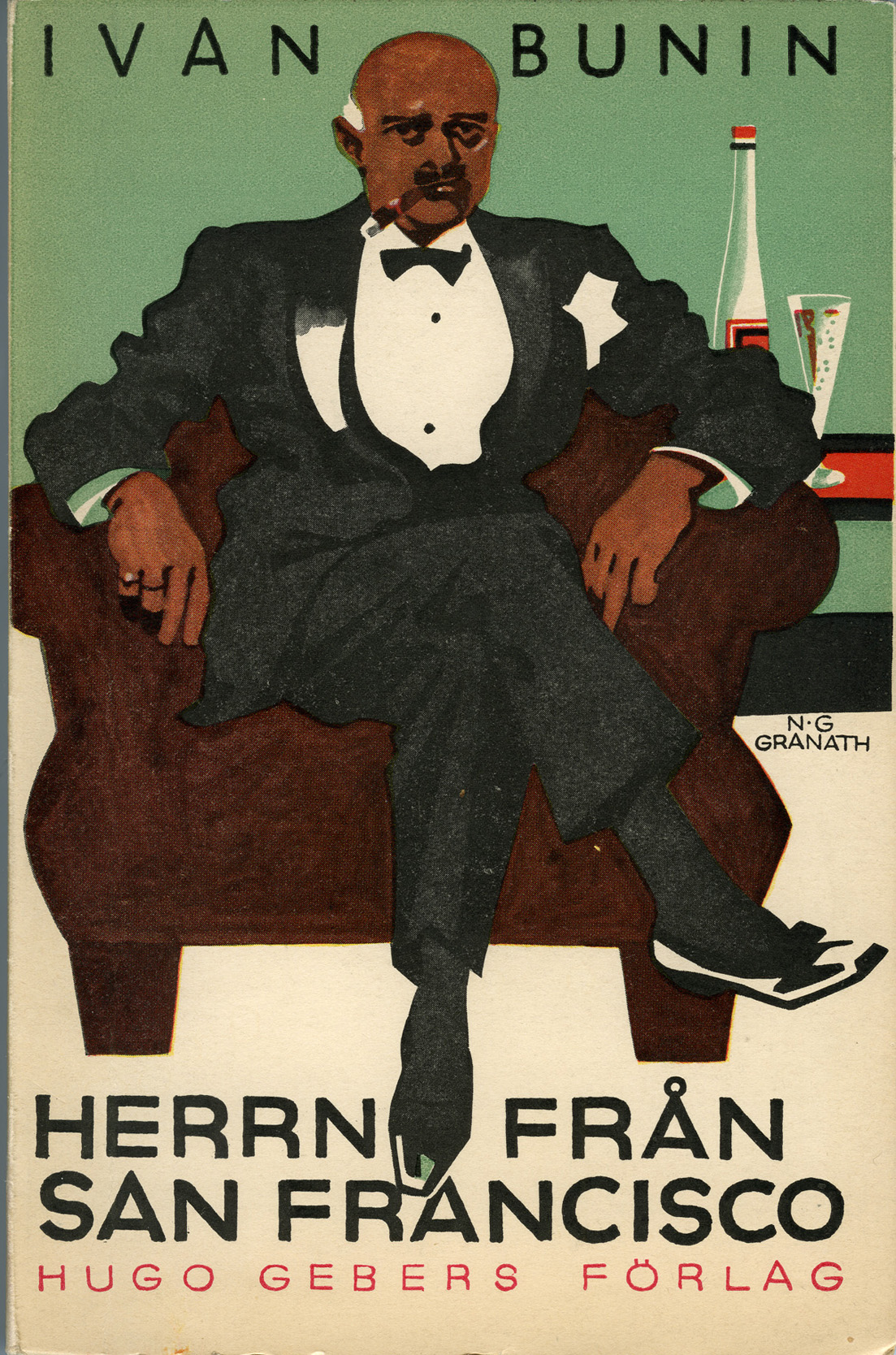
James H. Fraser and his wife Sibylle were eclectic and sometimes omnivorous collectors of the book arts, dedicated to the scholarly exploration of visual culture, the book, and the avant garde. A former Director of the Library at Farleigh Dickinson University and a consultant to many other academic libraries, James Fraser developed an omnivorous passion for German and Eastern European graphic design and book culture and had interests that ranged from Socialist children’s books to Judaica, the American left, Mongolian printing, and Japanese posters of the 1980s. James Fraser died in the fall 2013 and was survived by Sibylle and their two children.
This unusual collection of over 250 volumes is a product of the Frasers’ interest in Swedish book jacket design. Consisting nearly entirely of soft cover volumes printed between the 1920s and 1960s, primarily pre-war, and not necessarily written by Swedish authors, the collection reflects the work of many illustrators drawing on a range of graphic styles, from avant garde modernism to the later parts of the collection, which includes translations of popular works by writers such as Ian Fleming and Agatha Christie.
An Ecuadorian-born community activist, Carlos Vega moved to Holyoke, Massachusetts, with his family in 1955. Settling in the working-class “Flats” neighborhood at a time when many of Holyoke’s factories were relocating to the southern United States or Asia, the Vegas were one of the few Spanish-speaking families in the city, but when Carlos began to work on a local tobacco farm at the age of 14, he encountered the new influx of migrants from Puerto Rico who had been lured to the Connecticut Valley as agricultural laborers by the Department of Labor. With the Puerto Rican economy declining in the 1960s, many of these farm workers settled permanently in Springfield and Holyoke, but they soon discovered that the declining economy there combined with racism and urban decay blocked their hopes for upward mobility. Radicalized by the anti-colonial, anti-war, and Civil Rights movements of the late 1960s, Vega emerged as an important community organizer in the 1970s, working with Fair Share, New Unity, Urban Ministry, and other progressive organizations. With a backdrop of riots, arson, and racial tension, these organizations focused on issues relevant to the Puerto Rican community, particularly voter education and registration, fair housing, and education. In 1982, Vega helped found Nueva Esperanza, a non-profit community development organization whose mission was to restore and maintain blighted buildings in South Holyoke. He worked with Nueva Esperanza for over 30 years, continuing until 2010 after a brain cancer diagnosis in 1995. He survived until April 2012.
The materials in this collection reflect Vega’s interests in left wing movements in Central America, the Caribbean, Asia, South America and Africa from the 1960s through 1980s and include leaflets, pamphlets, books, and newsletters. The approximately 300 items offer sometimes scarce documentation of internationalist liberation movements such as the PAIGC in Guinea Bissau and Cape Verde, the Tupamaros in Uruguay, and the EFLNA in Eritrea. Of particular note is a small collection documenting Vega’s participation in the 1974 Venceremos Brigade and a collection of clippings, newsletters, notes, fliers, conference material, and newspapers from various groups such as New England Action Research, Friends of the Filipino People, The Latin American Student Association, and the Ethiopian Students Union of North America. Some printed materials are cataloged and housed with the rare books collection.
Central America--Foreign relations--United StatesCivil Rights movements--AfricaCivil Rights movements--Central AmericaCivil Rights movements--ChileCivil Rights movements--United StatesCivil Rights movements-AsiaCivil Rights movements-CaribbeanLatin America--PeriodicalsNicaragua--History--1979-1990Radicalism--United StatesRevolutionary literatureSocialismUnited States--Foreign relations--Central AmericaVenceremos Brigade
John Merrall Whitcomb was an architect, researcher, and life-long scholar. Born in New York City in July 1907, Whitcomb earned an undergraduate degree at Yale (1930) and a degree in architecture from the University of Pennsylvania (1934) and began working his way up the ranks of the architectural profession in Boston. After wartime service in the Air Force, he resumed his career, establishing his own firm in Cambridge, Johnson and Whitcomb. He died in 1998.
Part of a large collection of books amassed over a lifetime, this collection focuses largely on Whitcomb’s interest in “seditionist” literature, including works on Anglo-American Socialism and Communism, as well as topics ranging from American labor to political and social history, the rise of fascism in Europe, Soviet studies, the Vietnam War, and political theory. The bulk of the material dates from the 1930s through early 1960s.
Subjects
Communism--Great BritainCommunism--United StatesSocialism--Great BritainSocialism--United States
A long time professor of the Russian language, Marshall Winokur received his B.A. in Russian from the University of Massachusetts (1965) and his masters (1966) and doctorate (1973) in Slavic Linguistics from the University of Pennsylvania. While working on his doctoral thesis in 1969, he began teaching Russian and German at the University of Alabama in Tuscaloosa where he remained for the duration of his academic career. His research on Russian culture and the fate of Russian Orthodox churches, convents, and monasteries under the Soviet regime resulted in numerous publications and talks. After retiring from the University in 1994, Winokur and his wife Janice settled on an old farm in Deering, New Hampshire, consisting of an old house built circa 1800, a three-story barn dating back to 1850, and a carriage house, and has since been involved in the local community and exploring New Hampshire history.
The Winokur collection consists of hundreds of printed works pertaining to the history and culture of New Hampshire, about a quarter of which were published prior to 1900. Wide ranging in content, the collection includes state registers, directories, gazetteers, popular magazines, and a number of biographical works and local histories.
Russell K. Alspach Collection of William Butler Yeats
1888-1984
ca.475 items35 linear feet
Call no.: RB 014
The Irish poet W.B. Yeats was a key figure in the Celtic literary revival of the early twentieth century. Born into an artistic family in Dublin in 1865, Yeats was heavily influenced early in his career by Irish folk literature and Theosophical mysticism, but he was simultaneously rooted in the political issues of the day. An Irish nationalist by inclination, he became a two-term Senator in the Irish Free State and he was a key supporter of the arts and theatre in the new nation. His international reputation was cemented when he received the Nobel Prize for literature in 1923. Yeats died in 1939 at the age of 73.
The Alspach collection consists of hundreds of works by and about W.B. Yeats, collected by Yeats scholar Russell K. Alspach, a member of the UMass English faculty. An extensive assemblage with first editions of most of the key works, the collection also includes critical works on Yeats, works by his literary peers, bibliographies, and items published by the Cuala Press, a private press operated by Yeats’s sister Elizabeth that was a strong influence in the Celtic revival. A few items have been added to the collection since its acquisition in 1971.
Subjects
Irish poetry--20th century
Contributors
Alspach, Russell K. (Russell King), 1901-Cuala Press
Restrictions: Collection currently unavailable due to renovation in SCUA