The University of Massachusetts Amherst
Robert S. Cox Special Collections & University Archives Research Center
CredoResearch digital collections in Credo

Archive

Emmons, Marcus A.

Marcus A. Emmons Papers

1858-1864
1 folder 0.1 linear feet
Call no.: MS 034

A 21 year-old farmer from Hardwick, Mass., Marcus A. Emmons enlisted in the 21st Massachusetts Infantry in August 1861, and saw active service in North Carolina, Virginia, Kentucky, and Tennessee. Having survived many of the great battles of the eastern theatre, Emmons was killed in action at Bethesda Church on June 2, 1864.

The letters and journals that comprise this collection document Emmons’ tragically brief experience in the Civil War. Both letters date from April 1864, while the 21st Massachusetts was stationed in Annapolis, Md., prior to the campaigns of that summer. One journal includes some miscellaneous pre-war accounts, a complete list of the Civil War volunteers from Hardwick and their regiments (some with notation of fate in service); a list of conscripts added to Co. K, 21st Mass., in 1863; a list of Civil War battles; military accounts; recruits added to the regiment in 1862, listing place of residence; and a roster of Co. K, 21st Mass. Infantry, with place of residence and fate in the service. The other journal begins as a spelling exercise book and includes diary entries for Mar.-Sept., 1862, discussing farm work.
Subjects

Farmers--Massachusetts--HardwickHardwick (Mass.)--HistoryUnited States--History--Civil War, 1861-1865United States. Army. Massachusetts Infantry Regiment, 21st (1861-1864)

Contributors

Emmons, Marcus A.

Types of material

Account booksDiaries
Enfield (Mass.)

Enfield (Mass.) Collection

1800-1939
8 boxes 4 linear feet
Call no.: MS 010
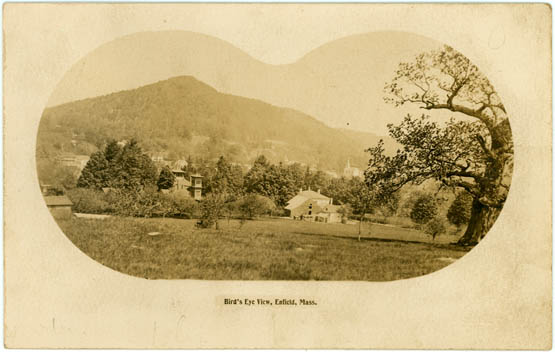
Depiction of Birdseye view of Enfield, ca.1915
Birdseye view of Enfield, ca.1915

Situated at the confluence of the east and west branches of the Swift River in western Massachusetts, Enfield was the largest and southernmost of the four towns inundated in 1939 to create the Quabbin Reservoir. Incorporated as a town in 1816, Enfield was relatively prosperous in the nineteenth century on an economy based on agriculture and small-scale manufacturing, reaching a population of just over 1,000 by 1837. After thirty years of seeking a suitably large and reliable water supply for Boston, the state designated the Swift River Valley as the site for a new reservoir and with its population relocated, Enfield was officially disincorporated on April 28, 1938.

The records of the town of Enfield, Mass., document nearly the entire history of the largest of four towns inundated to create the Quabbin Reservoir. The core of the collection consists of records of town meetings and of the activities of the town Selectmen, 1804-1938, but there are substantial records for the Enfield Congregational Church. The School Committee, Overseers of the Poor, the town Library Association, and groups such as the local chapter of the Daughters of the American Revolution and the Bethel Masonic Lodge.

Subjects

Enfield (Mass.)--HistoryEnfield (Mass.)--Politics and governmentEnfield (Mass.)--Religious life and customsEnfield (Mass.)--Social life and customsQuabbin Reservoir Region (Mass.)--HistoryQuabbin Reservoir Region (Mass.)--Social life and customsWomen--Societies and clubs

Contributors

Daughters of the American Revolution. Captain Joseph Hooker Chapter (Enfield, Mass.)Enfield (Mass. : Town)Enfield (Mass. : Town). Overseers of the PoorEnfield (Mass. : Town). Prudential CommitteeEnfield (Mass. : Town). School CommitteeEnfield Congregational Church (Enfield, Mass.)Enfield Congregational Church (Enfield, Mass.). Women's AuxiliaryEnfield Congregational Church (Enfield, Mass.). Women's Missionary Society

Types of material

Account booksChurch recordsPhotographsSermons
Esleeck Manufacturing Company

Esleeck Manufacturing Company Records

1898-1987
3 boxes 4.5 linear feet
Call no.: MS 505

A manufacturing firm specializing in the production of onion skin paper, the Esleeck Manufacturing Company was established in 1898 as the Monadnock Paper Co. The principal owners, Augustine W. Esleeck and Alfred T. Judd, had worked together with the Valley Paper Mills of Holyoke, Mass., but when striking out on their own, moved to Turners Falls, believing the town to be the ideal location for a mil. Changing their name to Esleeck Manufacturing Co. in 1901, the firm sought to be a good neighbor, using local labor and products from local firms in their manufacturing. After more than 100 years of continuous operation, the company was purchased by Southworth Co. in 2006.

The collection consists chiefly of financial records, but also includes three minute books from 1898-1961 that capture the the company’s early history, as well as a memorial history of the company written by a long-term employee in 1954.

Subjects

Paper industry--MassachusettsTurners Falls (Mass.)--History

Contributors

Esleeck Manufacturing Company
Estey, Joseph W.

Joseph W. Estey Account Book

1809-1827
1 vol. 0.25 linear feet
Call no.: MS 093

Joseph W. Estey was the owner of a farm in Greenwich, Massachusetts with a grist and sawmill. The account book (started in Springfield and Ludlow, Massachusetts with his business partner Abner Putnam) documents business dealings, hired male and female help, personal and farm expenses (hiring tanners and blacksmiths), and a deed.

Subjects

Agricultural laborers--Massachusetts--GreenwichDomestics--Massachusetts--GreenwichFarmers--Massachusetts--GreenwichGreenwich (Mass.)--Economic condition--19th centuryHowe, EdwardHowe, GideonLincoln, BenjaminLudlow (Mass.)--Economic conditions--19th centuryMarcy, LabanMills and mill-work--Massachusetts--GreenwichOaks, JohnParson Clapp TavernPutnam, A. W.Putnam, AbnerSpringfield (Mass.)--Economic conditions--19th centuryVaughan, JosiahWare Manufacturing Co. (Ware, Mass.)Warner, John

Contributors

Estey, Joseph W.

Types of material

Account books
Faber, William A.

William A. Faber Ledger

1848-1853
1 vol. 0.25 linear feet
Call no.: MS 244 bd

Owner of a livery stable in Great Barrington, Massachusetts. Includes lists of stabler activities, customers (individuals and businesses), and employed ostlers. Also contains method of payment (cash and services), and one labor account for Fred Berry, a nineteen year old Afro-American who was one of three ostlers living in Faber’s household at the time.

Acquired from Charles Apfelbaum, 1987

Subjects

African Americans--Massachusetts--Great BarringtonBerry, FredBurghardt, Thomas, b. 1790Cab and omnibus service--Massachusetts--Great BarringtonCoaching (Transportation)--Massachusetts--Great BarringtonCrane, Albert SGirling and DoolittleGranger and HillGreat Barrington (Mass. : Town)--Economic conditionsIves, GeorgePynchon, GeorgeRose Cottage Seminary (Great Barrington, Mass.)Stables--Massachusetts--Great Barrington

Contributors

Faber, William A., b. 1818

Types of material

Account books
Fall River Loom Fixers’ Association

Fall River Loom-Fixers' Association Records

1895-1917
2 boxes 1 linear feet
Call no.: MS 003

Members of the Fall River Loom Fixers Association included some of the most skilled workers in the New England textile industry. The association, on behalf of its members, sought to improve poor working conditions, to provide assistance for members affected by pay reductions or layoffs, and to intervene in conflicts between members and management. The union also served a social function, organizing parades, social gatherings, and excursions. In the 1910s it became affiliated with the United Textile Workers for America.

Records of the Loom Fixers Association include executive committee minutes (1900-1901 and 1911-1917), a treasurer’s book (1901-1905), and six dues books (1895-1907).

Subjects

Labor unions--MassachusettsTextile workers--Labor unions--Massachusetts
Famous Long Ago Archive

Famous Long Ago Collection

ca.1960-2005
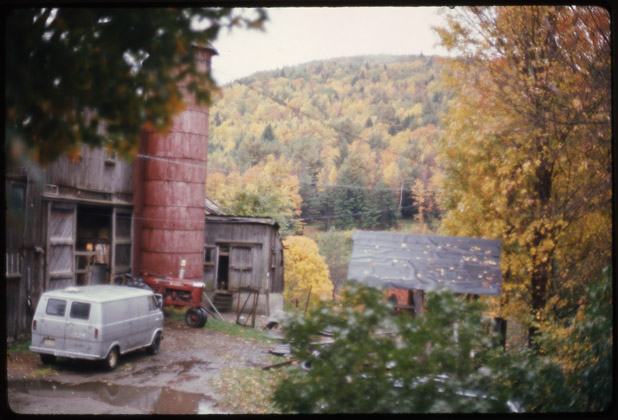
Depiction of The barn, Montague Farm Photo by Roy Finestone, Oct. 1976
The barn, Montague Farm Photo by Roy Finestone, Oct. 1976

Ray Mungo’s Famous Long Ago (1970) and Steve Diamond’s What the Trees Said (1971) are classic visions of late 1960s counterculture and of life in New England communes. The communes on which Mungo and Diamond settled, Packer Corner and the Montague Farm, became the center of what might be considered a single extended community, embracing the Wendell Farm and Johnson Pasture and Tree Frog Farm in Vermont. The Farmers themselves were, and remain, a diverse group, including photographers, novelists, and poets, artists, actors, and activists.

An umbrella collection, the Famous Long Ago Archive contains a growing number of collections relating to the communes at Montague Farm, Packer Corners, Johnson Pasture, Wendell Farm, and Tree Frog Farm. These range from the papers of Steve Diamond, Raymond Mungo, and Jonathan Maslow to Randy Kehler and Betsy Corner (the latter of whom lived at Montague Farm), the records of the Liberation News Service, the Alternative Energy Coalition, and Musicians United for Safe Energy, to the photographic collections of Roy Finestone and Stephen Josephs. View all the Famous Long Ago Collections.

Collections include:

Subjects

Antinuclear movement--MassachusettsCommunal living--MassachusettsCommunal living--VermontJohnson Pasture Community (Vt.)Montague Farm Community (Mass.)Packer Corners Community (Vt.)Political activists--Massachusetts
Federal Reserve Bank of Boston

Federal Reserve Bank of Boston Research Reports

1959
1 box 0.5 linear feet
Call no.: MS 066

Established in 1914 as one of a dozen federal reserve banks nationwide, the Boston Fed serves the six New England states. The collection consists of research reports issued by the Federal Reserve Bank of Boston in 1959 projecting economic conditions for New England in the year 1970 for manufacturing industries, banking, electronic industry, and population and labor force.

This small collection consists of an incomplete run of forecasts and research reviews of the New England economy in anticipation of the new decade, 1970.

Subjects

New England--Economic conditions

Contributors

Federal Reserve Bank of Boston
Ferguson, Ann

Ann Ferguson Papers

1970-2007
23 boxes 33 linear feet
Call no.: FS 101

Temporarily stored offsite; contact SCUA to request materials from this collection.

Ann Ferguson began her tenure at UMass as an Instructor in 1964 as she completed the last year of her doctoral work at Brown under supervision of R.M. Chisolm. With academic interests in ethics, aesthetics, women’s studies, and social and political philosophy, Ferguson has been politically engaged in human rights and social justice initiatives since the 1960s, supporting organizations such as Feminist Aid to Central America, Marxist Activist Philosophers, and the Radical Philosopher’s Association. In 1995, Ferguson accepted a three-year term as Director of Women’s Studies, describing the program as one with the “roots in political activism to fight social injustice.” Despite her 2008 retirement, Ferguson continues to teach in both Philosophy and Women’s Studies.
The Ferguson Papers document Ann Ferguson’s academic career at the University of Massachusetts Amherst as well as her commitment to political activism and social change. The papers include material relating to campus politics, the women’s movement and other social movements, Philosophy Department files (1971-1997) from Ferguson’s tenure as Head of the Philosophy Department, and course materials from both Women’s Studies and Philosophy. Also included among the papers are professional correspondence, feminist pamphlets (1970s-1980s), and several posters from Ferguson’s office.

Gift of Ann Ferguson, 2008-2014

Subjects

University of Massachusetts Amherst--FacultyUniversity of Massachusetts Amherst. Department of PhilosopyUniversity of Massachusetts Amherst. Program in Women's Studies

Contributors

Ferguson, Ann
Fernald, Charles H.

Charles H. Fernald Papers

1869-1963
8 boxes 3.75 linear feet
Call no.: FS 059
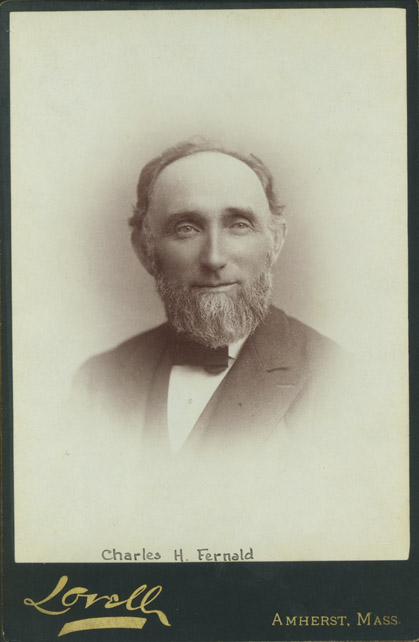
Depiction of Charles H. Fernald
Charles H. Fernald

During a long and productive career in natural history, Charles Fernald conducted important research in economic entomology and performed equally important work as a member of the faculty and administration at Massachusetts Agricultural College. Arriving at MAC in 1886 as a professor of zoology, Fernald served as acting President of the College (1891-1892) and as the first Director of the Graduate School (1908-1912), and perhaps most importantly, he helped for many years to nurture the Hatch Experiment Station.

Correspondence, published writings, publication notes, newspaper clippings, Massachusetts Board of Agriculture Reports, and biographical material including personal recollections of former student and colleague Charles A. Peters.

Subjects

Agriculture--Study and teachingEntomologyMassachusetts Agricultural College--FacultyMassachusetts Agricultural College. Department of ZoologyZoology--Study and teaching

Contributors

Fernald, Charles H.