Collection documenting Polish American culture, language, and history consisting of newspapers and news clippings, programs for Polish religious and cultural events, newsletters of Polish American organizations, and Polish publications including religious works and language textbooks.
Polish Architecture and Folk Art Photograph Collection
1980s
1 box, 234 items0.5 linear feet
Call no.: MS 279
234 photographs taken by Marian Pokropek and others of a variety of subjects in Poland, including homes, farms, buildings, churches, businesses, wood carvings, ceramics, corn dollies, friezes, metalwork, sculptors, paintings, textiles, ceremonies, and a Jewish graveyard. Many of these images were published in Pokropek’s books.
Founded in 1989, the Polish Genealogical Society of Massachusetts is a not-for-profit organization devoted to encouraging and supporting research into Polish family history and more generally into Polish culture and history. The Society sponsors educational programs and publications and operates a research library at the Polish Center of Discovery in Chicopee, Mass.
The collection consists of a complete run of the semiannual newsletter of the Polish Genealogical Society of Massachusetts, Biuletyn Korzenie (Roots Bulletin), from 1990-2023. At that point the Society became a chapter of the national organization, and Biuletyn Korzenie is continued as Massachusetts material in the Polish Genealogical Society of America journal, Rodziny.
Includes booklets containing parish and community histories, photographs, and local advertisements celebrating Jubilee, other anniversaries, and events in over twenty Massachusetts Polish American parishes; booklets furnishing histories and names associated with Polish American groups (such as the Brotherly Aid Society and Polish American Veterans); an historical paper on the Chicopee Polish Community; a pamphlet including songs and recipes; photographs; a booklet; and two books.
Polish-American women’s club located near Palmer, Massachusetts, that aims to encourage Polish women to become United States citizens and provide them with classes in the English language; to take an active part in local, state and federal politics; to support local Polish-owned businesses; to preserve and integrate Polish culture with those of other ethnicities present in the United States; to encourage higher education in the Polish-American community.
Includes meeting minutes (primarily in Polish), histories, anniversary programs, town and state citations, and government publications, documenting the activities, membership, and national recognition of the club over a period of seventy years.
Gift of Helen B. Grzywna and Sophie Wojtowicz-Valtelhas, 1995
Subjects
Americanization--History--20th centuryPalmer (Mass.)--Ethnic relations--20th centuryPalmer (Mass.)--Social conditions--20th centuryPoles--Cultural assimilation--Massachusetts--History--20th centuryPolish American friendly societies--Massachusetts--Palmer--HistoryPolish Americans--Ethnic identity--History--20th centuryPolish Americans--Massachusetts--PalmerPolish Americans--Political activity--History--20th century
Contributors
Massachusetts Federation of Polish Women's ClubsPolish American Women Citizens Political Club of Three Rivers and Thorndike (Palmer, Mass.)Polish Women's Club of Three Rivers (Palmer, Mass.)
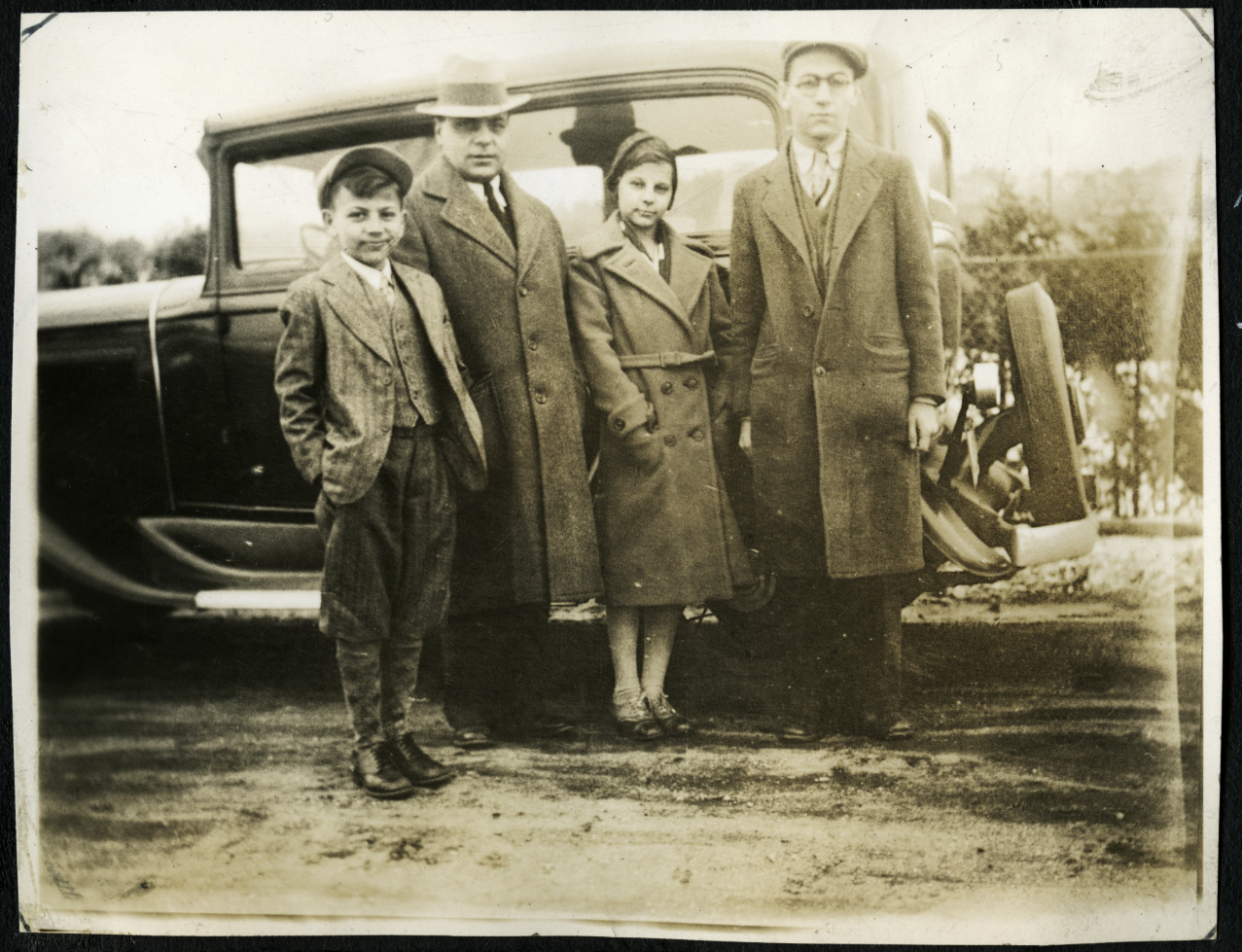
Dario, Antonio, Lillian, and Joseph Politella in Amherst, ca.1930
When Antonio Politella emigrated from Italy to Lawrence, Mass., in 1910, he joined an older half-brother Walter Pollano, but left behind his wife and infant son. Working as a pharmacist under Pollano, Politella was successful enough to reunite his family in 1919, and eventually raised a family of three, all of whom went on to earn undergraduate degrees at Massachusetts State College and dedicate their lives to education. The eldest child, Joseph (’33), served in the Army Air Corps during the Second World War, earned a PhD in philosophy at the University of Pennsylvania, and taught in eastern religions at Kent State University. Lillian (’42) became a French teacher, while Dario (’47), an aviator during the war, earned his doctorate at Syracuse and taught journalism at UMass Amherst for many years.
The Politella family collection contains correspondence received primarily by Lillian Politella (’42), the bulk of which reflects the impact on the war on both her family and college. Among the letters are dozens written by her brothers Joseph (’33) and Dario (’47) and friend Donald W. Cadigan (’39) while in the service, which are joined by an evocative series from their teacher and mentor, Ray Ethan Torrey. Torrey’s letters in particular offer insight into Mass. State College during and after the war and are replete with news about acquaintances and complaints about liberals and current events.
Gift of Norma E. Parras, Nov. 2015
Subjects
Buddhism--Study and teachingHinduism--Study and teachingMassachusetts State College--HistoryMassachusetts State College--StudentsMysticismTheosophyWorld War, 1939-1945
Contributors
Politella, DarioPolitella, JosephPolitella, V. LillianTorrey, Ray Ethan, 1887-1956
Brought together by Robert J. Pollock, this collection of souvenirs consists chiefly of playbills from New England and New York productions, and includes programs from ice skating shows, circuses, and musical revues.
A textile manufacturer, Ponakin (or Ponikin) Mill was established on the north branch of the Nashua River, half a mile from North Lancaster, in 1861, near the site of an earlier cotton mill. By the end of the Civil War, it boasted 40 employees who produced 500,000 yards of brown sheeting, but by the time it was incorporated in 1888, specializing in the production of cotton yarn, manufacturing in Lancaster was already on the decline. The company survived at least into the 1920s.
This survival from a central Massachusetts textile manufacturer contains miscellaneous business records copied into a letterpress (or wet press) copy book, in which a combination of moisture and pressure was used to transfer ink from the original onto a sheet of tissue paper. This records cover a wide terrain, including inventories of stock on hand, accounts payable, insurance and IRS tax information, payroll data (without names), shipping lists and lists of customers, and a few copies of business letters.
Pondtown Monthly Meeting of Friends, based in Winthrop, Maine, began as a worship group under the care of the Winthrop, Maine Monthly Meeting in 1982. After a year, it was set off from Winthrop Monthly Meeting to become a monthly meeting as part of the Vassalboro Quarterly Meeting. Eight years later, in 1991, the Farmington Monthly Meeting was set off from Pondtown.
The collection consists of six folders, containing minutes from 1991-1993, State-of-the-Society reports for 1991 and 1992, some correspondence and a query.
Gift of New England Yearly Meeting of Friends, April 2017
Subjects
Maine--Religious life and customsQuakers--MaineSociety of Friends--Maine