The University of Massachusetts Amherst
Robert S. Cox Special Collections & University Archives Research Center
CredoResearch digital collections in Credo

Archive

Boston & Maine Railroad. Fitchburg Division

Boston and Maine Railroad Fitchburg Division Records

1918-1958
1 box 0.5 linear feet
Call no.: MS 475

Chartered in June 1835, the Boston and Maine Railroad was the dominant railroad of northern New England for nearly one hundred years. This collection consists of records from the Engineering Department of the Fitchburg Division relating to the maintenance of bridges in Massachusetts, including correspondence, accident reports, financial records and progress reports on work recommended by bridge inspectors.

Subjects

Railroad companies--United States--History--20th century

Contributors

Boston and Maine Railroad. Fitchburg Division
Boston Bluegrass Union

Boston Bluegrass Union Records

1995-2002
32 digital objects
Call no.: MS 1273

The Boston Bluegrass Union (BBU) is run by an all-volunteer Board of Directors, with a mission to educate people in the Northeast about bluegrass music.  Formed in 1976, the BBU hosted its first concert on October 3, 1976, with Joe Val and the New England Bluegrass Boys. The BBU is the premier source for bluegrass music activities in the Northeast, presenting concerts, festivals, education programs, and informal music get-togethers. Over its nearly 50 years, the BBU has become the central resource for everything bluegrass in Boston and has, in part, been responsible for creating the vibrant market for bluegrass that exists today in the Boston area. Since its founding, BBU has presented over a thousand shows featuring top national and regional artists, making it one of the longest running such series in the country.  The list of bluegrass bands that have been featured over the years includes such acts as Bill Monroe and the Bluegrass Boys, Ralph Stanley , Jim and Jesse, Tony Rice, the Country Gazette, The Johnson Mountain Boys, The Seldom Scene,  J.D. Crowe and the New South, Hazel Dickens, Laurie Lewis, the Lynn Morris Band, the Good Old Persons, the Lonesome River Band, IIIrd Tyme Out, Special Consensus, Dry Branch Fire Squad, and the Claire Lynch Band. While BBU was first focused on concerts, their signature event is now the annual Joe Val Bluegrass Festival, presented Presidents Weekend at the Sheraton Framingham Hotel.  The Joe Val Festival had its origins in 1985 as a fundraiser to assist the ailing Joe Val with his medical expenses. His untimely passing and his remarkable talents continue to be honored with the three-day festival which bears his name. The event features a star-studded Main Stage, a Showcase Stage which shows off the talents of up-and-coming regional bands, the Joe Val Kids Academy, over 50 workshops, vendors, and round the clock jamming. The festival was awarded the International Bluegrass Music Association’s Event of the Year in 2006. 2026 marks the 40th edition of the Joe Val Bluegrass Festival, the 100th anniversary of Joe Val’s birth, as well as the 50th anniversary of the BBU’s founding.  

The Boston Bluegrass Records currently consists of 32 issues of the group’s newsletter, Bluegrass Breakdown, event flyers, and concert recordings. Additions to the collection are expected.

Gift of Boston Bluegrass Union, 2025.

Subjects

Bluegrass music--New EnglandBluegrass musicians--New EnglandFolk music--New England

Types of material

Newsletters
Boughton, Fred W.

Fred W. Boughton Collection

1970-1985
4 boxes 6 linear feet
Call no.: MS 1252

Born in 1912 in Fargo, North Dakota, Fred W. Boughton was raised in Twin Falls, Idaho. He graduated from the University of Kansas during the Great Depression with a degree in chemical engineering. Unable to find a good job closer to home, he accepted a position at the Eastman Kodak company in Rochester, New York, an up-and-coming firm specializing in photography. At Kodak, he worked with a team that invented a transformative photo paper. Over the years, he rose to the position of Vice President. His career was only half the picture, however, in his spare time, Boughton was an artist. He began taking figure drawing classes at a local gallery, then moved onto watercolors of some of his favorite landscapes. Later, he delved into larger oil paintings in the abstract expressionist mode. Finally, he did a series of portraits of his family and other people, which captured individuals’ essence. Boughton’s grave rubbings were created mostly on family vacations to New England. He thought that these images were worth preserving for ages to come. When he and his wife retired to Florida, he became active in the local art community and was a volunteer docent at an art gallery. Boughton died in 1999; he made his art a work of life, and his life a work of art.

The Fred W. Boughton Collection consists of gravestone rubbings from New England, with an emphasis on Massachusetts, slides and photographs of tombstones, and research files created and collected during the 1970s-1980s.

Gift of Otto Laske, 2024.

Subjects

Cemeteries--New EnglandSepulchral monuments—New England

Types of material

PhotographsSlides
Boyce, James K.

James K. Boyce Papers

1973-2025
19 boxes 28.5 linear feet
Call no.: FS 222

James K. Boyce, senior fellow at the Political Economy Research Institute at the University of Massachusetts Amherst and Professor Emeritus of Economics, received his B.A. from Yale University and doctorate from Oxford University. While an undergraduate, Boyce worked on a land reform and rural development program in India for two years. He completed his studies at Yale, designing an independent major in Agricultural Development, before returning to South Asia where he lived in a village in Bangladesh for a year. Out of this experience, Boyce and his partner, Betsy Hartmann, wrote and published the book, A Quiet Violence, which focused on the lives and perspectives of those who live in rural poverty. Throughout his career, he researched and wrote extensively on environmental economics. When Boyce joined the faculty at UMass Amherst in 1985, he established the first economics course on the topic called “the political economy of the environment.” During his first sabbatical in the 1990s, Boyce was a Fulbright Scholar at the Universidad Nacional in Costa Rica, where he helped establish a master’s program in sustainable development and ecological economics for Central America and the Caribbean. In addition to his focus on environmental economics, Boyce was active in the economics of violent conflict and peacebuilding. He traveled to El Salvadore soon after the signing of the peace accords and was asked to lead the Adjustment Toward Peace project for the United Nations Development Program. Boyce continues to write about topics related to political economy and climate policy.

The collection is a rich resource documenting Boyce’s research and professional contributions that include work on: South Asia with emphasis on irrigation and flood control; Africa; the Philippines; environmental topics such as climate policy, crop genetic diversity, Natural Assets Project, Toxic 100, Costa Rica; and peacebuilding, in particular in El Salvador. Publications and reports are contextualized within the collection through correspondence, drafts of writings, conference proceedings, and extensive notes and notebooks including those created on visits to Bangladesh.

Gift of James K. Boyce, 2025.

Subjects

Economic policy—Environmental aspectsEnvironmental economicsSustainable development

Types of material

ArticlesCorrespondence (letters)Notes
Brandon, Liane

Liane Brandon Collection

ca. 1970-1999
2 boxes 2 linear feet
Call no.: MS 1282

Liane Brandon is an award-winning filmmaker, photographer and University of Massachusetts Amherst Professor Emerita. She is a co-founder of New Day Films and was one of the first independent women filmmakers working in New England. She was also a founding member of FilmWomen of Boston and Boston Film/Video Foundation. Brandon’s groundbreaking films Sometimes I Wonder Who I Am (1970) Anything You Want To Be (1971) and Betty Tells Her Story (1972) were among the most frequently used consciousness raising tools of the Women’s Movement. Her films, which also include Once Upon A Choice and How To Prevent A Nuclear War have won numerous national and international awards, and have been featured on HBO, Cinemax and the Criterion Channel. They have twice received Blue Ribbons at the American Film Festival and have been presented at the Museum of Modern Art, the Barbican Centre in London, the Tribeca Film Festival and many other venues. In addition to her role as Professor at the University of Massachusetts and Chair of the Educational Technology Program in the College of Education, she was the Director of UMass Educational Television. Designed to provide the public with innovative, original educational programming, UMass Educational Television produced award winning, original educational programming for cable/home audiences throughout New England. The twelve original series (50 half-hour episodes) were carried by local and regional cable and were seen in over 40 cities and towns in Massachusetts and Connecticut. The College of Education became the first educational college in the country to produce original educational programming for cable/home audiences. Currently working as a photographer, her credits include stills for American Masters, Nova, and Unsolved Mysteries. Her photographs have been published in The New York Times, the Los Angeles Times, the Boston Globe and many other publications.

The Liane Brandon Collection consists chiefly of printed materials related to the antinuclear movement, peace movement, labor unions and workers’ movement, feminism and the women’s movement, women filmmakers, student movements and organizing, as well as photographs and videotapes of shows produced by UMass Educational Television (1995-1999). For materials related to Brandon’s contributions to UMET, see the UMass Educational Television Collection.

Brandon’s historic films and papers are held at the Archive of Documentary Arts at Duke University.

Gift of Liane Brandon, 2024-2025.

Subjects

Antinuclear movement--United StatesFeminism—PeriodicalsPeace movements

Types of material

PeriodicalsPhotographsVideotapes
Buckley, Kerry W.

Kerry Buckley Collection on the W. E. B. Du Bois Exhibit and Documentary Film

1961-2021 Bulk: 1979-1983
1 box 0.5 linear feet
Call no.: MS 1155

Kerry W. Buckley is an American History writer and artist. He graduated from Samford University in 1969 but continued his studies at the University of Georgia to get his Masters in 1971 and then completed his Ph.D. in American Social and Intellectual History at the University of Massachusetts Amherst. Buckley wrote and edited several books and articles, including “Mechanical Man”, a biography of the psychologist, John Broadus Watson. He’s a veteran from the Vietnam era and has taught and lectured at many different colleges and universities. Buckley became fascinated by Du Bois after writing a research paper, and eventually his thesis, on him. Throughout his life, he worked on a few projects centered around Du Bois, including a biographical travelling exhibit that contained some of Du Bois’s pictures and selected writings. Buckley also worked in the University of Massachusetts Archives to help process and create a guide for the W.E.B.Du Bois Papers.

The collection contains drafts, letters, publications and documents that focus on the creation of the Du Bois traveling exhibit , the production of the published guide to the papers, and the effort to create a Du Bois documentary by Black Flame Productions.

Gift of Kerry Buckley, 2021.

Subjects

Documentary filmsDu Bois, W. E. B. (William Edward Burghardt), 1868-1963

Contributors

Buckley, Kerry W.

Types of material

CorrespondenceGrant proposals
Burgett-Irey family

Burgett-Irey Family Papers

1832-2010 Bulk: 1929-2008
4 boxes 2 linear feet
Call no.: MS 605

Born in 1908 to Louis and Sarah Kessel Burgett, Katherine grew up on the family farm outside of Oquawka, Illinois. In 1924 her parents purchased their own farm in Monmouth, which they later lost due to the devastating impact of the Depression on agriculture, and it was there that she first met her future husband, Kenneth Monroe Irey, a student at Monmouth College. The newlyweds moved to New Jersey in 1931 where Kenneth was transferred for work. As a chemical engineer, Kenneth enjoyed a successful career and comfortably supported his wife and two children. Retiring in 1970, he and Katherine spent their later years pursuing two passions: traveling and bird-watching. Kenneth and Katherine’s eldest daughter, June Irey Guild, spent most of her adult life in Massachusetts where she has married twice, raised six children, and operated her own business. During her retirement years, June focused on preserving her family’s history by collecting letters and recoding family narratives.
The Burgett-Irey Family Papers chronicle the changes that many twentieth-century American families experienced as the nation descended into an economic depression, entered into a world war, and emerged as one of the most powerful countries in the world. The collection, which will continue to grow, includes approximately 65 letters between Katherine Burgett Irey and her family. Most of the letters exchange family updates, particularly precious after Katherine relocated to New Jersey. Among the earliest letters is an account of Katherine and Kenneth’s first meeting described as “fast work,” since he asked her out on the spot. Also included are autobiographical writings by Kenneth describing his cross-country trip to California in 1927 and a brief history of his life and career.

Subjects

Bird watchingBurgett familyIrey familyMarriage--United StatesMotherhood--United States--History--20th centuryMothers--United States--History--20th centuryWomen--United States--History--20th century

Contributors

Guild, June IreyIrey, Katherine BurgettIrey, Kenneth Monroe, 1905-1994

Types of material

DiariesLetters (Correspondence)Slides
Campano, Anthony

Anthony Campano Papers

1956-2007
2 boxes 1 linear feet
Call no.: MS 617

Anthony “Tony” Campano and Shizuko Shirai met by chance in January 1955 as Tony was passing through Yokohama en route to his new post in Akiya. Recently transferred to Japan, Tony enlisted in the U.S. Army a little over a year earlier, serving first in Korea. As their relationship blossomed, Tony and Shizuko set up housekeeping until his enlistment ended and he returned home to Boston. Determined to get back to Japan quickly and marry Shizuko, the two continued their courtship by mail, sending letters through Conrad Totman and Albert Braggs, both stationed in Japan. By the summer of 1956, Tony re-enlisted in the Army, this time stationed in the Medical Battalion of the 24th Division located in Seoul, Korea. There he remained until August 1957 when he was finally able to secure official authorization to marry Shizuko. Cutting their honeymoon short to deal with her medical emergency, Tony returned to his post in Korea. The couple reunited in November of that year after Tony secured a new assignment in Yokohama.

The letters of Tony Campano to Shizuko Shirai during the year or more they were separated document their unlikely romance. Soon after Tony returned home when his first enlistment ended, friends and family tried to discourage him from pursuing a relationship with Shizuko. Despite their age difference–Shizuko was eleven years older– and the language barrier, the two ultimately married. In addition to the couple’s long-distance courtship letters, the collection also contains about 100 letters exchanged between Campano and Conrad Totman, dating from their early days in the U.S. Army to the present; taken together they document a friendship of more than fifty years.

Subjects

Japan--Social life and customs--1945-United States. Army--Non-commissioned officers--Correspondence

Contributors

Campano, AnthonyCampano, Shizuko ShiraiTotman, Conrad D

Types of material

Letters (Correspondence)
Chrisman, Miriam Usher

Miriam Chrisman Papers

1937-2007
13 boxes 9 linear feet
Call no.: FS 128
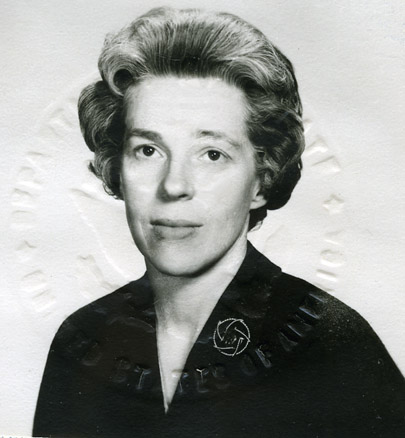
Depiction of Miriam U. Chrisman, 1964
Miriam U. Chrisman, 1964

A long-time historian at UMass Amherst, Miriam Usher Chrisman graduated from Smith College in 1941 and spent the war years as an intern and research assistant in various agencies, including the National Resources Planning Board. With the return of peace, Chrisman took master’s degrees in economics (American University) and education (Smith), before earning her doctorate in history from Yale in 1962 for a study of Reformation-era Strasbourg. From Yale, she landed a faculty appointment at UMass Amherst, where she remained for her ennitre career. As a historian of the 16th century, she was awarded a Prix d’honneur by the Societe des Amis de Vieux Strasbourg, an honorary doctor of humane letters by Valparaiso University, and the Wilbur Cross Medal from Yale. Chrisman retired from active teaching in 1985 and remained an active friend of the Du Bois Library until her death in November 2008.

A faithful and colorful correspondent, the bulk of Miriam Chrisman’s papers consist of letters written to family and friends stretching from her college days at Smith through the year before her death. The bulk of the correspondence is with her husband, Donald Chrisman, an orthopedic surgeon who was enrolled at Harvard Medical School during their courtship. Soon after the Chrismans married in November 1943, Donald left for active duty in the Navy on the U.S.S. Baldwin. The couple’s war correspondence is unusually rich, offering insight on everything from the social responsibilities of married couples to their opinions on the progression of the war. Of particular note is a lengthy letter written by Donald during and immediately after D-Day in which he provides Miriam a real-time description of the events and his reactions as they unfold. Later letters document Miriam’s extensive travels including a trip around the world.

Subjects

Smith College--StudentsUniversity of Massachusetts Amherst--FacultyUniversity of Massachusetts Amherst. Department of HistoryWorld War, 1939-1945

Contributors

Chrisman, Miriam Usher

Types of material

Letters (Correspondence)
CIA on Trial Project (Amherst, Mass.)

CIA on Trial Project Records

1985-1989
2 boxes 0.75 linear feet
Call no.: MS 508

In 1986 demonstrations against CIA recruitment on the University’s campus led by activists Abbie Hoffman and Amy Carter, daughter of former President Jimmy Carter, resulted in the takeover of two school buildings and more than sixty arrests. The CIA on Trial Project was a group established in Amherst to support the individuals arrested as well as to raise funds for their legal defense.

News clippings covering the protests, fliers, memos from the University’s administration, and correspondence with Chancellor Duffey capture the mood on campus during and after the protests.

Subjects

Activists--MassachusettsCIA on Trial Project (Amherst, Mass.)University of Massachusetts Amherst--History