The University of Massachusetts Amherst
Robert S. Cox Special Collections & University Archives Research Center
CredoResearch digital collections in Credo

Archive

Burn, Barbara B.

Barbara B. Burn Papers
1966-2001
8 boxes 12 linear feet
Call no.: FS 112
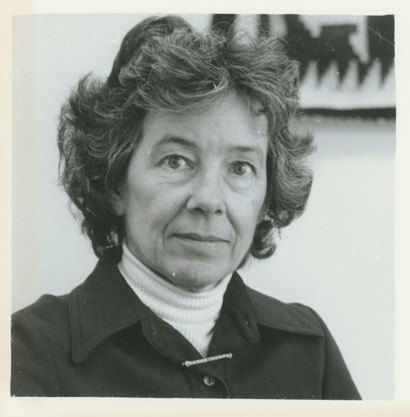
Depiction of Barbara Burn, 1975
Barbara Burn, 1975

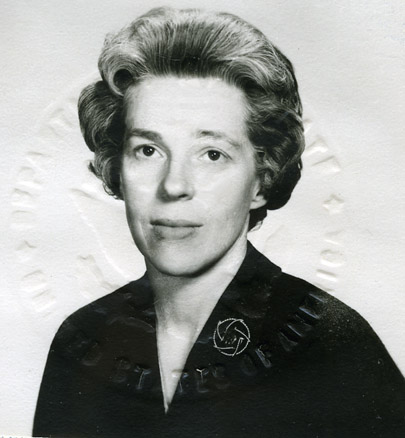
The founder of the the university’s International Program Office, Barbara Burn was widely recognized as an expert in international education. After attending the University of Michigan as an undergraduate, Burn received both her master’s degree and doctorate from the Fletcher School of Law and Diplomacy in 1955. She worked for several years on the faculty of the Foreign Service Institute and as a program specialist at the Asia Foundation before coming to UMass Amherst in 1968 to study the feasibility of developing an international programs office, after which she was appointed Director of International Programs and in 1988, Associate Provost. Under her leadership, the number of UMass undergraduates studying abroad increased ten fold. Burn died on Feb. 24, 2002, at the age of 76, leaving a son and a daughter.

The Burn Papers include detailed information regarding the establishment of the International Programs Office, including background information and sometimes extensive correspondence with universities around the world. Approximately three quarters of the collection consists of alphabetically arranged files on foreign universities and subjects pertaining to study abroad, with particularly interesting material in the 1970s and 1980s on exchanges with the People’s Republic of China.
Subjects

American students--Foreign countriesForeign studyUniversity of Massachusetts Amherst. International Programs Office

Contributors

Burn, Barbara B
Calidonna, Frank

Frank Calidonna Photograph Collection

1991
1 box 0.25 linear feet
Call no.: PH 021
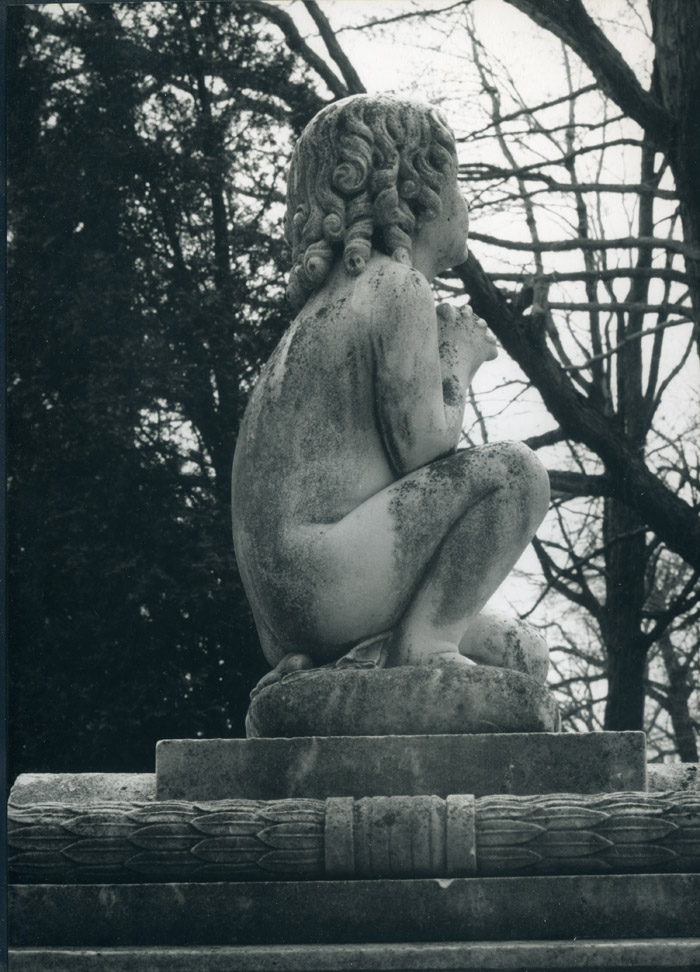
Depiction of Charles A. Jones monument, 1858
Charles A. Jones monument, 1858

A teacher at the New York State School for the Deaf since the 1970s, Frank Calidonna is a professional photographer based in Rome, N.Y. A long-time member of the Association for Gravestone Studies, Calidonna has a long standing interest in Victorian cemeteries and, among other projects, made a photographic study of the Victorian Mount Cemetery in Rochester, N.Y., in 1991.

The Calidonna Collection contains 55 black and white prints (5×7″) taken of monuments and gravestones in Mount Hope Cemetery, ca.May 1991, documenting the stylistic variation, ranging from high Victorian to relatively recent. The collection also includes two brochures for Mount Hope.

Subjects

Mount Hope Cemetery (Rochester, N.Y.)Sepulchral monuments--New York (State)
Campano, Anthony

Anthony Campano Papers

1956-2007
2 boxes 1 linear feet
Call no.: MS 617

Anthony “Tony” Campano and Shizuko Shirai met by chance in January 1955 as Tony was passing through Yokohama en route to his new post in Akiya. Recently transferred to Japan, Tony enlisted in the U.S. Army a little over a year earlier, serving first in Korea. As their relationship blossomed, Tony and Shizuko set up housekeeping until his enlistment ended and he returned home to Boston. Determined to get back to Japan quickly and marry Shizuko, the two continued their courtship by mail, sending letters through Conrad Totman and Albert Braggs, both stationed in Japan. By the summer of 1956, Tony re-enlisted in the Army, this time stationed in the Medical Battalion of the 24th Division located in Seoul, Korea. There he remained until August 1957 when he was finally able to secure official authorization to marry Shizuko. Cutting their honeymoon short to deal with her medical emergency, Tony returned to his post in Korea. The couple reunited in November of that year after Tony secured a new assignment in Yokohama.

The letters of Tony Campano to Shizuko Shirai during the year or more they were separated document their unlikely romance. Soon after Tony returned home when his first enlistment ended, friends and family tried to discourage him from pursuing a relationship with Shizuko. Despite their age difference–Shizuko was eleven years older– and the language barrier, the two ultimately married. In addition to the couple’s long-distance courtship letters, the collection also contains about 100 letters exchanged between Campano and Conrad Totman, dating from their early days in the U.S. Army to the present; taken together they document a friendship of more than fifty years.

Subjects

Japan--Social life and customs--1945-United States. Army--Non-commissioned officers--Correspondence

Contributors

Campano, AnthonyCampano, Shizuko ShiraiTotman, Conrad D

Types of material

Letters (Correspondence)
Carton, Robert J.

Robert J. Carton Papers

1935-2002 Bulk: 1983-2002
3 boxes linear feet
Call no.: MS 643

The environmental scientist Robert J. Carton emerged in the mid-1980s as one of the leading scientific critics of fluoridation of the water supply. After receiving his doctorate in Environmental Science from Rutgers University, Carton accepted a position in 1972 with the Office of Toxic Substances in the Environmental Protection Agency, assessing the risks associated with a range of toxic substances from asbestos to arsenic and hexachlorobenzene. By 1985, Carton became concerned about EPA standards for fluoride in drinking water, taking a public stance against undue political influence in framing those standards and insisting that there was no scientific evidence that fluorides prevented tooth decay and that any level of fluoride exposure presented a significant health hazard. In 1992, Carton left the EPA to work for as Chief of Environmental Compliance for the U.S. Army Medical Research and Materiel Command in Fort Detrick, Maryland.

Consisting primarily of research, notes, and some correspondence relating to the health effects of fluoridation of drinking water, the collection documents Robert Carton’s nearly two decade long struggle against the EPA and federal government. Also included are transcripts of filings relating to various legal challenges against fluoridation during the mid-1980s.

Subjects

Drinking water--Law and legislation--United StatesFluorides--Physiological effectUnited States. Environmental Protection Agency

Contributors

Carton, Robert J
Chenoweth, Walter W. (Walter Winfred), b. 1872

Walter W. Chenoweth Papers

1918-1941
1 box 0.5 linear feet
Call no.: FS 046
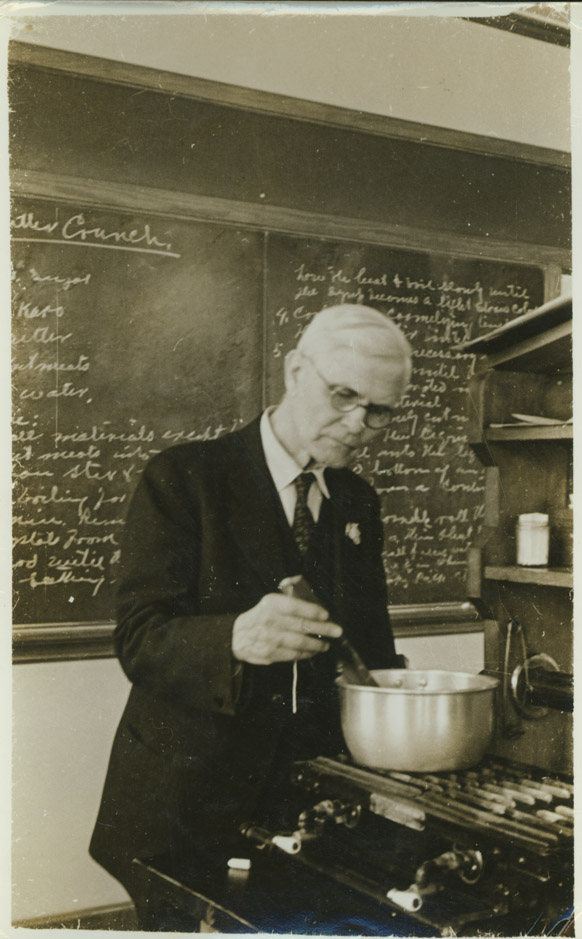
Depiction of Walter W. Chenoweth
Walter W. Chenoweth

Walter W. Chenoweth, the founder of the Horticultural Manufactures Department in 1918, the predecessor to the Food Science Department, was a key figure in the development of research and education in modern food science. Hired as a pomologist at Mass. Agricultural College in 1912, Chenoweth had no background in food science, but encouraged by Frank A. Waugh and supported by Frederick Sears, he developed a course of study from scratch, learning and standardizing many of techniques himself while teaching. His curriculum and the processes he and his students developed for preserving food contributed to easing the food shortages brought on by World War I. Under the aegis of the new department, Chenoweth initiated a program in community food preservation, instructing students and members of the public in canning and other techniques. In 1929-1930, he loaned his services to the Grenfell Mission in Newfoundland, setting up canneries and teaching the methods of food preservation to would-be colonizers in Newfoundland and Labrador. Faced with a dearth of solid literature in the field, he published a textbook, Food Preservation (1930), which was a standard text for many years. The University named the Food Science building in Chenoweth’s honor after it was built in 1965. Chenoweth retired in 1941 and died four years later at the age of 75 .

The Walter Chenoweth Papers includes many of Chenoweth’s published works on canning and food preservation including his 1930 text, Food Preservation, as well as a typescript text called How to Preserve Food, eventually published by Houghton Mifflin in 1945. Also in the collection are clippings and memorabilia from Chenoweth’s trips to Newfoundland while working at the Grenfell Mission and a set of glass lantern slides.

Subjects

University of Massachusetts Amherst--FacultyUniversity of Massachusetts Amherst. Department of Food Science

Contributors

Chenoweth, Walter W. (Walter Winfred), 1872-
Chrisman, Miriam Usher

Miriam Chrisman Papers

1937-2007
13 boxes 9 linear feet
Call no.: FS 128
Depiction of Miriam U. Chrisman, 1964
Miriam U. Chrisman, 1964

A long-time historian at UMass Amherst, Miriam Usher Chrisman graduated from Smith College in 1941 and spent the war years as an intern and research assistant in various agencies, including the National Resources Planning Board. With the return of peace, Chrisman took master’s degrees in economics (American University) and education (Smith), before earning her doctorate in history from Yale in 1962 for a study of Reformation-era Strasbourg. From Yale, she landed a faculty appointment at UMass Amherst, where she remained for her ennitre career. As a historian of the 16th century, she was awarded a Prix d’honneur by the Societe des Amis de Vieux Strasbourg, an honorary doctor of humane letters by Valparaiso University, and the Wilbur Cross Medal from Yale. Chrisman retired from active teaching in 1985 and remained an active friend of the Du Bois Library until her death in November 2008.

A faithful and colorful correspondent, the bulk of Miriam Chrisman’s papers consist of letters written to family and friends stretching from her college days at Smith through the year before her death. The bulk of the correspondence is with her husband, Donald Chrisman, an orthopedic surgeon who was enrolled at Harvard Medical School during their courtship. Soon after the Chrismans married in November 1943, Donald left for active duty in the Navy on the U.S.S. Baldwin. The couple’s war correspondence is unusually rich, offering insight on everything from the social responsibilities of married couples to their opinions on the progression of the war. Of particular note is a lengthy letter written by Donald during and immediately after D-Day in which he provides Miriam a real-time description of the events and his reactions as they unfold. Later letters document Miriam’s extensive travels including a trip around the world.

Subjects

Smith College--StudentsUniversity of Massachusetts Amherst--FacultyUniversity of Massachusetts Amherst. Department of HistoryWorld War, 1939-1945

Contributors

Chrisman, Miriam Usher

Types of material

Letters (Correspondence)
Clark, Orton Loring

Orton Loring Clark Papers

1910-1922
1 box 0.5 linear feet
Call no.: FS 047

Orton Loring Clark was an associate professor of botany and biology at the University of Massachusetts. After earning his B.A. in 1908 from the University, then the Massachusetts Agricultural College, Clark studied at the University of Strasbourg, where he earned his doctorate. He joined the faculty of his alma mater in 1913, specialized in plant physiology, and taught until his retirement in 1946. Known as a great teacher and fine artist, Clark was active in Amherst town politics. He passed away in 1965 at the age of 79.

Orton Loring Clark’s collection includes several notebooks of research notes, data, and hand-drawn field diagrams. The notebooks date from his student years in Germany to his first several years on the faculty at the Massachusetts Agricultural College. The collection also includes one letter from 1922.

Subjects

Massachusetts Agricultural College--FacultyMassachusetts Agricultural College. Botany Department

Contributors

Clark, Orton Loring
Cleary, Marie Sally

Marie Sally Cleary Papers

1980-2000
3 boxes 4 linear feet
Call no.: MS 606

Receiving her Ed.D in Foundations in Education from UMass Amherst in 1982, Marie Sally Cleary has been a member of the Associates Program for independent scholars based at the Five Colleges since 1983. In her book Myths for the Millions: Thomas Bulfinch, His America, and His Mythology published in 2007, Cleary provides an in-depth study of the man behind the landmark work, The Age of Fable, which has been responsible for introducing many Americans to classical mythology since its original publication in 1855.

The collection consists of drafts and subject files related to the research and writing of Cleary’s book.

Subjects

Bulfinch, Thomas, 1796-1867Mythology

Contributors

Cleary, Marie Sally
Cleary, Vincent J.

Vincent J. Cleary Papers

1962-2007
5 boxes 2.08 linear feet
Call no.: FS 123

Vincent J. Cleary is a retired Professor of Classics at the University of Massachusetts Amherst, where he taught until 1997. With a particular interest in Latin poetry, Cleary is both a journalist and writer. Most of his writings reflect his love for the Pioneer Valley; Cleary was most commonly published in the Hampshire Gazette, although he also submitted articles to larger magazines and newspapers.

The Cleary Papers are comprised of articles that Cleary wrote for magazines and newspapers such as Hampshire Life, and narratives relating to the town of Amherst for his book Amherst, Massachusetts 01002: One of the Best Small Towns in America. A bound copy of the book is included with the collection, as well as narratives and Cleary’s research materials. The collection contains complete newspapers and magazines and copies of Cleary’s articles (his earlier work is centered around Virgil’s The Aeneid). Also included among the papers are unpublished writings and an array of VHS and cassette tapes with copies of his lectures and class presentations.

Subjects

Amherst (Mass.)--Social life and customsUniversity of Massachusetts Amherst--Students

Contributors

Cleary, Vincent J
Coffin, Robert L.

Robert L. Coffin Ornithological Journal

1912-1922
1 vol. 0.1 linear feet
Call no.: MS 593 bd

Robert L. Coffin (1889-1976) began a long association with the Massachusetts Agricultural College when he arrived on campus in 1912 to begin work as an assistant photographer for the East Experiment Station. His skill as a technical photographer and his artistic eye, however, soon made him a valuable commodity on campus and within a few years of his arrival, Coffin had branched out to work for a wide range of departments across campus and, in the late 1920s, for the US Department of Agriculture in Pennsylvania and New Jersey as well. An avid birder and naturalist, Coffin was particularly known for his nature photography, using a battery of different cameras to capture everything from scenic vistas to photomicrographs. Although he established a commercial photographic studio in Amherst in 1931, Coffin continued to accept a wide range of assignments at UMass, earning recognition as the unofficial campus photographer. He remained active almost to the time of his death in 1976 at the age of 86.

Containing the meticulously detailed records of an avid birder, the Coffin journal contains records of sightings and first and last occurrences of birds observed in the years 1912 and 1917-1922. The records in the journal reflect Coffin’s many birding trips in western Massachusetts, mostly in the Connecticut River Valley, however the journal also contains records from the Swift River Valley, the Harvard Forest, the Boston area, and the Connecticut coast. In a few cases, Coffin recorded the numbers of birds observed.

Subjects

Bird watching--MassachusettsBirds--MassachusettsUniversity of Massachusetts Amherst

Contributors

Coffin, Robert L

Types of material

Field notes