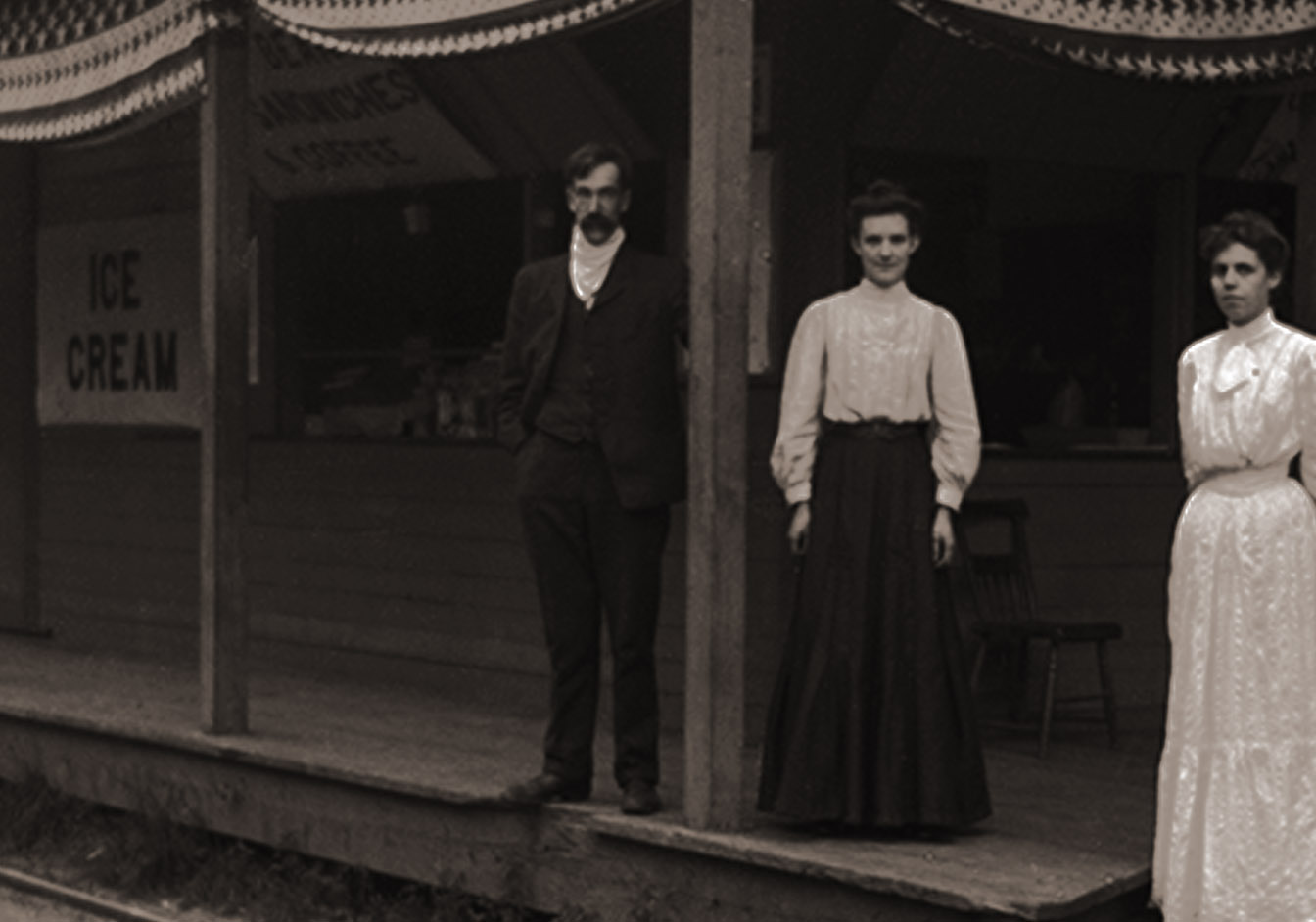
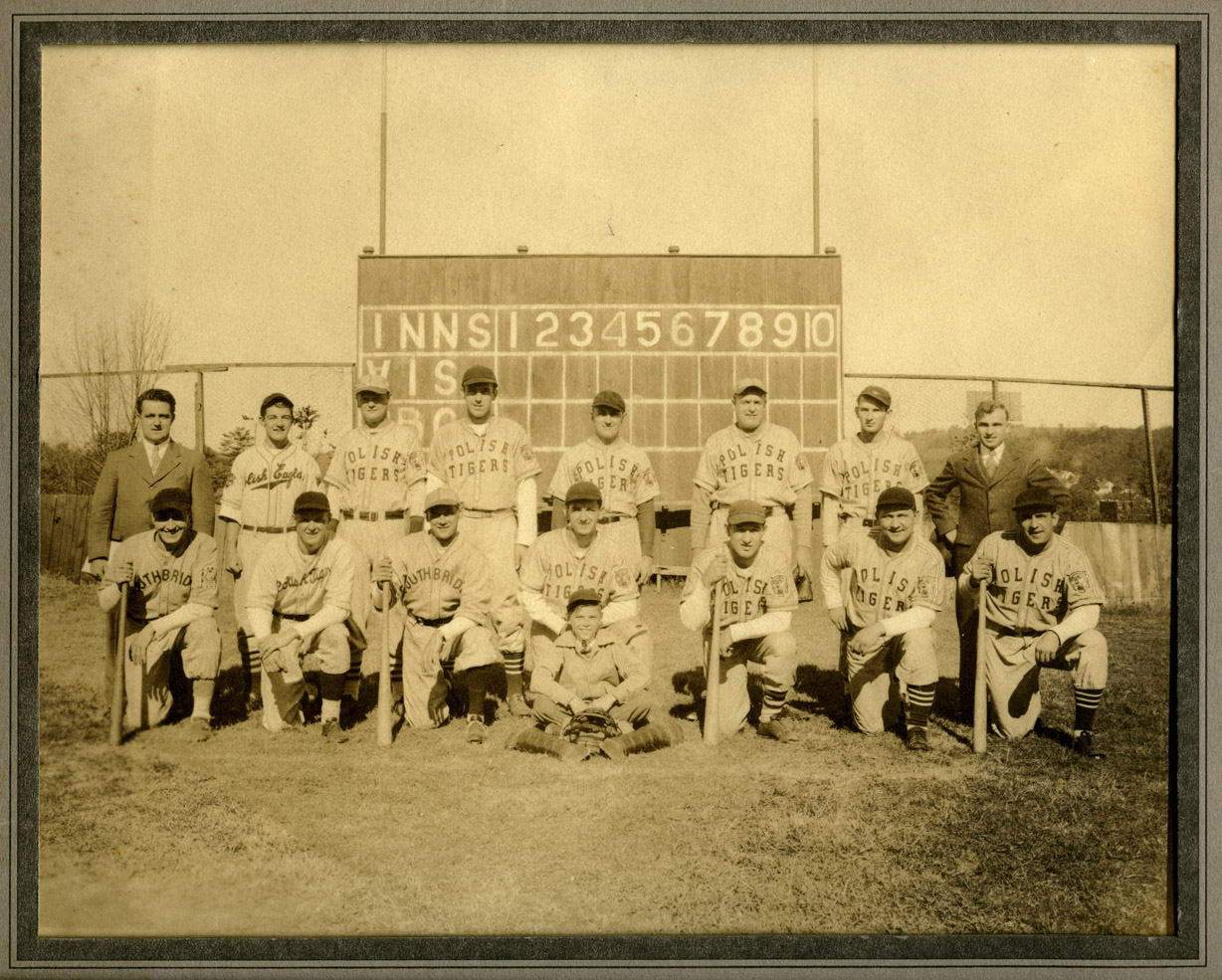
A member of the Polish community in Southbridge, Mass., John Libera (1919-2007) was a long-time employee of American Optical Company, but was best known as a promoter of polka music and dancing. A performer, song writer, and host of a radio show for over thirty years, Libera was inducted into the Polka Music Hall of Fame in 1982 and invited to perform at the American Folklife Festival in 1988.
The Libera collection consists of four photographs of the Polish community in Southbridge during the 1930s along with fourteen photos, a videotape, and some correspondence and ephemera relating to the American Folklife Festival.
Subjects
Baseball teams--Massachusetts--Southbridge--PhotographsPolish Americans--Massachusetts--Southbridge--PhotographsSouthbridge (Mass.)Women--Societies and clubs--Massachusetts--Southbridge--Photographs
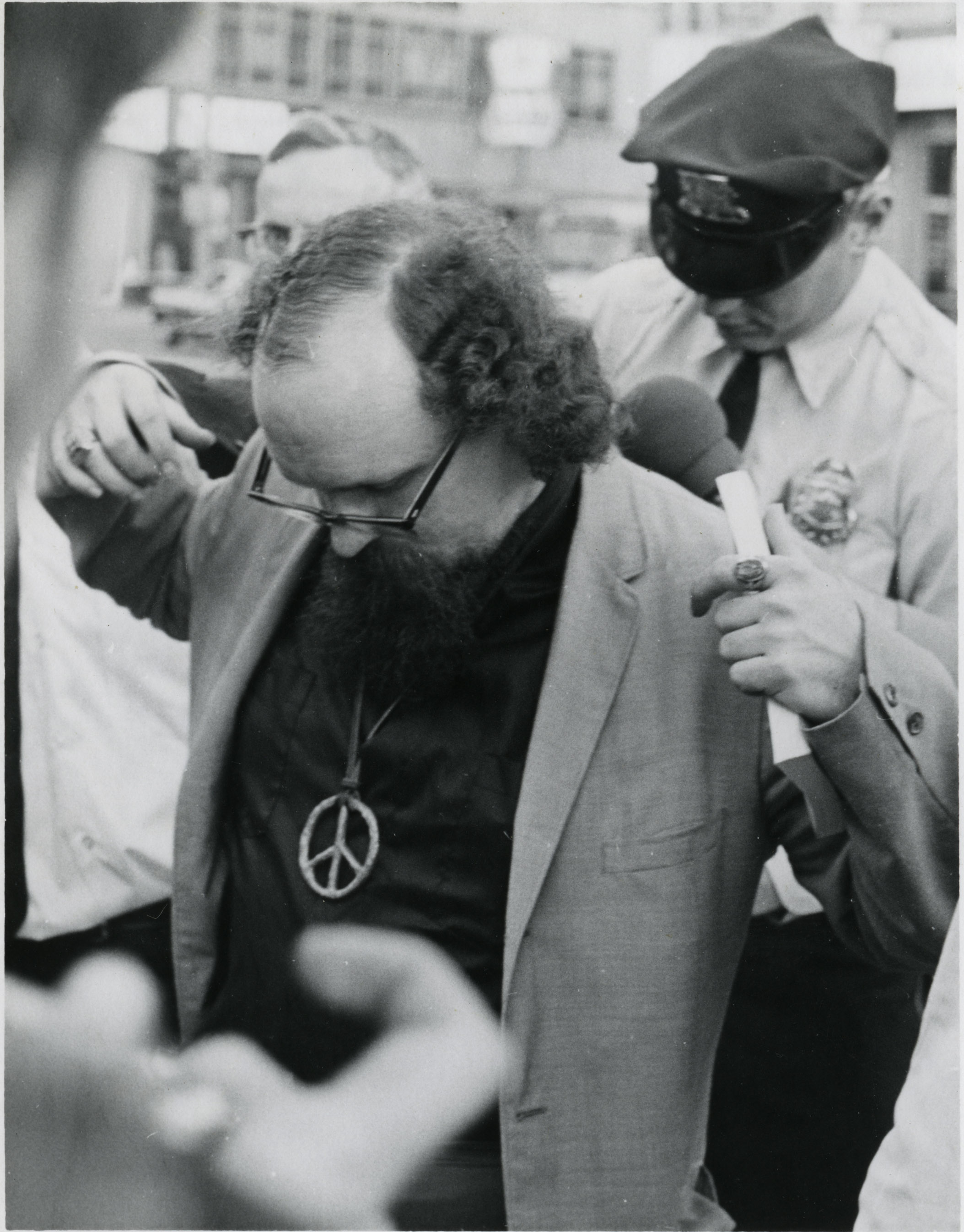
Arrest of Jon Higgenbotham (Milwaukee 14), Sept. 24, 1968
In 1967, Marshall Bloom and Raymond Mungo, former editors of the student newspapers of Amherst College and Boston University, were fired from the United States Student Press Association for their radical views. In response they collaborated with colleagues and friends to found the Liberation News Service, an alternative news agency aimed at providing inexpensive images and text reflecting a countercultural outlook. From its office in Washington, D.C., LNS issued twice-weekly packets containing news articles, opinion pieces, and photographs reflecting a radical perspective on the war in Vietnam, national liberation struggles abroad, American politics, and the cultural revolution. At its height, the Service had hundreds of subscribers, spanning the gamut of college newspapers and the underground and alternative press. Its readership was estimated to be in the millions.
Two months after moving to New York City in June 1968, the LNS split into two factions. The more traditional Marxist activists remained in New York, while Bloom and Mungo, espousing a broader cultural view, settled on farms in western Massachusetts and southern Vermont. The story of LNS, as well as of the split, is told in Mungo’s 1970 classic book Famous Long Ago. By 1969 Bloom’s LNS farm, though still holding the organization’s original press, had begun its long life as a farm commune in Montague, Mass. Montague (whose own story is told in Steve Diamond’s What the Trees Said) survived in its original form under a number of resident groups until its recent sale to another non-profit organization. Mungo’s Packer Corners Farm, near Brattleboro, the model for his well-known book, Total Loss Farm, survives today under the guidance of some of its own original founders.
The LNS Records include a relatively complete run of LNS packets 1-120 (1967-1968), along with business records, miscellaneous correspondence, some artwork, and printing artifacts, including the LNS addressograph.
Subjects
Activists--MassachusettsCommunal living--MassachusettsJournalists--MassachusettsLiberation News Service (New York, N.Y.)News agenciesPeace movements--MassachusettsStudent movementsUnderground press publicationsVietnam War, 1961-1975--Protest movements--Massachusetts
Born in February 1800, Abisha Lincoln kept a general store in Raynham, Mass., selling groceries, hardware, dry goods, shoes, and many other items to residents of the north end of town. Successful in business, Lincoln won election to local and state office and was followed into business by each of his three sons.
These daybooks from Abisha Lincoln record customer names, goods sold (such as groceries, hardware, dry goods, and shoes) and the form of payment: principally cash, with some local trade of agricultural commodities.
The Linguistic Atlas of New England project, begun in 1889 and published 1939-1943, documented two major dialect areas of New England, which are related to the history of the settling and dispersal of European settlers in New England with successive waves of immigration.
The collection contains handwritten transcription sheets (carbon copies) in the International Phonetic Alphabet, with some explanatory comments in longhand. Drawn from over 400 interviews conducted by linguists in communities throughout New England in the 1930s, these records document the geographic distribution of variant pronunciations and usages of spoken English. The material, taken from fieldworkers’ notebooks (1931-1933), is arranged by community, then by informant, and also includes audiotapes of follow-up interviews (1934); phonological analyses of informants’ speech; character sketches of informants by fieldworkers; fieldworkers’ blank notebook; and mimeograph word index to the atlas (1948).
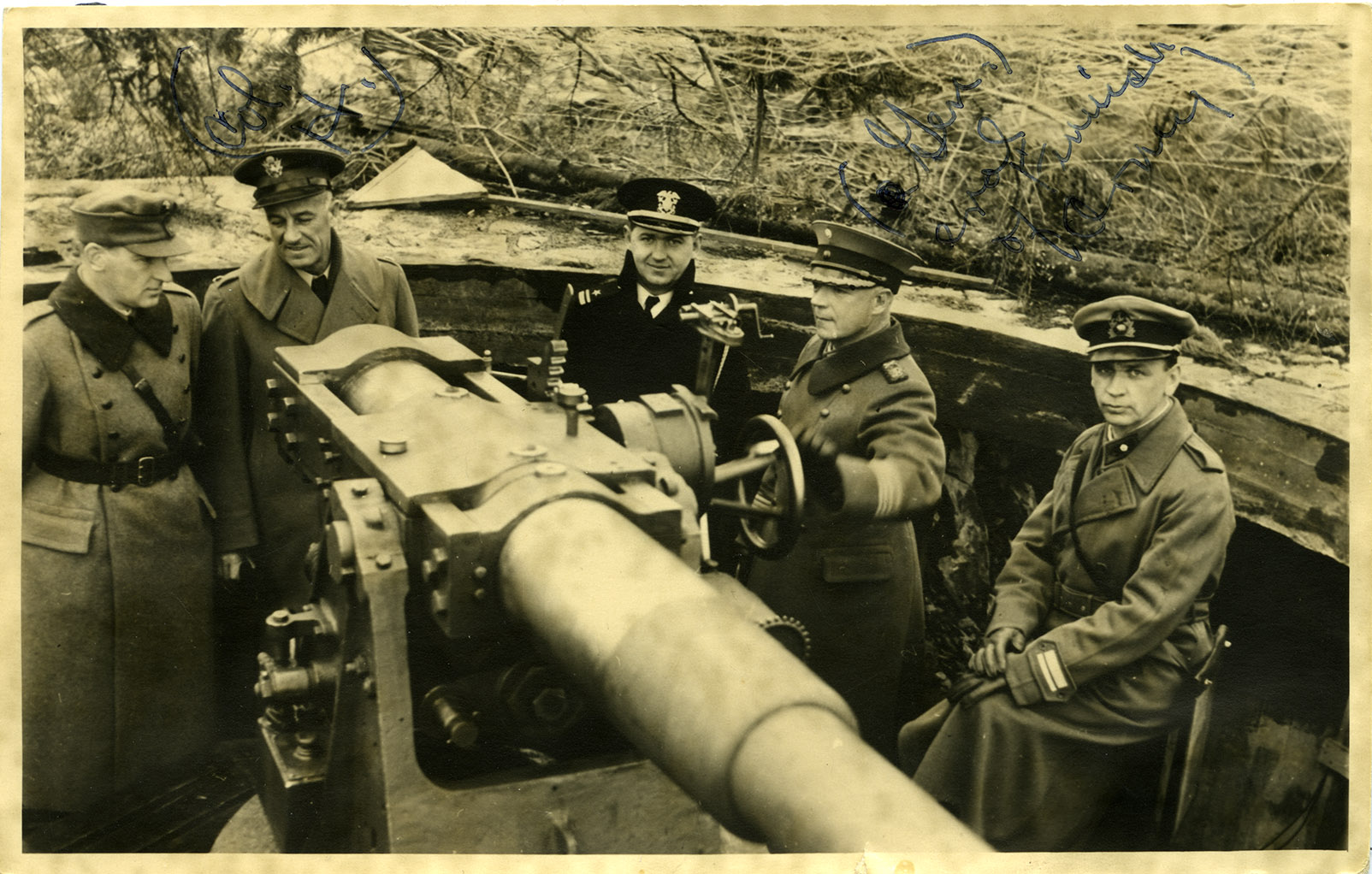
Antoni Lipski emigrated from Grodno, now Belarus, in 1907, and settled in the Oxbow neighborhood of Northampton, Mass. An employee of the Mount Tom Sulphite Pulp Company, he and his wife Marta had a family of twelve, ten of who survived to adulthood. Their oldest child Stanley Walter Lipski graduated from the US Naval Academy in 1935 and was killed in action aboard the USS Indianapolis in July 1945.
The slender record of two generations of a Polish immigrant family from Northampton, Mass., the Lipski collection includes two documents relating to Antoni Lipski and four photographs, two letters, and news clippings relating to his eldest son, Stanley Walter Lipski, a naval officer who was killed in action aboard the USS Indianapolis during the Second World War.
Gift of Anthony Lipski, Oct. 1991
Subjects
Polish Americans--MassachusettsUnited States. NavyWorld War, 1939-1945
Contributors
Lipski, Antoni, 1882-1953Lipski, Stanley Walter, 1911-1945
Born in Wales in 1833, Richard E. Lloyd found great financial success after migrating to Vermont in the 1850s. Beginning as the proprietor of a dry goods business in Fair Haven, Vermont, he diversified and expanded his holdings, eventually becoming a senior partner in the slate manufacturing firm Lloyd, Owens, and Co.
The daybooks from Richard Lloyd’s dry goods firm include numbered accounts of customers (many with Welsh surnames), lists of items purchased, price per measure, forms of payment (cash, goods, services, credit, making clothes), and the goods sold. Lloyd dealt in a typical range of goods found in a rural general store, including fabrics, ready-made clothes, eggs and dairy products, fruits and nuts, garden seeds, cutlery and tinware, and jewelry.
Businessman from West Cambridge, Massachusetts with additional dealings in Charlestown, Quincy, Waltham, and Tyngsboro.
The volume includes lists of personal and business purchases, services provided for his family, and business services such as whitewashing, carting coal, sawing wood, carrying letters, collecting debts, relaying a brick fireplace, and “work loading Sloop Rapid,” and barter and cash transactions. References made to Locke’s involvement with Universalism and members of the Tufts family of Cambridge and Middlesex County.
A prominent geologist and mining engineer, Benjamin Smith Lyman traveled to Japan in the 1870s at the request of the Meiji government, helping introduce modern surveying and mining techniques. Omnivorous in his intellectual pursuits, Lyman took an interest in the Japanese language and printing, collecting dozens of contemporary and antiquarian volumes during his travels.
Lyman’s book collection begins with his background in the natural sciences, but runs the gamut from language to literature, religion, the arts, and culture. With several hundred volumes, the collection includes a number of works dating to the eighteenth century and earlier, and while the majority were printed in Japan, a number, particularly of the older works, are in Chinese.
A native of Northampton, Massachusetts, Benjamin Smith Lyman was a prominent geologist and mining engineer. At the request of the Meiji government in Japan, Lyman helped introduce modern geological surveying and mining techniques during the 1870s and 1880s, and his papers from that period illuminate aspects of late nineteenth century Japan, New England, and Pennsylvania, as well as the fields of geology and mining exploration and engineering. From his earliest financial records kept as a student at Phillips Exeter Academy through the journal notations of his later days in Philadelphia, Lyman’s meticulous record-keeping provides much detail about his life and work. Correspondents include his classmate, Franklin B. Sanborn, a friend of the Concord Transcendentalists and an active social reformer, abolitionist, and editor.
The papers, 1848-1911, have been organized into nine series: correspondence, financial records, writings, survey notebooks, survey maps, photographs, student notes and notebooks, collections, and miscellaneous (total 25 linear feet). A separate Lyman collection includes over 2,000 books in Japanese and Chinese acquired by Lyman, and in Western languages pertaining to Asia.
Language(s): JapaneseEnglish
Subjects
Geological surveys--AlabamaGeological surveys--IllinoisGeological surveys--India--PunjabGeological surveys--JapanGeological surveys--Japan--MapsGeological surveys--MarylandGeological surveys--Nova ScotiaGeological surveys--PennsylvaniaGeological surveys--Pennsylvania--MapsGeologists--United StatesGeology--Equipment and supplies--CatalogsGeology--Japan--History--19th centuryJapan--Description and travel--19th centuryJapan--MapsJapan--PhotographsJapan--Social life and customs--1868-1912Mining engineering--Equipment and supplies--CatalogsMining engineering--Japan--History--19th centuryMining engineers--United States
Contributors
Lyman, Benjamin Smith, 1835-1920Sanborn, F. B. (Franklin Benjamin), 1831-1917
Includes letters addressed mostly to Mary Lyons or her brother Frederick D. Lyons about friends and family in Greenfield and Colrain, Massachusetts, New York, Pennsylvania, Illinois, Indiana, and Iowa. Topics discussed are sickness, death, accidents, an instance of probable wife abuse, recipes, Greenfield scandals, clothing, quilting, Methodist/Universalist bickering, and Aunt Mary’s investments.
Subjects
Abused wives--United States--History--19th centuryClothing and dress--United States--History--19th centuryColrain (Mass.)--BiographyColrain (Mass.)--Social life and customs--19th centuryCookery--United States--History--19th centuryGreenfield (Mass.)--BiographyGreenfield (Mass.)--Social life and customs--19th centuryLyons familyMethodist Church--Relations--Universalist ChurchMethodist Church--United States--History--19th centuryQuilting--United States--History--19th centuryScandals--Massachusetts--Greenfield--History--19th centuryUniversalist churches--Relations--Methodist ChurchUniversalist churches--United States--History--19th centuryWife abuse--United States--History--19th centuryWomen--Massachusetts--Colrain--Correspondence