A knitter in a Northampton silk factory during the years of the Great Depression, Carroll Bush was a Socialist and officer with the American Federation of Hosiery Workers.
The Bush papers offer a small but fascinating glimpse into political radicalism and union organizing among Northampton silk workers during the Great Depression. An active Socialist and union member in the Textile Workers Union of America, Bush corresponded with other textile workers and union organizers in Massachusetts and entertained an interest in union agitation more generally. The collection consists entirely of letters received by Bush.
Gift of Bruce Rubenstein via Eugene Povirk, Oct. 2018
Subjects
Communists--Massachusetts--NorthamptonHosiery workers--Labor unions--Massachusetts--NorthamptonNorthampton (Mass.)--History--20th centurySilk industry--Massachusetts--NorthamptonStrikes and lockouts--Massachusetts--EasthamptonTextile workers--Labor unions--Massachusetts--NorthamptonTremont Silk Company
Contributors
American Federation of Hosiery WorkersUnited Elastic CorporationUnited Textile Workers of America
The Friends Meeting at Dover, New Hampshire, is one of the oldest in British North America, with worship held there as early as 1662 when three Quaker women missionaries arrived on Dover Neck. Originally called Piscataqua, the meeting emerged as Dover Monthly Meeting by the latter decades of the seventeenth century and became the hub of a thriving Quaker community and the font from which several other New Hampshire meetings derived. In addition to overseeing a number of worship groups and preparatory meetings, Dover became the mother of monthlies and Berwick and Sandwich, which were set off in 1802, and Gonic in 1981.
The records of Dover Monthly Meeting offer extensive documentation of one of the oldest Quaker meetings in northern New England. Although most of the earliest records have not survived, the collection includes a nearly unbroken set of minutes from the turn of the eighteen century to 1981; extensive records of births, deaths, and marriages; spotty records for Ministry and Oversight and finance, and an array of recent newsletters. Minutes for the Women’s Meeting for the years 1783-1814 are not present and presumed lost.
Gift of New England Yearly Meeting
Subjects
Dover (N.H.)--HistoryQuakers--New HampshireSociety of Friends--New Hampshire
Types of material
Minutes (Administrative records)NewslettersVital records (Document genre)
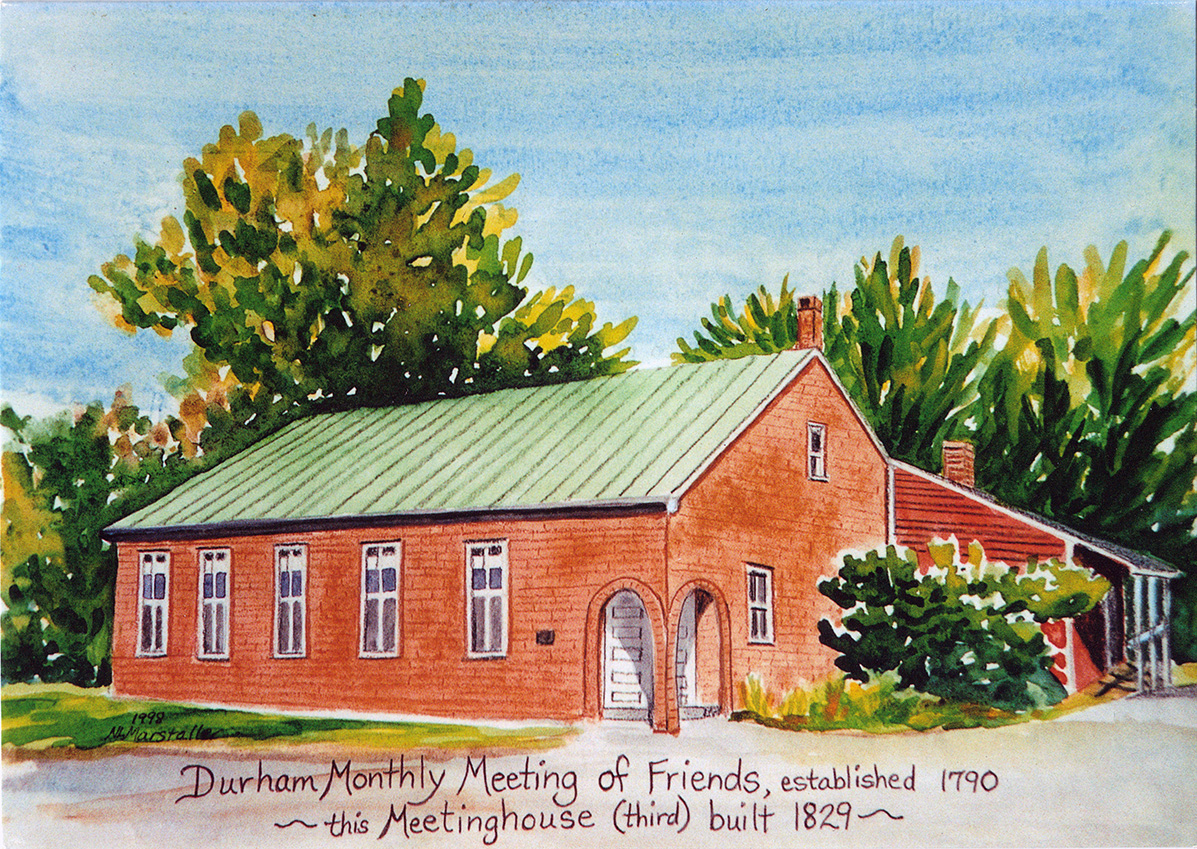
Durham Friends Meeting was set off as a monthly meeting under Salem Quarter in 1790, and was transferred to Falmouth Quarter in 1794. Leeds Monthly was set off from Durham in 1813, and Durham over saw a preparative meeting in the adjoining town of Lewiston until it, too, was set off in 1980.
The records of Durham Monthly Meeting consist of minutes of the meeting for business since 1987 and newsletters from 1967 to the present. Older records for the meeting are held at the Maine Historical Society
Gift of NEYM and Durham Friends Meeting
Subjects
Durham (Me.)--Religious life and customsNew England Yearly Meeting of FriendsQuakers--MaineSociety of Friends--Maine
George Naughton was born in 1951 into an academically inclined family. His father, Thomas, was a writer and magazine editor and his mother a music teacher; his grandfather Julius Seelye Bixler was a college professor and president of Colby College (1942-1960); and his great-great-grandfather Julius Seelye served as the fifth president of Amherst College (1876-1890). Naughton grew up in the 1960s in Old Saybrook, Conn. He graduated from Mount Hermon School in 1969 and from New College in Sarasota, Fla., with a BA in General Studies, in 1973. For the next few years, Naughton lived, worked, and meditated in Cambridge, Mass., and California, then in March of 1978 moved to Amherst and took a job at UMass. From 1978 until his retirement in 2011, he worked in University Information Systems in Whitmore Administration Building. Now president of the Amherst Historical Society, Naughton is also active in the Pelham Historical Society and lives in Pelham with his wife, Cindy.
Naughton’s lifelong interests have included mathematics, science fiction, cultural alternatives, and books, and he accumulated a wide collection of print material on a variety of topics. The Naughton Collection is a reflection of many of those interests and comprises underground comics as well as pamphlets, periodicals, and ephemera on spirituality, new age thinking, counterculture, politics, the environment and sustainability, and intentional communities.
Born in 1930 in Delaware, Ohio, Margaret Theodora “Teddy” Milne, graduated from Boston University in 1952 before attending the University of Paris in 1953-1954 for post-graduate studies. Milne moved to Northampton, Mass. in 1959 to teach at the Northampton School for Girls. She married Alexander W. Milne, general manager of radio station WHMP, in 1965 and together the couple had three sons: Timmon, Peter, and James. Milne worked as a writer, serving as a reporter and copy editor at the Daily Hampshire Gazette, before establishing and editing two journals focused on peace: Laser, a children’s newsletter, and Compassion Magazine. She owned and operated the Pittenbruach Press, which published her journals as well as several book she authored, including Peace Porridge (v. 1-3, 1987-1995), War is a Dinosaur (1987), Solo Publishing (1990), Mooncakes and Flower Beans (1994), and Calvin Coolidge Doesn’t Live Here Any More (1994), and contributed articles, stories, and crossword puzzles to magazines and newspapers.
As an active author and peace activist, the Teddy Milne Papers cover all of her primary passions from parenting and teaching to publishing and anti-nuclear activism. The collection contains photographs and newsletters from her days as a teacher at the Northampton School for Girls as well as articles and columns she prepared for the Daily Hampshire Gazette. There are extensive records documenting the Pittenbruach Press, which Milne operated, including materials related to the journals and books she published. A series of letters along with files related to committee work and Milne’s membership in Quakers United in Publishing (QUIP), reveal the important role her Quaker faith played in her life.
Subjects
Antinuclear movement—United StatesAuthors and publishersNorthampton School for Girls (Northampton, Mass.)Peace movementsPublishers and publishing—Vocational guidanceQuakers—New England
David Graham Du Bois was a visiting lecturer in the Journalism and African-American Studies Departments from 1983 until his retirement in 2001. Du Bois was the son of activist and artist Shirley Graham Du Bois, who married W.E.B Du Bois in 1961. Du Bois earned his B.A. at Hunter College in 1950 and a Masters in American Civilization from New York University in 1956. After studying at Beijing University, he traveled to Cairo, Egypt, fell in love with the city, and settled there in 1961, working as a foreign correspondent for the Pacific News Service, Variety, and as an assistant editor for several Egyptian news publications. An activist, like his step-father and mother, Du Bois became the spokesperson for the Black Panther Party, and agitated for racial liberation throughout his life. After his mother’s death in 1977, he became the custodian of W.E.B Du Bois’ legacy and founded the W.E.B. Du Bois Foundation to continue working toward his step-father’s goals. While at the University, Du Bois played an essential role in naming the University Library after his step-father. Du Bois died on January 28, 2005.
The David Graham Du Bois Papers document his later life and his managing of W.E.B. Du Bois’ estate. The papers include a selection of David Du Bois’ correspondence, speech manuscripts, clippings describing his step-father, as well as seleced personal financial records from his time in Amherst, Massachusetts. Additional Du Bois materials remain with the family.
Transferred by the Department of Journalism, 2007
Subjects
Du Bois, W. E. B. (William Edward Burghardt), 1868-1963University of Massachusetts Amherst--FacultyUniversity of Massachusetts Amherst. Department of Afro-American StudiesUniversity of Massachusetts Amherst. Department of JournalismW.E.B. Du Bois Foundation
Access restrictions: Temporarily stored offsite; contact SCUA in advance to request materials from this collection.
A professor of English at UMass Amherst, James A. Freeman is a scholar of seventeenth century British literature who has compiled an impressively eclectic array of publications and research projects. Educated at Amherst College (AB 1956) and the University of Minnesota (PhD 1968), Freeman joined the faculty in the English Department at UMass shortly after completing his doctorate. He has published on topics ranging from Latin and Greek poets to Shakespeare, Milton, Swift, Tennyson, James Agee, Donald Duck, 17th century regicides, and 1930s radio. He has also served as a regular contributor and editor for the Association for Gravestone Studies Quarterly.
The Freeman Collection contains research materials, drafts, and images from Freeman’s varied research projects in the field of gravestone and cemetery studies.
Gift of James A. Freeman and the Association of Gravestone Studies, June 2018
Subjects
Cemeteries--New EnglandSepulchral monuments--New England
Founded by Johanna Halbeisen in 1974, the New Song Library was a collaborative resource for sharing music with performers, teachers and community activists, who in turn shared with a wide variety of audiences. Based initially in Boston, the Library was devoted to the music of social change and particularly music that reflected the lives and aspirations of workers, women and men, elders and young people, gays and lesbians, other minorities, and Third World people.
This collection contains over forty years of organizational and operational records of the New Song Library along with hundreds of sound recordings, primarily audiocassettes made at concerts, music festivals, song swaps, and gatherings of the People’s Music Network. The Library also collected newsletters and magazines on folk music, and most importantly dozens of privately produced songbooks and song indexes.
In May 2017, a group of archivists and librarians convened at the Moving Image Archiving and Preservation Program at NYU’s Tisch School of the Arts for a two-day colloquium on the impact of environmental change on historical memory institutions. The speakers in the Libraries and Archives in the Anthropocene colloquium explored the profound implications of cataclysmic climate change on the missions and practices of cultural heritage institutions, the challenges confronting them, and the opportunities for future efforts and investigations.
This digital collection consists of video recordings of each of the sessions held at the Libraries and Archives in the Anthropocene colloquium. Following the keynote address by Roy Scranton, each day of the colloquium consisted of two or three panels of twenty-minute talks, a round of five-minute lightning talks, and a concluding plenary and discussion.
Since the early 1970s, George Ebert has been a significant national figure in the anti-psychiatry and psychiatric survivors’ movements. Radicalized by three periods of involuntary incarceration, Ebert founded the Mental Patients Liberation Alliance in 1978 as a self-help, mutual support, human rights, and advocacy organization, and he has spoken out consistently against all forms of coercive psychiatry, including electroconvulsive therapy and forced drugging. While serving as director of the Mental Patients Alliance of Central New York, Ebert has also been active in Activists for Alternatives and the Network Against Coercive Psychiatry.
A significant collection for study of the psychiatric survivors’ movement, Ebert’s papers contain a wealth of correspondence from activists throughout the United States and abroad, along with notable runs of newsletters and periodicals from many early ex-patient groups that are now defunct, photographs of demonstrations, and organizational materials relating to the Mental Patients Liberation Alliance.
Gift of George Ebert, Aug. 2018
Subjects
AntipsychiatryEx-mental patientsPeople with disabilities--Civil rightsPeople with disabilities--Legal status, laws, etc.Psychiatric survivors movement