International Brotherhood of Teamsters Locals 170 and 404 Records
1952-1966
3 boxes1.5 linear feet
Call no.: MS 030
The International Brotherhood of Teamsters, organized in 1903 when two leading team driver associations merged, is one of the largest unions in the U.S. Local 170, representing central Massachusetts, and Local 404, representing western Massachusetts, were both granted their charters with the Teamsters in 1933, and continue to thrive today. The records of these locals consist entirely of agreements between the union and local businesses.
Local chapters of the International Union of Electrical, Radio and Machine Workers representing workers in Connecticut. Records document a full range of union activities from elections and contract negotiations to arbitration and grievances. Also includes some union realia such as button, t-shirts, and bumper stickers.
Subjects
International Union of Electrical, Radio and Machine WorkersLabor unions--Connecticut
Union that represented workers at the American Bosch plant in Springfield, Massachusetts, affiliated with the International Union of Electrical, Radio and Machine Workers after 1949.
Records include by-laws, minutes of the Executive Board, General Council, and Membership meetings, correspondence, membership reports, grievance and arbitration records, contract negotiation proposals and counter-proposals, strike materials, and publications documenting the administration, activities, and membership of Local 206. Effects of changing national economy and international trade on workers and union affairs, through time, are evident.
Subjects
American Bosch--HistoryCollective bargaining--Machinery industry--Massachusetts --SpringfieldIndustrial relations--Massachusetts--SpringfieldInternational Union of Electrical, Radio and Machine Workers. Local 206 (Springfield, Mass.)Labor unions--Massachusetts--SpringfieldMachinists--Labor unions--Massachusetts--SpringfieldMetal-working machinery industry--Massachusetts --SpringfieldPlant shutdowns--Massachusetts--SpringfieldSpringfield (Mass.)--Economic conditionsSpringfield (Mass.)--IndustriesStrikes and lockouts--Machinery industry--Massachusetts --SpringfieldUnited Electrical, Radio and Machine Workers of America. Local 206 (Springfield, Mass.)
Local chapter of the International Union of Electrical, Radio and Machine Workers that represented workers at the Chapman Valve Manufacturing Company of Indian Orchard, Massachusetts. Records include detailed minute books of general and executive board meetings as well as several ledgers that reflect the activities of the credit union and the Chapman Valve Athletic Association.
Subjects
Chapman Valve Manufacturing CompanyElectricians--Labor unions--MassachusettsInternational Union of Electrical, Radio and Machine WorkersLabor unions--Massachusetts
Temporarily stored offsite; contact SCUA to request materials from this collection.
As a university student in Warsaw, Poland, in January 1977, Barbara Jakubowska-Schlatner made the decision to join the democratic resistance to the Communist regime. For more than twelve years, she was an active member of the Solidarity (Solidarnosc) movement, organizing opposition to state oppression, producing and distributing underground literature, and working with the pirate broadcasts of Solidarity radio.
Recognizing the importance of the underground press to the Solidarity movement, Jakubowska-Schlatner went to extraordinary lengths to collect and preserve their publications. At various times, the collection was kept in the basement of her mother’s house, spread around among a series of safe locations, and sometimes even secreted in small caches in back lots. The collection of over 1,500 titles is centered on the underground press in Warsaw, but includes titles published in Wroclaw, Gdansk, Krakow, and other cities. These include a startling array of publications, from fliers, handbills, and ephemera to translations of foreign literature, newspapers and periodicals, a science fiction magazine, and instructions on how to run a small press.
The author, publisher, and radical bookseller Michael Katanka (1922-1983) was a staunch Socialist and historian of British labor. Beginning with his 1868: Year of Unions in 1968, Katanka wrote or edited a series of books and articles on Fabianism, satirical caricature, and trade unionism.
The Katanka-Fraser Political Music Collection consists of audio recordings, sheet music, and songbooks of politically-inspired music in a variety of languages. The works range from the English and German Socialist press of the 1880s to the antiwar movement of the 1960s and 1970s, touching upon labor agitation, proletarian songs, student protest, the anti-imperialist and anti-capitalist struggles, the Spanish Civil War, and Communism and Socialism. The collection also includes a few books and sound recordings from the extreme right in Nazi Germany.
Gift of James and Sibylle Fraser, June 2007
Subjects
Communists--MusicInternational Workers of the World--MusicPolitical ballads and songsProtest songsRadicalism--Songs and musicSocialists--MusicWorking class--Music
Chance and geography conspired early in the history of New England to lay a foundation for both industrialization and the rise of organized labor.
This miscellaneous collection contains materials relating to work, business, and organized labor with an emphasis on New England. Among other materials, there are sets of by-laws, reports, and agreements pertaining to Masschusetts locals of IUE, IBEW, Cigarmakers International, Bricklayers, and Retail Clerks.
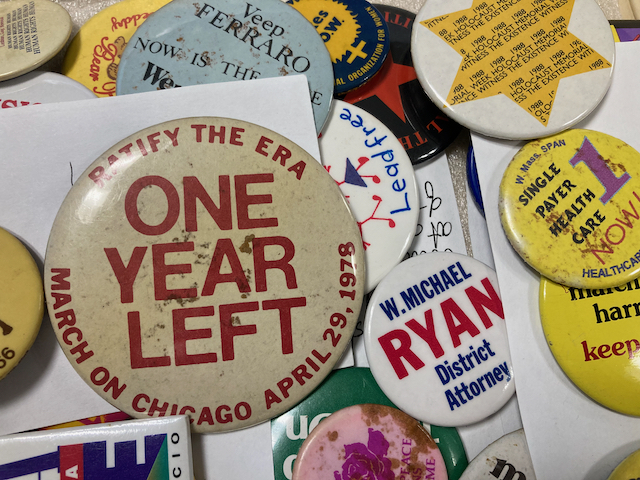
Collection of 38 political buttons donated by Karen Lederer, UMass Women, Gender, Sexuality Studies Department faculty member, covering several social change issues including: gay rights, political candidates, unions, anti-nuclear activism, women’s rights, campaigns at UMass, racism, anti-war movement, AIDS, single payer health care, the environment, domestic violence, the Equal Rights Amendment, and other assorted events in Western Mass.
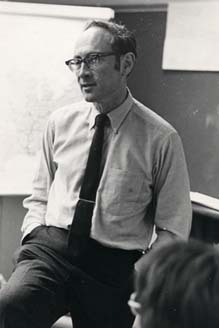
Born on April 15, 1919 in Baltimore, Maryland to David and Minnie Lipshires, Sidney was raised in Northampton, Massachusetts where his father owned two shoe stores, David Boot Shop and The Bootery. He attended the Massachusetts State College for one year before transferring to the University of Chicago and was awarded a BA in economics in 1940. His years at the University of Chicago were transformative, Lipshires became politically active there and joined the Communist Party in 1939. Following graduation in 1941, he married Shirley Dvorin, a student in early childhood education; together they had two sons, Ellis and Bernard. Lipshires returned to western Massachusetts with his young family in the early 1940s, working as a labor organizer. He served in the United States Army from 1943 to 1946 working as a clerk and interpreter with a medical battalion in France for over a year. Returning home, he ran for city alderman in Springfield on the Communist Party ticket in 1947. Lipshires married his second wife, Joann Breen Klein, in 1951 and on May 29, 1956, the same day his daughter Lisa was born, he was arrested under the Smith Act for his Communist Party activities. Before his case was brought to trial, the Smith Act was ruled unconstitutional by the U.S. Supreme Court. Disillusioned with the Communist Party, he severed his ties with it in 1957, but continued to remain active in organized labor for the rest of his life. Earning his masters in 1965 and Ph.D. in 1971, Lipshires taught history at Manchester Community College in Connecticut for thirty years. During that time he worked with other campus leaders to establish a statewide union for teachers and other community college professionals, an experience he wrote about in his book, Giving Them Hell: How a College Professor Organized and Led a Successful Statewide Union. Sidney Lipshires died on January 6, 2011 at the age of 91.
Ranging from an autobiographical account that outlines his development as an activist (prepared in anticipation of a trial for conspiracy charges under the Smith Act) to drafts and notes relating to his book Giving Them Hell, the Sidney Lipshires Papers offers an overview of his role in the Communist Party and as a labor organizer. The collection also contains his testimony in a 1955 public hearing before the Special Commission to Study and Investigate Communism and Subversive Activities, photographs, and biographical materials.