The University of Massachusetts Amherst
Robert S. Cox Special Collections & University Archives Research Center
CredoResearch digital collections in Credo

Archive

Tyler, Philemon L., b. 1812

Phileman L. Tyler Daybooks

1841-1852
2 vols. 0.25 linear feet
Call no.: MS 236 bd

The shoemaker, Philemon L. Tyler, was born in Massachusetts in 1812. He and his wife Tersilla, also a native of Massachusetts, settled in New York some time before the birth of their first child in 1838. By 1850, after at least a decade in the village of Springville in the agricultural town of Concord, New York, Tyler had three children, and real estate valued at $4,400.

Daybooks include a record of the prices of boots and shoes, and the method and form of payment (rarely cash, sometimes labor, but often apples, potatoes, chicken, wheat, mutton, pork, beef, hay, and other farm products such as cow hides and calf skins).
Subjects

Barter--New York--Erie County--History--19th centuryBoots--Prices--New York--Erie County--History--19th centuryDebtor and creditor--New York--Erie County--History--19th centuryErie County (N.Y.)--Economic conditions--19th centuryErie County (N.Y.)--Rural conditions--19th centuryHides and skins--New York--Erie County--History--19th centuryShoemakers--New York--Erie County--Economic conditions--19th centuryShoes--Prices--New York--Erie County--History--19th centurySpringville (Erie County, N.Y.)--Economic conditions--19th centurySpringville (Erie County, N.Y.)--Rural conditions--19th century

Contributors

Tyler, Phileman L., 1812-

Types of material

Daybooks
Tymoczko, Maria

Maria Tymoczko Papers

1973-2002
3 boxes 2.5 linear feet
Call no.: FS 141

As an undergraduate at Harvard, Maria Tymoczko was lured away from the study of biochemistry into medieval literature, remaining at Harvard through her doctorate and eventually making the subject into an academic career. Since joining the faculty at UMass Amherst in 1974, she has written or edited six books and has built an international reputation in three fields: Celtic medieval literature, Irish studies, and translation studies. A popular instructor, she has also played a leading role on several university committees.

The Tymoczko Papers document both the career and university service of a scholar of Irish literature and theorist of translation. In addition to her professional correspondence (1973-1980), the collection includes a significant quantity of material documenting Tymoczko’s university service, including notes from her time as chair of the General Education Council (1986-1994), from the Joint Task Force of UMass and Community College Relations, and the Rules Committee and Ad-hoc Committee on Retention of Administrators of the Faculty Senate. Additions to the collection are expected in the future.

Subjects

Irish literatureTranslating and interpretingUniversity of Massachusetts Amherst--FacultyUniversity of Massachusetts Amherst. Department of Languages, Literatures, and CulturesUniversity of Massachusetts Amherst. Program in Comparative Literature

Contributors

Tymoczko, Maria
U.S. Interstate Commerce Commission. Bureau of Valuation

U.S. Interstate Commerce Commission, Bureau of Valuation, Engineering Report upon the Boston and Maine Railroad Company

1931
1 box 0.25 linear feet
Call no.: MS 641

Chartered in 1835, the Boston and Maine Railroad was one of the largest and most successful railroad operations in northern New England for over a century, hauling both freight and passengers. The Railway began a slow decline as early as the 1930s with the decline in manufacturing in the region and later with the decline of passenger service. It came through a bankruptcy in 1970 and continues as a non-operating ward of Pan Am Railways.

This collection consists of blueprint valuations of the assets of the Boston and Maine Railroad, compiled by the Bureau of Valuation of the U.S. Interstate Commerce Commission in 1931.

Subjects

Boston and Maine RailroadRailroads--New England
U.S. Presidential Campaigns

U.S. Presidential Campaign Audio and Video Tapes

1972-1988
8 boxes 12 linear feet
Call no.: MS 120

The collection consists of audio and visual tapes of radio and television coverage of U.S. presidential elections in 1972, 1980, and 1988. In total there are more than 250 tapes containing interviews with the candidates, election commercials, speeches, party conventions, and news media commentary.

Subjects

Presidents--United States--Election

Types of material

Videotapes
UMass Amherst. Dean of Students

UMass Amherst. Dean of Students, 1948-1987. 27 boxes (13.25 linear feet).

The Office of the Dean of Students at UMass Amherst was established by President John Lederle in 1961 to replace the separately structured offices of the Dean of Men and Dean of Women, and to provide more effective, more flexible support for a growing and changing student body. In the 1960s, the Dean of Students had responsibility for almost all operational units related to student life, including Admissions, Records, Residence Halls, Dining Halls, Student Union, Student Activities, Placement, and Financial Aid. As the University became a statewide administrative unit with the opening of UMass Boston and the Medical School, there was an increasing conflict between the Office of the Dean of Students on the Amherst campus and the growing demands for a responsive administrative hierarchy. In 1970, the Office of the Vice Chancellor for Student Affairs was therefore created to provide an appropriate level of supervision for the various Student Affairs divisions with regard to budget, personnel and administration. The Office of the Dean of Students then became a student contact-based office, which cooperated and collaborated with the other divisions. The first Dean of Students, William Field came to UMass in 1951 as a guidance counselor and assistant professor of psychology. His tenure coincided with the massive expansion of campus and the turbulent years of the late 1960s and early 1970s, during which he played an important mediating role. The recipient of the Chancellor’s Medal in 1983, Field retired from office in 1988.

An important series of records documenting student life on the UMass Amherst campus, with an emphasis on the 1960s and 1970s. Among these are an extensive series of bylaws and charters for residence halls and registerred student organizations (RSOs) at UMass, as well as subject files on campus protests and demonstrations, students of color, and student groups of various sorts.

Subjects

  • African American students–Massachusetts.
  • Field, William.
  • Student movements–Massachusetts.
  • University of Massachusetts Amherst. Dean of Students.
  • University of Massachusetts Amherst–Students.
Call no.: RG 30/2
UMass Peacemakers

UMass Peacemakers Records

1965-1990 Bulk: 1983-1990
10 boxes 20 linear feet
Call no.: MS 309
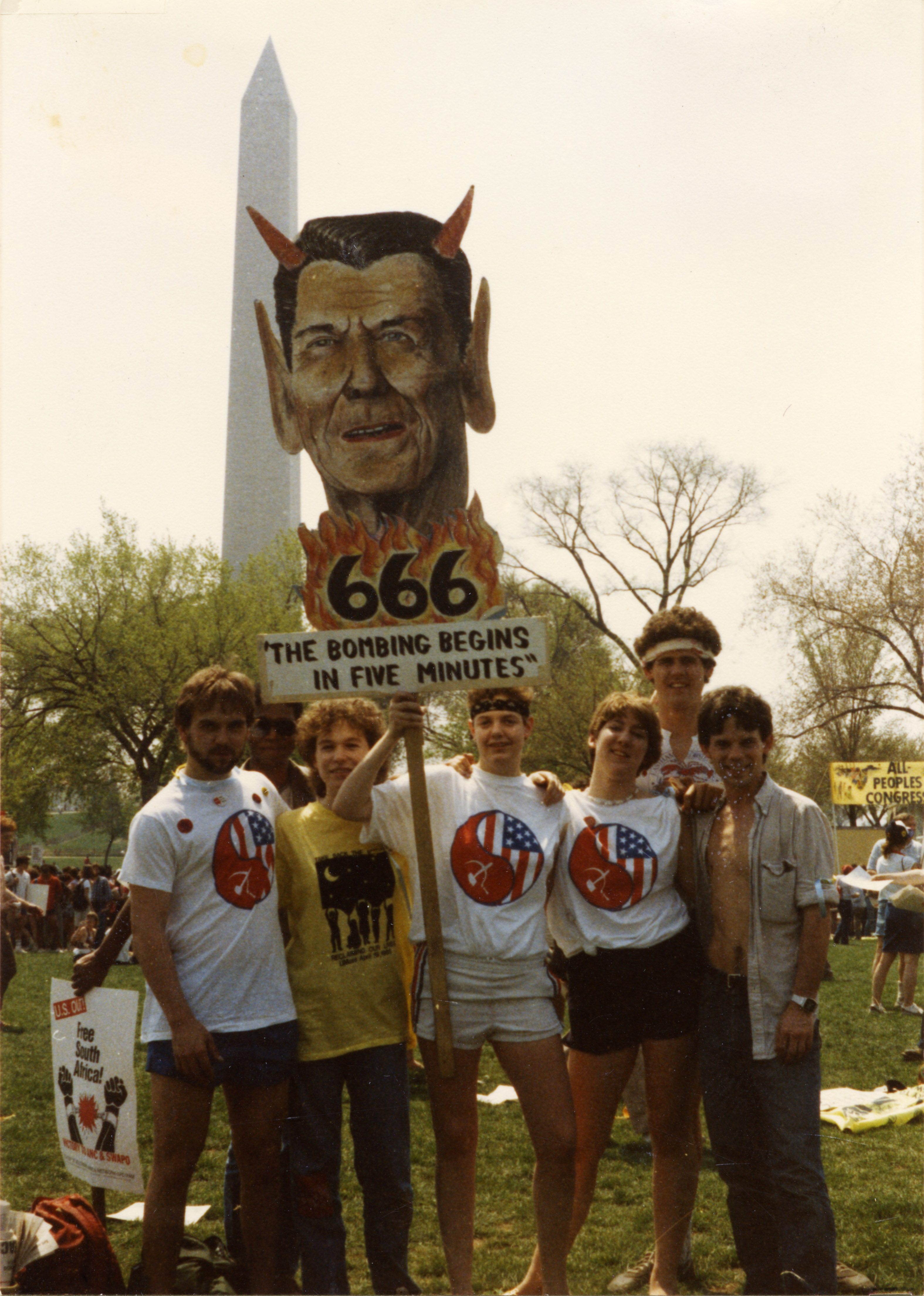
Depiction of Peacemakers contingent at the Four Days in April protests, 1984
Peacemakers contingent at the Four Days in April protests, 1984

Although the precise origins of UMass Peacemakers are murky, by 1982, the group was an active presence on the UMass Amherst campus organizing opposition to militarism and the nuclear arms race and providing support for the nuclear freeze movement. Organizing vigils, demonstrations, informational workshops, and providing civil disobedience training, the Peacemakers were the most visible pacifist group on the UMass Amherst campus in the 1980s.

The UMass Peacemakers Records focus on the activities of the student group between 1983 and 1990, documenting their role in confronting the aggressive international expansionism of the Reagan administration and its “Star Wars” program, while also engaging at the local and national level by organizing rallies, lectures, poetry readings, and film screenings. At UMass, Peacemakers was part of the larger Progressive Student Network, and worked alongside other student organizations including the Radical Student Union.

Gift of Peacemakers through Peter Sakura, May 1991

Subjects

Antinuclear movements--Massachusetts--AmherstCentral America--Foreign relations--United StatesDisarmament--MassachusettsPeace movements--Massachusetts--AmherstStudent movements--Massachusetts--AmherstUnited States--Foreign relations--Central AmericaUniversity of Massachusetts Amherst--StudentsVietnam War, 1961-1975--Protest movements--Massachusetts

Contributors

American Friends Service CommitteeUMass Peacemakers

Types of material

BrochuresPhotographs
Undertaker (Wilton, N.H.)

Undertaker's Daybook

1855-1884
1 vol. 0.1 linear feet
Call no.: MS 904 bd

A small town situated on the Southegan River in the southern tier of New Hampshire, Wilton had a population of over 1,300 in 1860. Fed by an influx of Irish and Canadian immigrants, the economy at the time was based on a mix of agriculture and small-scale manufacturing, including woolen and yarn mills and factories for furniture and shoes and boots.

Although the identity of the undertaker who kept this volume is nowhere recorded, research into the names of his clients strongly suggests that he operated in or near Wilton (Hillsborough County), New Hampshire. The entries are invariably brief but informative, noting the name of the deceased, date of death and age, notes on the services provided (coffin plate, handles, “sexton service,” “grave”), and the cost of those services. On rare occasions, there are notes on the cause of death, including a cluster of deaths by consumption in the winter of 1858-1859.

Acquired from M&S Rare Books, Mar. 2016

Subjects

Undertakers and undertaking--New Hampshire--WiltonWilton (N.H.)--History

Types of material

Daybooks
Undertaker (Wrentham, Mass.)

Undertaker and Home Furnishings Dealer Account Book

1881
1 vol. 0.25 linear feet
Call no.: MS 171 bd

Owner of business (identity unknown) who served in the vicinity of Wrentham, Massachusetts, as a purveyor of home decorating supplies and furnishings and as an undertaker. The account book includes records of goods for sale and services provided (repairing and upholstering furniture, packing bodies in ice, carrying to tomb, grave digging, etc.); forms of payment (cash, exchange of goods such as soap, eggs, tables, and chairs, and exchange of services); and lists of customers, including City Mills Felting Company, A.H. Morse, J.A. Guild, Joseph Hutchinson, Charles Scott, and Foster Smith.

Acquired from Charles Apfelbaum, 1987

Subjects

Undertakers and undertaking--Massachusetts--WrenthamWrentham (Mass.)--History

Types of material

Account books
United Auto Workers. District 65 Boston University Local

UAW District 65 Collection

ca.1985
1 folder 0.2 linear feet
Call no.: MS 320

The decision of clerical and technical workers at Boston University to organize with District 65 of the UAW was as rooted in the labor movement as it was in the womens movement. By the early 1970s, office workers at B.U. were dissatsified with working conditions that included — among other grievances — sexual harassment and a classification system that did not value “women’s work.” In 1979 after an intense struggle with the administration, B.U. finally recognized the union and signed their first contract.

The collection includes a printed history and videotape documenting unionization activities at Boston University’s Medical Campus.

Gift of Leslie Lomasson

Subjects

Boston University. Medical CampusCollective bargaining--Professions--Massachusetts--BostonCollective labor agreements--Medical personnel --Massachusetts--Boston--HistoryLabor unions--Massachusetts

Contributors

United Automobile, Aircraft, and Vehicle Workers of America. District 65

Types of material

Videotapes
United Brotherhood of Carpenters and Joiners of America

United Brotherhood of Carpenters and Joiners of America Records

1885-1978
57 boxes 30 linear feet
Call no.: MS 110

The first local of the United Brotherhood of Carpenters and Joiners to be founded in western Massachusetts was chartered in 1885 as Springfield Local 96, followed in quick order by locals in Holyoke (390) and Chicopee (685). With the pace of unionization picking up at the turn of the century, the Springfield District Council was established in 1906 to coordinate collective bargaining efforts and apprenticeships, and to enforce work rules in the local construction industry. Holyoke carpenters formed their own District Council soon thereafter. Tthe logic of consolidation and a unified voice eventually led the Springfield locals to consolidate as Local 32 in 1968, which in turn merged with the Holyoke District Council in 1973 to form Local 108.

The records of the Western Massachusetts locals and district councils of the UBCJA documents the rise of unionization among carpenters in the Connecticut River Valley since the 1880s. This collection represents a merger of separate accessions for the District Councils in Springfield (MS 110), the Pioneer Valley (MS 231), and Holyoke (MS 108), along with post-merger records for Local 108. In general, each has been maintained as a distinct series

Subjects

Carpenters--Labor unionsLabor unions--Massachusetts

Contributors

United Brotherhood of Carpenters and Joiners of America