Originating in 1991, the Society for the History of Authorship, Reading and Publishing (SHARP) was established “to create a global network for book historians working in a broad range of scholarly disciplines.” With more than 1,000 members, research interests include the composition and reception of books as well as their survival and transformation over time.
Records cover the earliest days of the organization’s development, including founding documents, and document a variety of their activities from hosting conferences and publishing a newsletter to promoting scholarship.
Subjects
Authors and readersAuthorshipBooks--HistoryPublishers and publishing
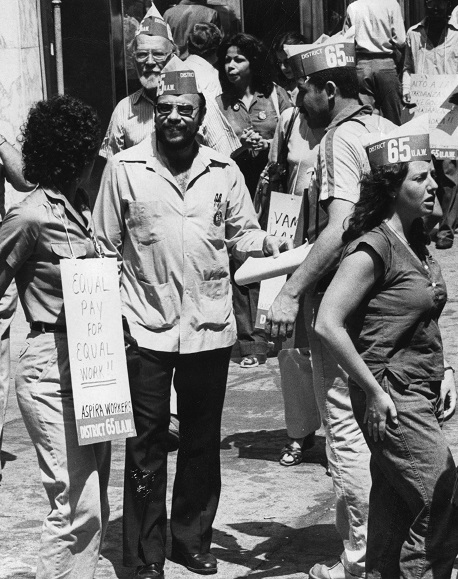
A scholar of labor studies and activist, José Soler was born in New York City to a Dominican mother and Puerto Rican father and has been an activist in the cause of Puerto Rican independence and human rights since the 1970s. While a student at the University of New Mexico (BA 1972), Soler emerged as a leader in the Chicano rights organization, the Brown Berets, and while living in Puerto Rico in the late 1970s, he joined the Puerto Rican Socialist Party. Soler has subsequently worked in the labor movement as a shop steward, union organizer with UAW District 65, and labor journalist. As a committed Marxist and prolific writer and editor, he has taken part in causes ranging from anti-imperialist work in the Caribbean and Central America to the anti-apartheid struggle, and he has served on the Executive Board of the US Peace Council. From 1993 until his retirement in 2015, Soler worked as Director of the Arnold M. Dubin Labor Education Center at UMass Dartmouth where he has continued to work on behalf of public education and human rights and national self-determination.
The Soler Papers chronicle over forty years of a life-long activist’s interests and participation in left-wing political, labor, and social justice movements. There is a particular focus on topics relating to socialism and the pro-independence movement in Puerto Rico, anti-imperialist movements in South and Central America and Africa, and issues affecting Puerto Rican and Hispanic workers in the United States, New England, and the New York City area. Published and promotional materials such as periodicals, magazines, newsletters, and pamphlets make up the bulk of the collection, with extensive coverage of the concerns of the Puerto Rican Socialist Party (Partido Socialista Puertorriqueño, PSP), the Communist Party of the United States of America (CPUSA), as well as New Jersey chapters of the unions Communications Workers of America (CWA) and District 65, which eventually joined the International Union, United Automobile, Aerospace, and Agricultural Implement Workers of America (UAW). An additional seven boxes were added to the collection in June 2016, which remain unprocessed. The new materials offer additional documentation from the Dubin Labor Education Center and Soler’s work and interests in education (testing, privatization, and unions), labor, Marxist-Leninism, and various events in the United States and Latin America.
Gift of Jose Soler, 2015, 2016
Subjects
Communications Workers of AmericaLabor unions--New York (State)--New YorkPartido Socialista PuertorriqueñoUnited Automobile, Aircraft, and Vehicle Workers of America. District 65
Originating as an independent worship group in Monterey, Mass., in about 1952, the South Berkshire Friends Meeting came under the auspices of the Middle Connecticut Valley Monthly Meeting in 1955 as the Great Barrington Worship Group. It changed name to Gould Farm in 1962, and then to Berkshire in 1971 before setting off formally from the Mount Toby Monthly Meeting in 1984.
This small collection contains minutes and newsletters of the meeting since it was organized as a monthly in 1984.
Gift of New England Yearly Meeting of Friends, April 2017
Subjects
Quakers--MassachusettsSociety of Friends--Massachusetts
The South Kingstown Monthly Meeting of the Society of Friends was the home meeting of John Wilbur and as such, the epicenter of the Wilburite separation of 1845. A part of Rhode Island Quarter, the meeting became a locus for the Wilburite separation of 1845 when the membership at South Kingstown rebuffed efforts to discipline Wilbur. After being suspended from 1842 to 1847, the Gurneyite South Kingstown Monthly Meeting was laid down in 1899.
The records of South Kingstown Monthly Meeting contain an extensive set of minutes, though sparse in the post-separation years, along with vital records, records of meeting disciplinary cases, certificates of manumission for people enslaved by members of the meeting, and miscellaneous other content.
Gift of New England Yearly Meeting of Friends, April 2016
Subjects
Quakers--Rhode IslandSociety of Friends--Rhode IslandSouth Kingstown (R.I.)--Religious life and customs
Contributors
New England Yearly Meeting of FriendsWilbur, John, 1774-1856
As the home of John Wilbur, South Kingstown Monthly Meeting was at the epicenter of the Separation of 1845 within the New England Yearly Meeting of Friends. The South Kingstown Monthly Meeting (Wilburite) was formed in 1845 from members of South Kingstown and Greenwich Monthly Meetings and placed under the care of Rhode Island Quarterly Meeting. It was one of only three Wilburite monthly meetings to survive through the unification of 1945, when it became Westerly Monthly Meeting.
The relative success of South Kingstown Monthly Meeting (Wilburite) did not parlay into a large body of records. The collection contains one volume each of official minutes from the men’s and women’s meetings, two slender volumes from the Select Preparative Meeting, a letterbook, and a slender volume of vital records.
Gift of New England Yearly Meeting of Friends, April 2016
Subjects
Quakers--Rhode IslandSociety of Friends--Rhode IslandWesterly (R.I.)--Social life and customsWilburites
Contributors
New England Yearly Meeting of Friends
Types of material
Minutes (Administrative records)Vital records (Document genre)
The Friends Monthly Meeting at South Starksboro, Vermont, began as Creek Allowed Meeting, and has had a complex organizational history. It became part of New England Yearly Meeting in 1975, and gained status as a monthly meeting for the second time in 1996, operating under Northwest Quarter.
The records of South Starksboro Monthly Meeting date from the period starting shortly before it returned to monthly status in 1982. They consist of minutes of meetings (sparse for later years) and state of the meeting reports, along with a somewhat incomplete run of newsletter.
Gift of New England Yearly Meeting of Friends, April 2016
Subjects
Quakers--VermontSociety of Friends--VermontSouth Starksboro (Vt.)--Religious life and customs
The Southeast Asia Collection highlights the regional wars from the 1970s to the 1980s, including a series on Southeast Asian refugees in America, along with materials on regional economic development, especially in the Mekong River Basin. The collection contains hundreds of reports on agricultural and industrial projects in the region, examining everything from the impact of electrification on village life in Thailand to a description of a Soviet-built hospital in Cambodia in 1961, to an assessment of herbicide in Vietnam in 1971.
Collected primarily by Joel Halpern and James Hafner, the collection includes background, field, and situation reports by U.S. Operations Missions and U.S. Agency for International Development; reports, publications, statistics, and background information from other U.S. government agencies, governments of Laos and Thailand, and the United Nations; correspondence, reports, and reference materials of nongovernmental organizations; reports and essays by individuals about Southeast Asia; news releases and newspapers; published and unpublished bibliographies; and interviews with U.S. military personnel. Most material comes from governmental and organizational sources, but there are papers by, and debriefs of, numerous individuals.
Subjects
Cambodia--History--1953-1975Laos--HistoryVietnam War, 1961-1975
The Southern Maine Monthly Meeting (Falmouth Quarter) is a small, unprogrammed Quaker meeting that gathers in Friends’ homes twice monthly in York County. Established as an independent worship group in 1980 under Falmouth Quarterly, the meeting achieved monthly status as Waterboro Monthly Meeting two years later. With changes in membership in 2005, and the departure of some longtime supporters, they changed name to Southern Maine Monthly Meeting to reflect the “broader range of the various members and attenders.”
The records of Southern Maine Monthly are comprised of a relatively complete set of minutes and state of the society reports.
Gift of New England Yearly Meeting, April 2016
Subjects
Maine--Religious life and customsQuakers--MaineSociety of Friends--Maine
Spain. Real Chancillería de Granada, Carta executoria de hidalguia
1590
1 vol.0.2 linear feet
Call no.: 1108
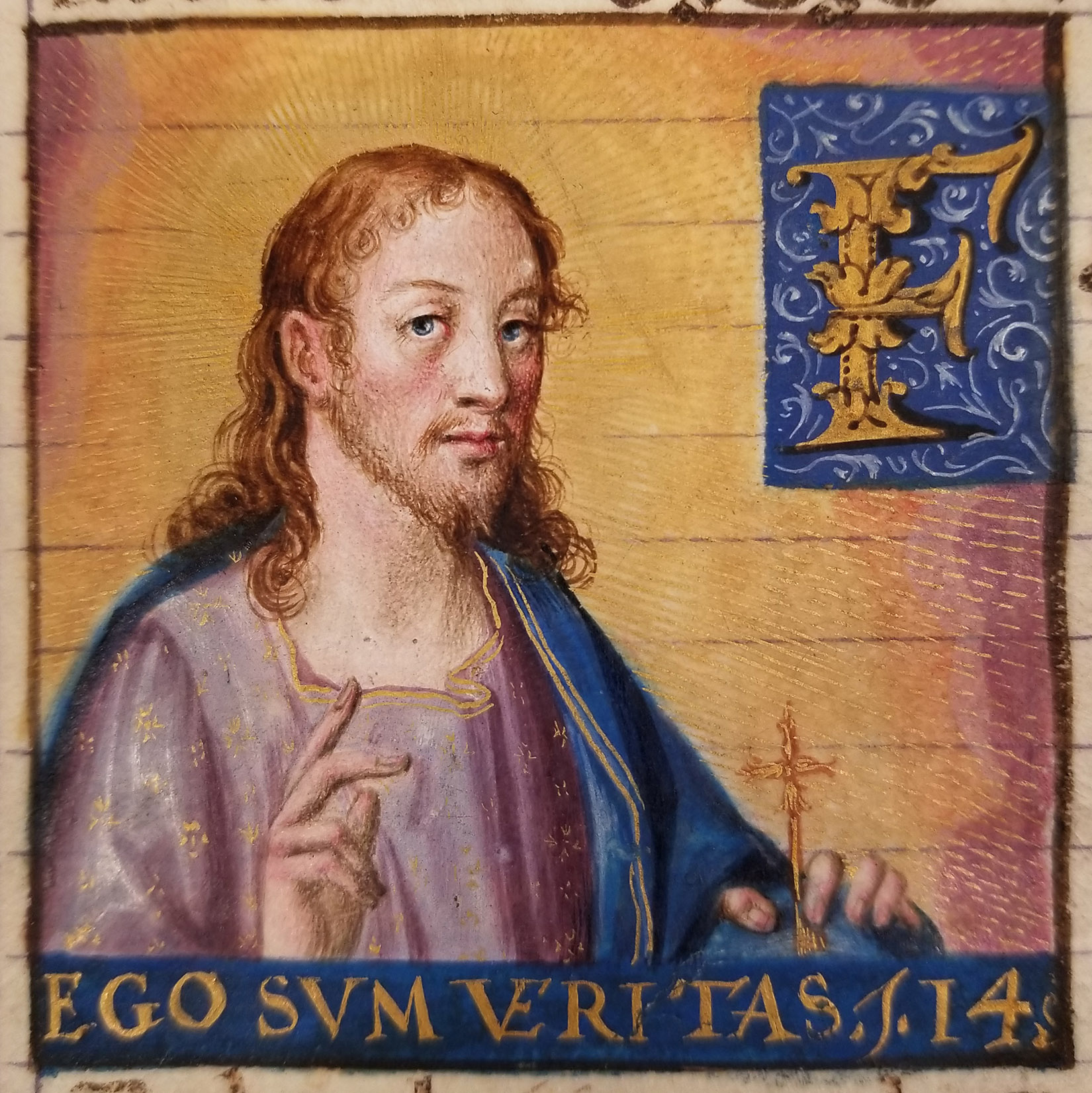
Christ holding an orb surmounted by a cross
In 1589, Pedro Guillén de las Casas of Jaen, Andalusia, began the effort to petition the crown to have his claim to a noble lineage recognized. The carta executoria de hidalguia he sought was the written culmination of a legal process that began with assembling a “pruebas de hidalguia” containing evidence of a noble lineage and testimonies from town or regional officials. The request was submitted to one of two chancelleries that handled lawsuits of nobility, the Real Chancillería in Granada (for southern Spain) or Valladolid (for the north), and if approved, the carta executoria was issued acknowledging, rather than granting, nobility. De las Casas’s petition was approved in May 1590.
Issued in the name of King Philip II of Spain and Portugal at the time of his marriage to Mary I (1554-1558), this document is an exceptional example of the patents of nobility produced in Granada during the late sixteenth century. Bound in contemporary red velvet, it bestows the rank of hidalgo (gentleman) on Pedro Guillén de las Casas, and is illuminated with a series of exquisite miniatures, including one of Philip II, aged 33. The carta appears to be missing a frontispiece and text leaf, but includes a single paper leaf loosely inserted at the beginning with a nineteenth-century depiction of Christ carrying the Cross.
In 1956, the graphic designer Pat Spaulding left for a tour of Europe. During her seven months abroad, she and her friend Maureen Jones traveled by motor scooter through France, Italy, Switzerland, Austria, and Germany, staying in hostels and taking in the sights. Perhaps most memorably, Spaulding tore her Achilles tendon while visiting in Siena, Italy, receiving generous care from her hosts during the four-week period of her recovery.
A refreshing record of two young American women traveling alone in Europe during the mid-1950s, this scrapbook is populated with dozens of well laid-out photographs of sites seen, along with Spaulding’s letters home and a raft of ephemera such as picture postcards, copies of ticket stubs and passport pages, an international driver’s license, smallpox immunization certificate, maps, newsclippings, and beer coasters. Notably, the album also includes a number of beautiful, skillfully-rendered line drawings.
Gift of Mary Patricia Spaulding, 2016
Subjects
France--Description and travelGermany--Description and travelItaly--Description and travelItaly--PhotographsLondon (England)--Description and travelLondon (England)--PhotographsParis (France)--Description and travelParis (France)--Photographs