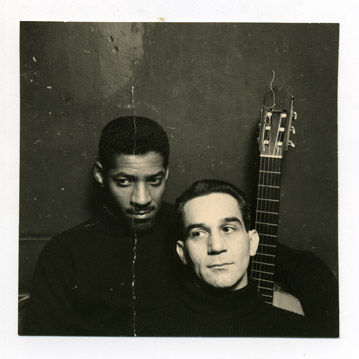
A multi-talented performer, the African American expatriate Gordon Heath was variously a stage and film actor, musician, director, producer, founder of the Studio Theater of Paris, and co-owner of the Parisian nightclub L’Abbaye. Born in New York City, Heath became involved in acting as a teenager and enjoyed a career that spanned post-World War II Broadway to the Black Arts Movement of the 1970s. In addition to his many roles on film and stage, he and his partner Lee Payant enjoyed success as recording artists in the 1950s and 1960s.
The Heath collection includes personal and professional correspondence, scrapbooks containing photos and clippings from assorted television and film productions in addition to songs, poetry, and reviews of plays or playbills from productions he attended. The Papers also contain art work, sheet music, personal and production photographs, and drafts of his memoirs.
Subjects
Abbaye (Nightclub : Paris, France)African American actors--France--Paris--HistoryAfrican American singers--France--Paris--HistoryAfrican Americans in the performing arts--HistoryAfrican-American theater--History--20th centuryBaldwin, James, 1924-Chametzky, JulesDodson, Owen, 1914-Expatriate musicians--France--Paris--HistoryHughes, Langston, 1902-1967Musicians--United States--HistoryNightclubs--France--Paris--HistoryParis (France)--Intellectual life--20th centuryPayant, Lee--CorrespondencePrimus, PearlRive gauche (Paris, France)--Intellectual life--20th centuryStudio Theater of ParisTheater--Production and direction--France--Paris--History
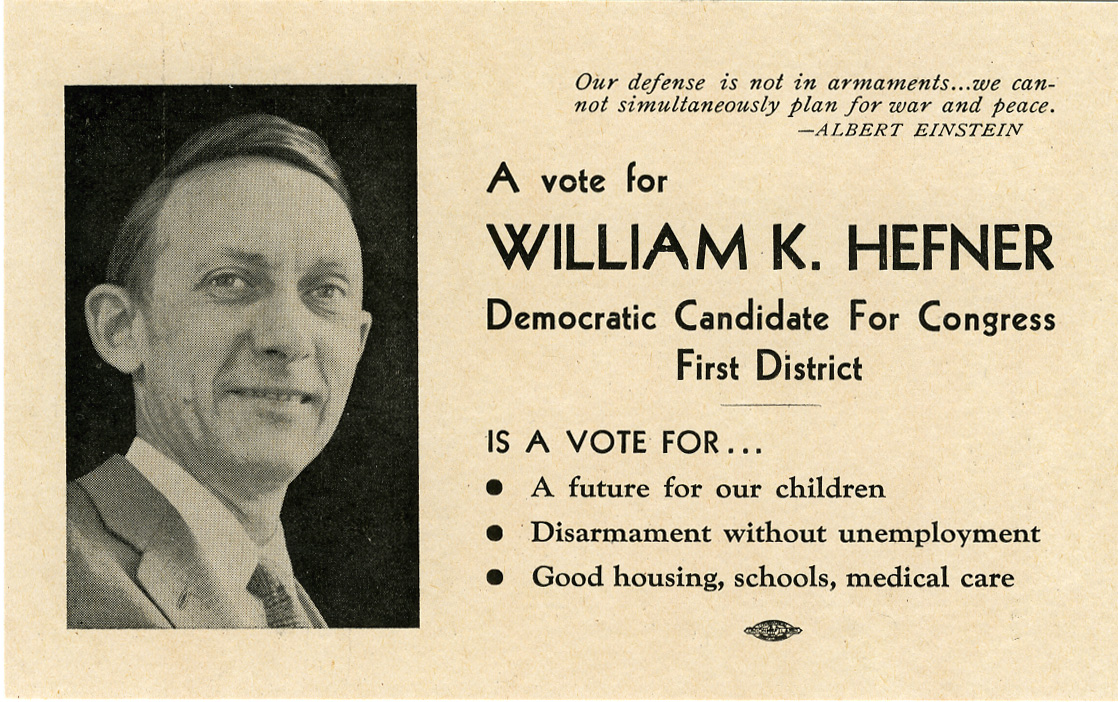
In 1960, William K. Hefner (1915-1993) became one of the first of new breed of radical pacifists to run for elective office, when he ran as a peace candidate for Congress in the 1st district of Massachusetts. An accountant from Greenfield, Hefner was involved at a national level with movements for peace and civil rights. An early member of SANE, a founder of Political Action for Peace in 1959 (now CPPAX) and the Greenfield Peace Center (1963), and an active member of the American Friends Service Committee, War Resisters League, Turn Toward Peace, and the World Without War Conference, Hefner was an energetic force in the movements for peace and disarmament, civil rights, and a more just economic system. He ran unsuccessfully for office in three elections between 1960 and 1964, and supported peace candidate H. Stuart Hughes in his bid for election to the U.S. Senate in 1962.
The Hefner papers offer a remarkable record of politically-engaged activism for peace and social justice in the early 1960s. With an intensely local focus, Hefner was tied in to the larger movements at the state and national level, corresponding with major figures such as A.J. Muste, Bayard Rustin, Benjamin Spock, and Arthur Springer. The collection includes particularly rich documentation of the early years of Political Action for Peace, which Hefner helped found, with correspondence, minutes of meetings, and publications, as well as equally rich materials on Hefner’s bids for congress in 1960 and 1962.
Subjects
American Friends Service Committee Western MassachusettsAntinuclear movement--MassachusettsCivil Rights movements--MassachusettsGreenfield Community Peace CenterMassachusetts Political Action for PeaceNonviolencePacifists--MassachusettsPeace movements--MassachusettsPlatform for Peace (Organization)Political Action for PeaceSANE, IncTurn Toward Peace (Organization)United States. Congress--Elections, 1960United States. Congress--Elections, 1962Vietnam War, 1961-1975--Protest movements
Contributors
Boardman, Elizabeth FHefner, William K.Hughes, H. Stuart (Henry Stuart), 1916-1999Muste, Abraham John, 1885-1967Rustin, Bayard, 1912-1987Springer, Arthur
Born in Amherst, Mass., in 1788, Samuel Henry became a relatively well to do justice of the peace, merchant, landowner, and entrepreneur from the Quabbin towns of Prescott and Shutesbury, Massachusetts. Predeceased by his wife Cynthia, and three daughters, he died on April 24, 1862 and is buried in Shutesbury.
The nine surviving volumes of Henry’s contain descriptions of his duties as justice of the peace, a book of deeds and mortgages from local real estate transactions, account books of sales in his general store and from his palm leaf hat business, and notes of accounts with individuals.
Subjects
General stores--Massachusetts--ShutesburyPanama hat industry--MassachusettsPrescott (Mass.)--HistoryShutesbury (Mass.)--Economic conditions--19th centuryShutesbury (Mass.)--History
Harvard educated and a veteran of the American Revolution, Benjamin Heywood was a jurist and prosperous farmer from Worcester, Mass.
Includes documentation of civic and farming activities, such as which animals were put to pasture on what date, which pastures were leased to others, the names and terms of indentured laborers, and the sale/exchange of agricultural products to customers such as Isaiah Thomas, William Eaton, Nathaniel Stowell, Ithamar Smith, and Jonathan Rice. Also contains references to family members.
Professor of Physical Education at the University of Massachusetts Amherst when it was known as Massachusetts Agricultural College who established the physical education program for women and helped to create the women’s gymnasium and athletic field. In her retirement she composed music that was performed by the University of Arizona orchestra.
Includes musical scores, lesson-plan photographs illustrating instruction in modern dance, correspondence, printed programs for performance of the musical compositions, text of an address, a history of physical education for women at Massachusetts State College by Mrs. Hicks, personnel records, and brief biographical items.
A resident of South Worthington, Massachusetts, Lyman Higgins appears in the Federal Census and in town histories as also pursuing a variety of other callings: mechanic, farmer, blacksmith, sawmill proprietor, and manufacturer. Higgins eventually devoted his work life to basket making, supplying textile mills and paper companies as far away as New York City with large batches of assorted baskets tailored to their needs.
Higgins’ account book includes records of jobs performed, payment (in goods and services as well as in cash), employees and their wages, and the local companies to which he sold his custom-made basket products.
Subjects
Basket industry--Massachusetts--South Worthington--History--19th centuryBasket making--Massachusetts--South Worthington--History--19th centuryHarris Woollen MillLawrence Duck Co.Paper industry--Equipment and supplies--History--19th centurySawmills--Massachusetts--History--19th centurySouth Worthington (Mass.)--Economic conditions--19th centuryStark MillsSugar River Paper Co.Textile industry--Equipment and supplies--History--19th centuryWages--Basket industry--Massachusetts--History--19th centuryWages-in-kind--Massachusetts--South Worthington--History--19th century
A native of Swanzey, N.H., David W. Hill became a brass finisher in the years following his military service during the Civil War, working as a machinist for several concerns in Cambridgeport, Mass., New York City, NY, Newport, R.I., and Haydenville, Mass., through the mid-1880s.
The 13 pocket diaries in the Hill collection contain regular entries describing the weather, Hill’s work as a brass finisher, his travels, the state of his health, and miscellaneous mundane observations on his daily life.
Acquired from Peter Masi, Mar. 2005.
Subjects
Brass industry and trade--MassachusettsCambridge (Mass.)--History--19th centuryHaydenville (Mass.)--History--19th century
Brothers Charles W. and Joseph F. Hodges moved from Norton, Mass., to Foxboro, and established a successful retail grocery business just prior to the Civil War that became the basis for other mercantile enterprises.
These two account books appear to be customer ledgers of the grocery firm Hodges and Messinger, which was to become the Union Store of Charles W. and Joseph F. Hodges.
Farmer from New Salem, Massachusetts, whose secondary occupation was that of a shoe repairman. Daybook documents a component of small-scale, handwork shoe production in a local economy prior to the arrival of centralized, mechanized manufacturing; lists Holden’s shoemending skills and the method and form in which he was paid by customers, including cash, customers’ labor, and services or wares such as butchering pigs or cows, chopping or gathering wood, traveling by buggy to a different town, using a neighbor’s oxen, and a variety of food and tools.
Subjects
Barter--Massachusetts--New Salem--History--19th centuryFarmers--Massachusetts--New Salem--Economic conditions--19th centuryNew Salem (Mass.)--HistoryShoemakers--Massachusetts--New Salem--Economic conditions--19th centuryShoes--Repairing--Massachusetts--New Salem--History--19th centuryWages-in-kind--Massachusetts--New Salem--History--19th century
Shortly after earning his doctorate in plant pathology from Cornell in 1954, the internationally known phytopathologist, Francis W. Holmes began his career at UMass Amherst. Working in the Department of Plant Pathology (1954-1991) and later as Director of the Shade Tree Laboratories, Holmes became a leader in the study of Dutch elm disease, and he conducted important research on injury to trees from road salt and the relationship between salt injury and Verticillium wilt disease. During Holmes’s tenure, the Shade Tree Labs tested nearly 250,000 elm samples for Dutch elm disease and diagnosed a great variety of other diseases on more than 150 other types of trees. While on a Fulbright fellowship in the Netherlands, he devoted his free time to preparing a monograph on six Dutch women scientists who discovered the source of Dutch elm disease in the 1920s and 1930s. Holmes retired from the University in 1991 and remained in Amherst until his death in 2007.
The papers document Holmes’s research on shade trees and his tenure as a professor of microbiology. The collection includes some professional correspondence (1954-1977), awards, research notes and publications, and memorabilia. Holmes’s translations of phytopathological works from Dutch to English may be of interest to scholars of Dutch elm disease.
Subjects
Dutch elm diseaseShade TreesUniversity of Massachusetts Amherst--FacultyUniversity of Massachusetts Amherst. Department of Plant PathologyUniversity of Massachusetts Amherst. Department of Plant, Soil & Insect SciencesUniversity of Massachusetts Amherst. Shade Tree Laboratories

 View
View