The University of Massachusetts Amherst
Robert S. Cox Special Collections & University Archives Research Center
CredoResearch digital collections in Credo

Page 5 of 168

Bush, Roderick D. & Melanie E. L.

Roderick and Melanie Bush Papers

ca. 1960-2013
Call no.: MS 1259

Bush, Roderick D. (1945-2013)

Roderick Bush, Ph.D., born in Sanford, Florida, overcame early adversity to become a distinguished scholar, activist, and community leader. A graduate of Madison High School (Rochester, NY), Howard University, and Binghamton University, he dedicated his life to pursuing justice, Black liberation, and transformative education.

Rod was deeply involved in Black radical and internationalist movements, working with organizations such as the Congress of African People, the African Liberation Support Committee, and the Black Radical Congress. His scholarship, including We Are Not What We Seem (1999) and The End of White World Supremacy (2009), examined race, nationalism, and class struggle. As a professor at Seton Hall and later St. John’s University, he mentored generations of students, inspiring them to engage critically with issues of race, democracy, and globalization.

An unwavering advocate for human rights, Rod’s work took him worldwide, fostering collaborations that bridged academic and activist communities.

Newby, Robert G. (n.d.) Roderick Douglas Bush – 1945-2013. https://rodbush.org/wp-content/uploads/2014/02/roderick-douglas-bush-biography-footnotes.pdf

Bush, Melanie E. L. (b. 1955)

Melanie E. L. Bush, Ph.D. is a sociologist, social justice advocate, and global scholar recognized for her pioneering research on white supremacy and racial justice. A Fulbright scholar and dedicated educator, she serves as a professor of sociology at Adelphi University, where her work focuses on race, ethnicity, class, nation, social movements, political economy, and higher education.

Bush is the author of Breaking the Code of Good Intentions: Everyday Forms of Whiteness and Everyday Forms of Whiteness: Understanding Race in a “Post-Racial” World. She also edited and co-authored Rod Bush: Lessons from a Radical Black Scholar on Liberation, Love, and Justice, honoring the legacy of her late husband, Roderick Bush.

Beyond her academic contributions, Bush is a research fellow at the University of South Africa and a senior research associate at the University of Johannesburg. Her scholarship and advocacy continue to shape critical conversations on race, power, and social transformation.

Subjects

African American intellectuals--Political activity--History--20th centuryAfrican Americans--Social conditions--20th centurUnited States--Social conditions--1980-2020White people--United States--Attitudes

Contributors

Bush, Melanie E. L., 1955-
Johnson-Simon, Deborah

Deborah Johnson-Simon Papers

ca. 1967-2015 Bulk: 1997-2010
5 Boxes 2.085 linear feet
Call no.: MS 1254

Dr. Deborah Johnson-Simon, PhD, is a museum anthropologist dedicated to advancing social justice and fostering community engagement through cultural heritage projects. She focuses on attracting and maintaining African American audiences and works extensively on museum outreach and development. Dr. Johnson-Simon is the co-editor of The Second Generation of African American Pioneers in Anthropology, a work that highlights significant contributions in the field.

She is the founder and CEO of the African Diaspora Museology Institute (ADMI), formerly known as the Center for the Study of African and African Diaspora Museums and Communities (CFSAADMC). The institute is committed to conducting and distributing research on the history and culture of African and African Diaspora museums and communities, furthering the understanding of their impact and significance. Dr. Johnson-Simon’s research interests center on these communities’ cultural and historical narratives, emphasizing their role in museum studies and broader cultural heritage.

Dr. Johnson-Simon received her BA from Rollins College in 1997 and her MA from Arizona State University with a certification in Museum Studies. She earned her PhD in 2007 from the University of Florida in 2007.

The Deborah Johnson-Simon Papers document Dr. Johnson-Simon’s research, travels, and professional engagements. The collection includes photographs from her research in Arizona, culminating in Culture Keepers Arizona, as well as ephemera from her time at Rollins College in Florida and her research and teaching at Santa Fe Community College in Gainesville, Florida. It also highlights her extensive work with and on Rev. Dr. C.T. Vivian and the C.T. Vivian Leadership Institute. Additionally, the collection contains an extensive collection of cards from individuals she met at conferences, during research, and while traveling. Notably, it includes her work with industrial designer Charles “Chuck” Harrison, who revolutionized the View-Master, along with a View-Master and more than 80 accompanying slides.

Subjects

African American anthroplogistAfrican Americans--MuseumsAnthropology--United States--HistoryEthnology--United States--History

Contributors

Johnson-Simon, Deborah
Comité de Apoyo Pro Alfabetización

Rachel Wyon Comité de Apoyo Pro Alfabetización / Pro Literacy Support Committee Collection

1982-1985 Bulk: 1982-1985
1 box .2 linear feet
Call no.: MS 1253
Two men holding a banner that reads "U.S. Educators for Peace in El Salvador" in a crowd
Members of the U.S. Educators for Peace in El Salvador holding a sign. Photograph by Tom Mattie

The Comité de Apoyo Pro Alfabetización was formed in 1983 by Rachel Wyon and others in Estelí, Nicaragua where Lyon was living and working in solidarity with the Salvadoran popular movement in exile, including the Salvadoran Teachers Association ANDES 21 de Junio. The group continued their solidarity work from the Cambridge/Boston area, where Wyon was based.

The bulk of this small collection consists of approximately 100 photographs taken in Guatemala, El Salvador, and Nicaragua between 1982-1985. One of the members of the Committee, Tom Mattie, traveled to Central America in 1985 and took photos documenting everyday life. Some of the subjects covered in the photographs include: family living conditions, group meetings, public events, rural education projects, marches, and the effects of the civil war. There is also a series of photos of Mélida Anaya Montes (aka Commander Ana María), who was a Salvadoran educator, guerrilla, and co- founder of the Popular Liberation Forces (FPL) that in 1980 merged with other organizations to form the Farabundo Martí National Liberation Front (FMLN). The photos in the collection were given to the Committee for their solidarity work in the U.S. In addition, there is a small folder of documents from the ANDES 21 de Junio, the National Association of Salvadoran Educators, an issue of The Freeze, an adult literacy pamphlet, a flier for Tom Mattie and Wendy Shaull’s exhibit of photographs, and a script for a Comité do Apoyo Pro-Alfabetización educational slideshow.

Language(s): Spanish

Subjects

Central America--Social conditions--PhotographsDocumentary photographyEl Salvador--Politics and governmentEl Salvador--Social conditions--PhotographsPacifists--Photographs

Contributors

Mattie, TomWyon, Rachel

Types of material

Photographs
Smith, William M., 1918-1970

William M. Smith Jr. Papers

1939-2014 Bulk: 1939-1940
4 boxes 1.7 linear feet
Call no.: MS 1248
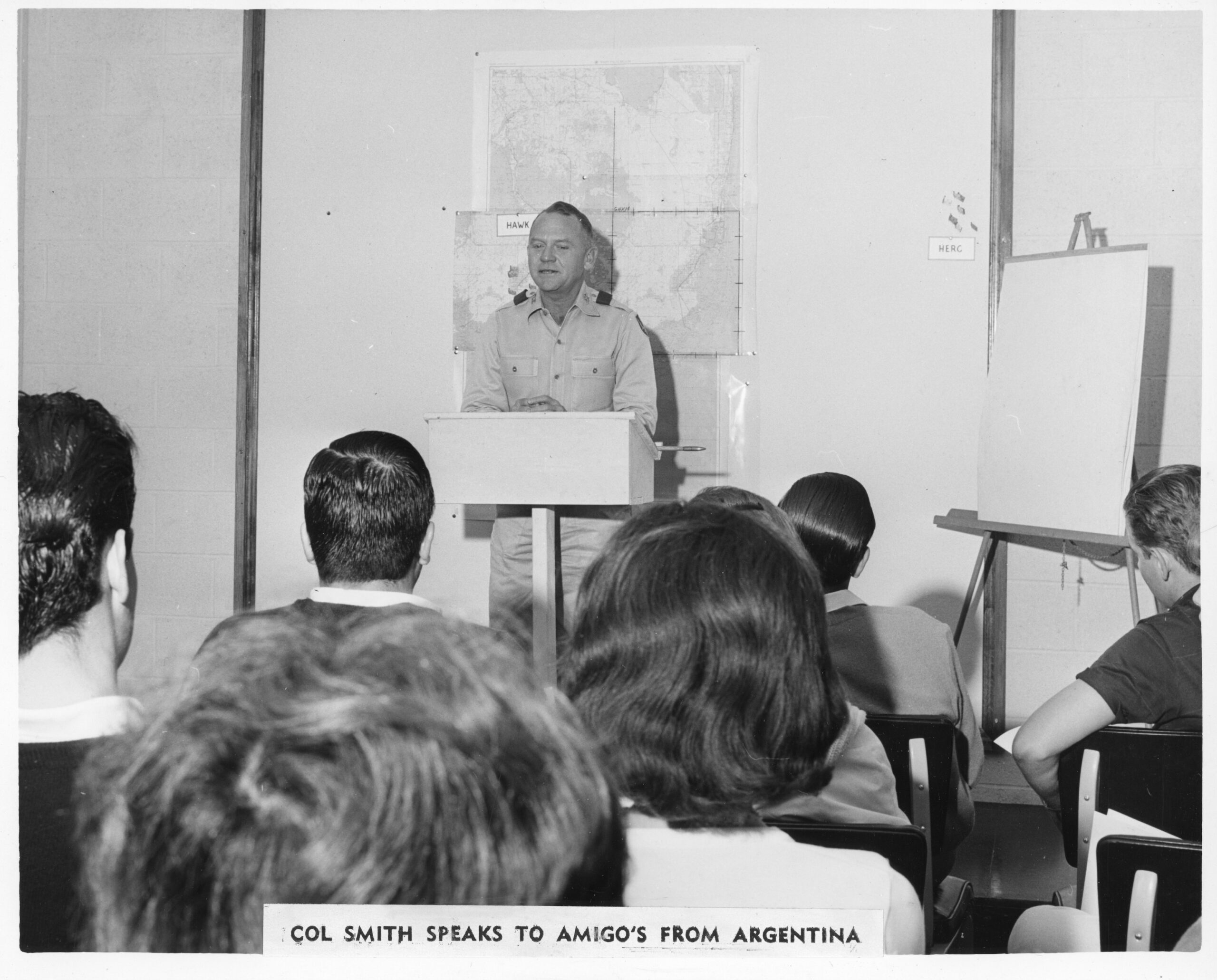
Colonel William M Smith speaks at a podium before an assembled group of people from Argentina.
Colonel William Smith speaking at podium before a group of people from Argentina

Colonel William “Billy” Mitchell Smith Jr. was born in 1918 in Carpenter, Mississippi to William M. Smith Sr. and Fay Smith (neé Craig). The family later moved to Alabama and lived in Birmingham and Auburn, where Smith graduated from Auburn High School in 1936, then Auburn University in 1940 with high honors. After college, he enlisted in the military, and served with the 19th Artillery attached to General Sharp’s staff in France during World War II. In 1944, he was awarded a Bronze Medal for “meritorious service and gallantry in action”. Following the war, he was stationed in Frankfurt, Germany where he oversaw post-war reconstruction there, and later, Japan. He also served in the Korean War. In 1962, he commanded a ring of missile units of the Army Air Defense Command in Homestead, Florida during the Cuban Missile Crisis. He served as a Colonel in Vietnam in 1964-1966. Smith died in late 1970 when he took his own life.

The bulk of this small collection consists of correspondence between Smith and his wife to be, Eloise Lennard, during their courtship in 1939-1940. In addition, there are letters written during Smith’s time serving in Vietnam from 1965-1966 where he discusses the tone of the war and the degree to which the war weighed on him as a commanding officer. The collection also contains clippings, military documents and ephemera related to each of his duty stations, as well as a photographic memory book from his deployment at a base in Homestead, FL during the Cuban Missile Crisis with the 13th Artillery Group. There is also correspondence from friends and family following Smith’s death.

Gift of Stephanie Cramer, 2024

Subjects

Soldiers--Germany--CorrespondenceSoldiers--Vietnam--CorrespondenceVeteransVeterans familiesVietnam War, 1961-1975--Veterans--United StatesWorld War, 1939-1945--Veterans--United States

Contributors

Smith, EloiseSmith, William M., 1918-1970

Types of material

CorrespondenceHoliday cardsNewspaper clippingsPhotographsPublicationsSympathy cards
Restrictions: none none
Glassberg, David

David Glassberg Papers

1986-2024
13 13 linear feet
Call no.: FS 218

David Glassberg, ca. 2016

David Glassberg (1954-) taught United States cultural, public, and environmental history at the University of Massachusetts, Amherst between 1986 and 2024. A native of Philadelphia, he earned a BA from the University of Chicago (1976) and PhD from The Johns Hopkins University (1982). His research examines the interrelationship of historical consciousness and environmental perception in the US as represented in politics, culture, and the landscape. Among his publications are American Historical Pageantry: The Uses of Tradition in the Early Twentieth Century (1990); Sense of History: The Place of the Past in American Life (2001); “What’s ‘American’ about American Lieux de Mémoire?” (2008); (with Robert Paynter) “Du Bois in Great Barrington: The Promises and Pitfalls of a Boyhood Historic Site” (2012); “Place, Memory, and Climate Change” (2014); “The Changing Cape: Using History to Engage Coastal Residents in Community Conversations About Climate Change” (2017); “Practicing Heritage Justice: Helping Your Community Decide Which Historic Places To Protect From The Impact Of Climate Change (and Which to Let Go)” (2022); and “Laurance S. Rockefeller and the Outdoor Recreation Resources Review Commission: Race, Recreation, and National Parks” (2022). Glassberg has also collaborated with a number of museums and national parks, including the W.E.B. Du Bois National Historical Landmark, the Statue of Liberty National Monument, Minnesota Historical Society, Boston Children’s Museum, Pinelands (N.J.) National Reserve, Marsh-Billings-Rockefeller National Historical Park, Springfield Armory National Historical Site, and the Cape Cod National Seashore.

Box 1. Glassberg before UMASS
Box 2. Glassberg California History Notes
Box 3. Consulting and Conference notes, other papers and writing (1996-2024)
Box 4. NPS and Landscape Conservation notes
Box 5. Glassberg’s Public History Program materials and local history
Box 6. New Jersey Pinelands research
Box 7. Pageantry Notes and photocopies
Box 8. Pageantry Notes and photocopies
Box 9. Pageantry Notecards
Box 10. Slides, town character notes
Box 11. Research notes for Sense of History
Box 12. Annual Reports and Publications
Box 13. Consulting, conferences, and other writing (1986-1995)

Gift of David Glassberg, 2024

Subjects

HistoryNatural history--CaliforniaNew Jersey--Pinelands National ReserveUnited States. National Park Service.

Contributors

David Glassberg
Boughton, Fred W.

Fred W. Boughton Collection

1970-1985
4 boxes 6 linear feet
Call no.: MS 1252

Born in 1912 in Fargo, North Dakota, Fred W. Boughton was raised in Twin Falls, Idaho. He graduated from the University of Kansas during the Great Depression with a degree in chemical engineering. Unable to find a good job closer to home, he accepted a position at the Eastman Kodak company in Rochester, New York, an up-and-coming firm specializing in photography. At Kodak, he worked with a team that invented a transformative photo paper. Over the years, he rose to the position of Vice President. His career was only half the picture, however, in his spare time, Boughton was an artist. He began taking figure drawing classes at a local gallery, then moved onto watercolors of some of his favorite landscapes. Later, he delved into larger oil paintings in the abstract expressionist mode. Finally, he did a series of portraits of his family and other people, which captured individuals’ essence. Boughton’s grave rubbings were created mostly on family vacations to New England. He thought that these images were worth preserving for ages to come. When he and his wife retired to Florida, he became active in the local art community and was a volunteer docent at an art gallery. Boughton died in 1999; he made his art a work of life, and his life a work of art.

The Fred W. Boughton Collection consists of gravestone rubbings from New England, with an emphasis on Massachusetts, slides and photographs of tombstones, and research files created and collected during the 1970s-1980s.

Gift of Otto Laske, 2024.

Subjects

Cemeteries--New EnglandSepulchral monuments—New England

Types of material

PhotographsSlides
Union Video Center TV (University of Massachusetts Amherst)

Union Video Center TV Collection

1970-2015 Bulk: 1974-2013
65 boxes 78.75 linear feet linear feet
Call no.: RG 045_30_u7
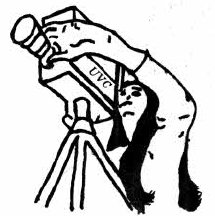
Illustration of a person with long black hair using an early videocamera
UVC logo

Founded in 1976, originally under the name of the Student Video Project, UMass’ Union Video Center was planned as early as 1972 and quickly gained popularity alongside the general rise of public access television in the late 70s. The UVC’s mission has been consistent throughout its existence, emphasizing their ability to offer students the opportunity to work in/with video production in a structured and organized manner that, at the time, was not generally accessible. Through the UVC’s workshops, students are taught the various aspects of the video production process, surrounding areas such as cinematography, lighting, editing, screenwriting and more. Through these UVC workshops the organization created a community through media made by UMass students. The variety of programs created through UVC are extremely diverse and include original programs like UMass This Week, the UMass Sports Weekly Show, a comedy sketch show known as Yak Back, dating shows and others, as well as documenting hundreds of events on campus. The organization was shepherded in its early years by early founders/directors such as Mark Chesak, David Skillicorn, Irene Starr, Mark Gunning, and Dennis Martin, in addition to many student staff and volunteers.

UVC began with an investment of $30-$40,000 of half inch reel to reel EIAJ video equipment. They were, and still are, one of the few student agencies that receives funding from the Student Government Association, as opposed to other student run organizations that have a budget allocated for them. This difference in funding is specifically garnered for student agencies that are seen as integral to strengthening the student experience at UMass.

Throughout the UVC’s extensive history, they have covered an array of important UMass and community events such as concerts/festivals, distinguished lectures, campus protests, independent student films, sporting events and much more. This collection contains over 3,000 recordings and are on an array of different video formats such as Betamax, VHS, SVHS, EIAJ, CDs, DVDs, VHSC, miniDV, and eventually to digital files and a YouTube channel.  Some highlights from the collection include substantial coverage of artists who have performed at UMass including the Sun Ra Orchestra, Archie Shepp, Jonathan Richman, Black Flag, The Wailers, Dinosaur Jr., Max Roach, Sweet Honey in the Rock and countless others. Other highlights include sizable coverage of UMass’ diverse community events such as the Asian American Student Association’s Asian night celebrations. Furthermore, UVC’s vast coverage of activism and political speakers on campus is documented through lectures by Noam Chomsky and James Baldwin as well as student protests against the invasion of Grenada, the US presence in El Salvador, and Iraq invasion teach-ins. Beyond the events that UVC documented, the collection also sheds light on the inner workings of the organization through correspondence, financial documents , and training material. The collection also includes extensive budget planning, yearly reports of the organization’s goals and accomplishments, video workshop teaching materials, guidelines/manuals, UVC alumni networks, and fliers.

Donated by UVC in 1985, 2008, and 2022

Subjects

Documentary films--Amherst (Mass.)Documentary television programsProtest movements--Amherst (Mass.)Rock concert filmsStudent activities--Massachusetts--Amherst (Mass.)Student movements--Amherst (Mass.)Universities and colleges--SportsUniversity of Massachusetts AmherstVideo artVideo journalism--Amherst (Mass.)

Types of material

Beta (Betamax)BudgetsCorrespondenceFliersMini-DVMotion pictures (visual works)Open reel videotapesVHSVideocassettes
Lieblich, Julia

Julia Lieblich Papers

1978-2023 Bulk: 1988-2015
14 18.42 linear feet
Call no.: MS 1234
Julia Lieblich seated on a bench with a notebook listening to Maya actress Maria Mercedes Coroy
Julia Lieblich seated (left) on a bench with a notebook listening to Kaqchikel Maya actress Maria Mercedes Coroy (center) and unidentified person

Julia Lieblich was a human rights journalist and author who spent much of her career exploring the effects of war, abuse, trauma, war, despair, and terror to shed a light on these horrific acts in an effort to make the world a better place. Through reporting and books, she tackled difficult subjects like the wars in Bosnia and Afghanistan, conflict zones in Guatemala and Sierra Leone, the truth and reconciliation commission in South Africa, and clergy sex abuse in Chicago. Lieblich had deep empathy for her subjects and stayed in touch with many of them long after her stories and books were published. She became a godmother to five children in San Antonia Aguas Calientes, Guatemala and visited her adopted family twice a year over the course of 25 years. As a religion reporter and Jewish woman, she explored conflicts in Judaism, Islam, Christianity, and Catholicism. She taught writing and was an assistant professor at Loyola University Chicago, a research fellow at Northwestern University Law School’s Center for International Human Rights, and a scholar-in-residence at the Newberry Library in Chicago.

Lieblich was born on April 25, 1958 in Long Island, NY. Later, her family moved to St. Louis, MN. She attended the Interlochen Arts Academy boarding school in Michigan and received her Bachelor’s degree in literature at Washington University and a master’s in theological studies from Harvard Divinity School. During her career as a journalist she was a religion writer for the Chicago Tribune and the Associated Press, and published news and feature articles in The New York Times, Los Angeles Times, The Washington Post, Boston Globe, Miami Herald, Plain Dealer, Time, Life, Ms., Fortune, The Nation, American Health, American Photo, Harvard Business Review, Harvard Divinity Bulletin and Agni literary review. She also wrote op-eds for the Los Angeles Times, Chicago Tribune, The Washington Post and others. In her twenties, she oversaw the annual billionaire’s issue for Fortune by day, while writing about nuns who had taken a vow of poverty by night. Her first book, Sisters: Lives of Devotion and Defiance about cloistered Roman Catholic nuns, was originally published as an article in the New York Times Magazine. Her other book, Wounded I Am More Awake: Finding Meaning After Terror which was co-authored with Esad Boskailo, about Bosnian concentration camps, was published in 2012.

Lieblich struggled with a bipolar disorder for much of her life and in November of 2023, feeling overwhelmed by “wars that are killing children, a refugee and housing crisis, the murder of young people on our own streets, the increasing threat of nuclear war and climate change”, she ended her own life. In her final note to friends, she stated that she could no longer handle more sadness, death and destruction and “just wanted the pain to stop”. Her ashes were scattered on the grave of her goddaughter, Kendy Carmona outside of Antigua in Guatemala.

Lieblich’s papers document the working life of a career journalist. Besides copies of many, if not all, of the articles she published, there are letters, notes, research materials, drafts, and interview transcripts gathered throughout her life. The collection also contains a book proposal that Lieblich wrote in 2023 before she died called The Sacred in the Ordinary: Spiritual Teachers of a Secular Traveler that was intended to describe her spiritual journey as a secular woman as she encountered remarkable teachers from many traditions. It was intended to be a “book of stories that address the questions and themes that have animated my quest for meaning during my thirty years as a secular religion writer.” In addition, the collection contains personal photographs, artwork, and audio and video recordings of interviews.

Gift of Dan Gauger, 2024
Language(s): Spanish

Subjects

AtrocitiesBosnia and HerzegovinaDame, Mary AileenJewish journalistsJournalismNicgorski, DarleneNuns--United StatesO'Reilly, CatherinePeople with bipolar disorderQuinn, DonnaSexual abuse victimsTerrorismYugoslav War, 1991-1995

Types of material

ArticlesAudiocassettesCorrespondenceNewspaper clippingsNotes (documents)PhotographsVideotapes
Johnson, A. Hale

A. Hale Johnson Papers

1840-2022
8 boxes, 2 OS folders 9 linear feet
Call no.: MS 1235

Allen Hale Johnson, known professionally as Hale Johnson, was born on December 25th of 1937 to parents Louise and Lawrence Johnson. Hale reflects on his childhood, writing “The key is to have passion. What a gift that is. My parents gave me a little talent and I’ve tried not to abuse it. I feel lucky”. This appreciative nature and desire to nurture his creativity would go on to define all corners of Hale’s life – from his career, to his marriage, to the way he loved his golden retrievers.

He married his wife, Lorraine Karaffy on October 7, 1961 at Narrow Memorial Methodist Church of Maplewood, New Jersey. Hale spent some of the early years of his marriage stationed at Fort Dix, New Jersey, with both the ins and outs of his experiences there as well as the dynamics of his relationship beautifully encapsulated within the abundance of correspondence within this collection.

Their lives, both as a unit and as individuals, were defined by their love for art, beautiful places, and each other. Lorraine went on to work as a florist, spending her free time giving back to the community through volunteer work at places like the Greenfield Public Library. Hale went on to have a successful career painting very detailed landscapes – booking one-man exhibitions with galleries such as, but not limited to, The Tilting Windmills, The Harrison Gallery, William Baczek Fine Arts, and The Greylock Gallery. The subject matter of these works typically revolve around Western Massachusetts, broadly New England, and coastal Maine, aiming to capture the richness of the landscapes, void of people.

Lorraine and Hale eventually settled at a home in Colrain, Massachusetts, which is where they would stay for the remainder of their adult lives. This property and the many people who would come to visit it over the years, are a recurring subject in his personal photographs.

Hale and Lorraine stayed together until her passing on November 10, 2019. Hale made a large donation of $500,000 in her name to the Greenfield Public Library, which at the time was undergoing a major reconstruction project. The reading room of the Greenfield Public Library is now dedicated to Lorraine Johnson due to this hefty contribution.

The A. Hale Johnson Papers consists of a mix of documents and ephemera spanning from the mid-19th century to 2022. Included in the collection is correspondence, records and photographs covering two main categories: his professional work as a landscape painter and his personal life, spanning from his time as a young man in the military all the way through his older years as an established member of his community.

Gift of A. Hale Johnson, 2023

Subjects

Landscape painting, American

Contributors

Johnson, A. HaleJohnson, Louise

Types of material

CorrespondenceManuscripts (documents)Reproductive photographsSlides (photographs)Study photographs
Quabbin Towns

Quabbin Towns Local History Collection

1927-1986
5 boxes 8 linear feet
Call no.: MS 1244

To meet the growing needs for potable water in the Boston metropolitan region, the Massachusetts state legislature ordered the evacuation of the relatively sparsely populated towns of Dana, Enfield, Greenwich, and Prescott, as well as portions of other adjoining towns such as New Salem, to make way for the construction of a massive reservoir. Over the course of almost two decades, the population of the towns was systematically relocated, the houses moved or razed, and bed of the future reservoir was stripped of trees and brush. The last remaining residents of the region were removed in 1938 and the four primary towns were officially disincorporated as the dam was completed and the waters began to rise.

The Quabbin Towns Local History Collection contains an assortment of materials that document the history of the Swift River Valley towns that were evacuated to make way for the Quabbin Reservoir, including Dana, Enfield, Greenwich, Millington (New Salem), and Prescott. The collection includes newspaper scrapbooks and photographs.

Gift of Friends of the Quabbin, Inc., 2024.

Subjects

Dana (Mass.)--History

Types of material

Newspaper clippings
« Older posts Newer posts »